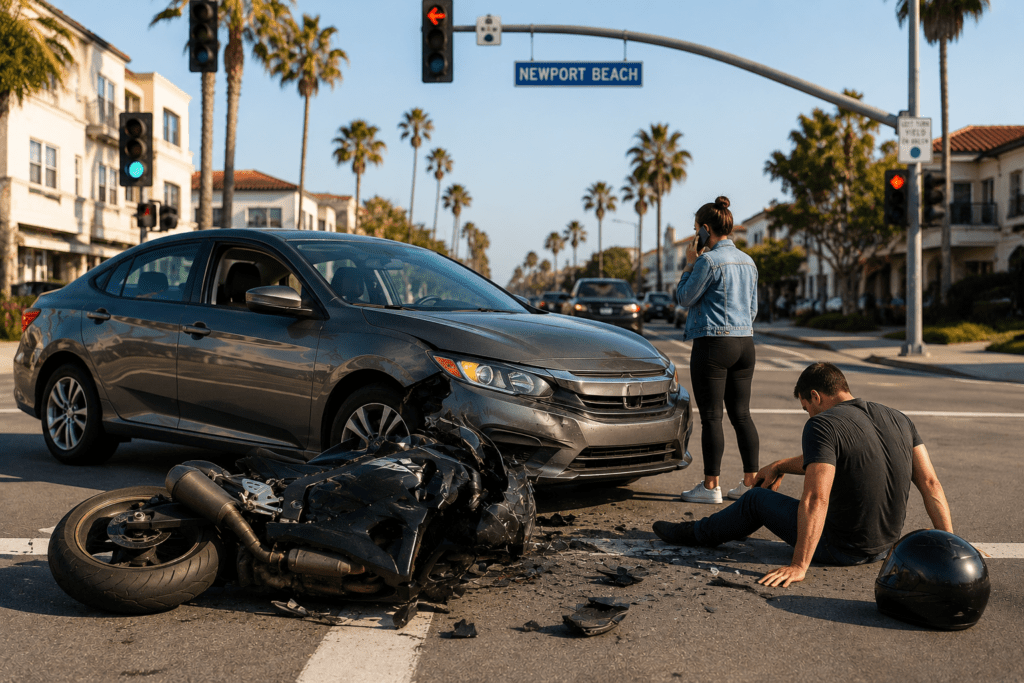
Left-turn motorcycle accidents happen faster than most people realize.
A driver approaches an intersection, sees a gap in traffic, and begins to turn. At the same time, a motorcycle is approaching—often closer or faster than it appears. Within seconds, both paths intersect, and the result is a collision that could have been avoided.
Understanding what happens if a driver turns left in front of a motorcycle in Newport Beach is critical because these accidents are among the most common and most serious types of motorcycle crashes. They often involve questions about visibility, timing, and right-of-way that are not always clear at first.
In many cases, the outcome depends not only on what happened in that moment, but on how the situation is interpreted afterward.
Why are left-turn motorcycle accidents so dangerous?
Visibility issues for drivers
Motorcycles are smaller than other vehicles, which makes them harder to see.
Drivers often scan for cars and trucks when checking for traffic, but a motorcycle can be overlooked or misjudged in that quick glance. Even when the motorcycle is clearly present, its size can create the illusion that it is farther away than it actually is.
This visibility issue is one of the main reasons why these accidents occur so frequently.
Understanding what happens if a driver turns left in front of a motorcycle in Newport Beach often begins with how the motorcycle was—or wasn’t—seen.
Speed misjudgment
Even when a driver sees a motorcycle, judging its speed can be difficult.
Because motorcycles are smaller, they may appear to be moving slower than they actually are. This can lead a driver to believe there is enough time to complete a turn when there isn’t.
We’ve seen cases where the driver was certain they had enough space, only to realize too late that the motorcycle was much closer than expected.
This misjudgment plays a significant role in what happens if a driver turns left in front of a motorcycle in Newport Beach, especially in busy intersections.
In many of these situations, the issue is not that the driver didn’t look—it’s that they misinterpreted what they saw.
Motorcycles approach differently than larger vehicles. Their size and profile can make them appear farther away, especially in bright coastal conditions like those in Newport Beach where glare and lighting can affect visibility. A driver may believe they have enough time to complete a turn, only to realize too late that the motorcycle is already in the intersection.
We’ve seen cases where the driver later said they “didn’t see the motorcycle,” but when the situation is reviewed more closely, it becomes clear that the motorcycle was visible—it was simply misjudged. That distinction matters, because it affects how responsibility is evaluated.
Understanding what happens if a driver turns left in front of a motorcycle in Newport Beach often comes down to these small timing errors. A difference of just a second or two can completely change the outcome.
Limited reaction time for riders
Motorcyclists have very little time to react when a vehicle turns in front of them.
Unlike drivers in larger vehicles, riders have fewer options to avoid a collision. Swerving may not be possible, and braking distance may not be enough to stop in time.
Even when a rider reacts quickly, the sudden nature of the turn often leaves no safe escape path.
This is why these accidents tend to be more severe, even when speeds are not extremely high.
Who may be at fault in a left-turn collision?
Drivers failing to yield
In many cases, the driver making the left turn is expected to yield to oncoming traffic.
If a motorcycle is approaching and has the right-of-way, the driver may be considered at fault for turning in front of it.
However, determining fault is not always immediate. It depends on timing, positioning, and whether the motorcycle was visible under the conditions at the time.
Situations involving shared fault
There are situations where fault may be shared.
For example, if a rider was speeding or not visible due to lighting conditions, those factors may be considered when evaluating responsibility.
California follows a comparative fault system, meaning more than one party can share responsibility for the accident.
Understanding what happens if a driver turns left in front of a motorcycle in Newport Beach often involves analyzing both sides of the situation.
Traffic signal and right-of-way considerations
Traffic signals and intersection design also play a role.
If the turn occurred at a signalized intersection, the timing of the light and the driver’s position within the intersection may affect how the situation is evaluated.
In some cases, both parties may believe they had the right-of-way, which adds another layer of complexity.
What injuries are common in these crashes?
Head and brain injuries
Motorcyclists are more exposed than drivers in enclosed vehicles.
Even with a helmet, head injuries can occur, especially in high-impact collisions. These injuries can range from mild concussions to more serious traumatic brain injuries.
Lower extremity injuries
The legs are often the first point of impact in these accidents.
Fractures, ligament damage, and other injuries to the lower body are common when a motorcycle collides with a turning vehicle.
Road rash and fractures
When riders are thrown from their motorcycle, contact with the road can cause significant abrasions and fractures.
These injuries may not always appear severe immediately but can require extensive treatment over time.
Understanding what happens if a driver turns left in front of a motorcycle in Newport Beach includes recognizing the physical impact these crashes can have.
What evidence helps clarify what happened?
Traffic signal timing and intersection layout
The timing of traffic signals can help determine who had the right-of-way.
Intersection layout, including lane positions and visibility, also plays a role in understanding how the accident occurred.
Witness statements
Witnesses can provide valuable insight into what each party was doing at the time of the crash.
Their perspective can help confirm whether the motorcycle was visible and how the driver approached the turn.
Vehicle damage and positioning
The position of the vehicles after the crash often provides clues about how the collision occurred.
Damage patterns can indicate angles of impact and movement, which help reconstruct the sequence of events.
Without this information, understanding what happens if a driver turns left in front of a motorcycle in Newport Beach becomes much more difficult.
What should riders do after this type of crash?
Seeking immediate medical care
Medical attention should always come first.
Even if injuries seem minor, symptoms can develop later. Early evaluation creates a record that connects the injury to the accident.
Documenting the scene
If possible, documenting the scene can help preserve important details.
Photos of vehicle positions, road conditions, and traffic signals can provide valuable evidence later.
Reporting the accident
Filing a report ensures there is an official record of what happened.
This becomes part of how the situation is evaluated moving forward.
This is often when people begin to understand what happens if a driver turns left in front of a motorcycle in Newport Beach, because the process involves more than just the initial impact.
How Insurance Companies Evaluate These Cases
Insurance companies approach these accidents carefully. This is often where understanding what happens if a driver turns left in front of a motorcycle in Newport Beach becomes especially important, because insurance companies rely heavily on how these situations are interpreted.
They evaluate visibility, speed, and timing to determine how the collision occurred. Even when fault seems obvious, they often look for factors that may reduce their responsibility. In some situations, we’ve seen insurance bad faith where claims are delayed or disputed unnecessarily.
For general guidance on how liability is evaluated, California courts provide an overview of civil cases: https://selfhelp.courts.ca.gov/civil-lawsuit
Understanding this process helps explain why these cases can take time to resolve.
What We’ve Seen in Newport Beach Motorcycle Cases
In our experience, these cases often follow similar patterns. In many of these situations, what happens if a driver turns left in front of a motorcycle in Newport Beach becomes clearer only after additional evidence is reviewed.
They begin with a clear collision but become more complex as details are reviewed. We’ve seen situations where responsibility was reassessed after additional evidence was considered.
In many cases, what happens if a driver turns left in front of a motorcycle in Newport Beach becomes clearer only after the claim develops and all factors are evaluated.
Why These Accidents Feel Different From Typical Collisions
Motorcycle accidents involve a level of exposure that is not present in standard vehicle collisions.
Riders are more vulnerable, and the consequences of even a small mistake can be significant.
Understanding what happens if a driver turns left in front of a motorcycle in Newport Beach helps explain why these cases often involve more serious outcomes.
How Can You Get Help After a Motorcycle Accident?
Free consultation for injured riders
If you are unsure how your situation should be handled, reviewing it early can provide clarity.
No fee unless you win
Most cases are handled on a contingency basis, meaning no upfront costs.
24/7 support and contact options
Support is available whenever you need it.
If you’re still unsure what happens if a driver turns left in front of a motorcycle in Newport Beach, speaking with a motorcycle accident lawyer can help you understand your options.
Connect with Super Woman Super Lawyer today:
Online Form: Request a case review
Call Now: 800.800.6916
Live Chat: Speak with a legal professional instantly
 Maryam Parman