Halloween accidents can turn a Los Angeles family’s celebration into an evening of uncertainty. The holiday should end with candy on the kitchen counter, costumes on the floor, and everyone safely home. In Los Angeles, however, the drive to a party or the walk between decorated houses can bring families into contact with serious traffic dangers. This year, several familiar risks overlap on the same weekend.
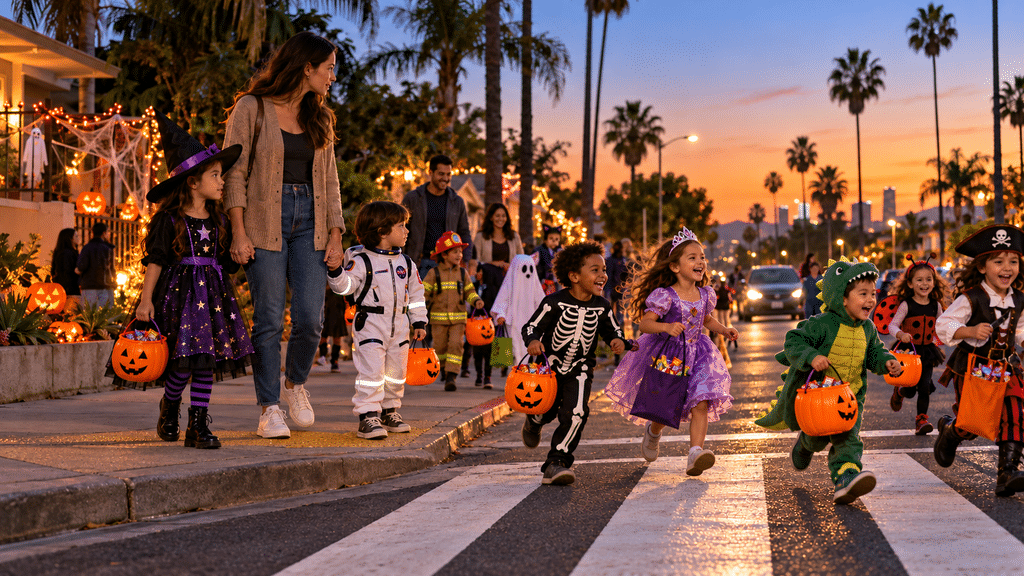
Halloween 2026 falls on a Saturday. Sunset in Los Angeles arrives at approximately 6 p.m., just as many families may be heading outside. Later, adult celebrations continue into the night, and California turns its clocks back early Sunday morning. If rain develops, wet pavement and glare could add another challenge.
At Super Woman Super Lawyer, our message about Halloween accidents starts with prevention and extends to people who need help after an injury. We want families to enjoy the season, drivers to recognize the people sharing the road, and injured pedestrians and motorists to know they can ask for legal guidance.
For Los Angeles families, pedestrian accidents and motor vehicle accidents are concerns that deserve a practical response. This guide explains the overlapping risks, ways to plan a safer evening, and how to start a conversation with a personal injury lawyer if someone gets hurt.
Why Halloween accidents deserve extra attention in 2026
The concern about Halloween accidents in 2026 comes from several road safety issues overlapping during the same evening. Thinking of the weekend as a “perfect storm” helps connect those concerns: the light changes, people move between celebrations, and drivers encounter different kinds of activity as the night progresses.
Consider the sequence. Families begin walking while daylight fades. Drivers travel through neighborhoods on their way to Saturday celebrations. Later, people leave parties or nightlife destinations. The clock change takes place while some Halloween activities may still be underway.
Each part of that sequence deserves attention. Together, they create a reason to plan for the whole night, including the trip home. A family focused on trick-or-treating and an adult focused on getting to a party may be using the same intersection with very different expectations.
The available historical statistics support taking Halloween traffic safety seriously. Although they cannot tell us exactly how many accidents Los Angeles will experience in 2026, they give families a reason to prepare. Recognizing those conflicts gives everyone a chance to help prevent Halloween accidents before leaving home.
Darkness and Halloween accidents on Los Angeles streets
Los Angeles sunset on October 31, 2026, is approximately 6 p.m. That timing puts the transition from daylight to evening close to the hours when many households may begin trick-or-treating.
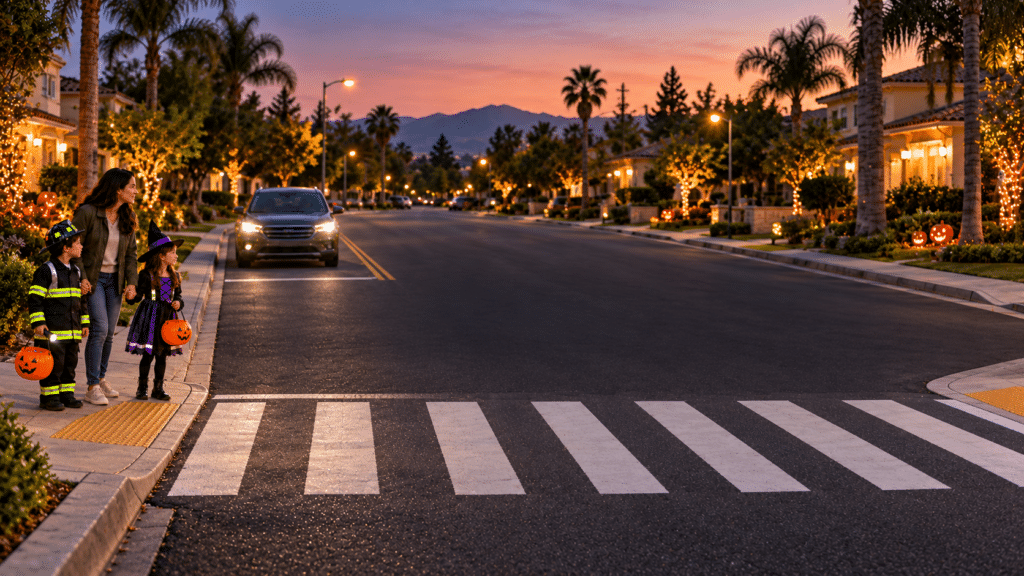
Visibility is central to the concern about Halloween accidents involving people on foot. A dark costume can be difficult to distinguish against a shadowed street. An unlit crossing can leave less visual information for an approaching driver. A turning vehicle can bring a driver and a pedestrian into the same space while both are looking elsewhere.
For example, imagine a family approaching a corner as a driver prepares to turn toward a party. The family is watching the crossing; the driver is also checking traffic. In fading light, neither should assume the other has already noticed them. The details of an ordinary intersection deserve extra attention when people are arriving from several directions.
When planning around the risks of Halloween accidents, consider your route as carefully as your departure time. Look at where the group will cross and how it will return home. Drivers should anticipate that a street which seemed quiet earlier in the day may have people walking through it after sunset.
Halloween pedestrian accidents and the danger of an unseen child
Halloween advertising often relies on imaginary threats. The concern behind our campaign about Halloween accidents is personal: a driver who fails to see a child in the roadway.
That concern should encourage attention rather than blame. Children are excited about their costumes and the next decorated house. Parents may be coordinating siblings or keeping a group together. Drivers must remain aware that the people near the curb are not simply background scenery.
A meaningful safety conversation can be specific. Before leaving, decide which adult will lead the group and where everyone will pause before crossing. Give children a chance to ask questions. If plans change during the walk, regroup before choosing the next direction.
Drivers can discuss ways to prevent Halloween accidents before leaving for the evening, especially when their route passes families on foot. Arriving at a party does not take priority over giving a family time and space to cross. A few minutes of patience belong in the evening’s plan.
Super Woman Super Lawyer’s message to parents is straightforward: your concern for your child’s safety deserves to be taken seriously. Our message to drivers is equally clear: expect families to be out, and give the road your attention.
What the 43% Halloween pedestrian statistic means
A study published in JAMA Pediatrics examined 42 years of U.S. fatal-crash data, covering 1975 through 2016. Researchers compared pedestrian deaths between 5 p.m. and 11:59 p.m. on Halloween with deaths during the same hours one week earlier and one week later.
The study reported a 43% higher relative pedestrian fatality risk on Halloween evenings compared with those control evenings. That finding is the basis for the statistic in our Halloween safety campaign.
The context matters. This was a historical nationwide comparison. It was not a Los Angeles-only study, and it did not predict a 43% increase for Halloween 2026. It also did not mean that an individual pedestrian had a 43% chance of dying.
The appropriate takeaway is that preventing Halloween accidents deserves deliberate pedestrian-safety planning. The statistic gives weight to that message without requiring exaggerated claims about what will happen this year. Families can celebrate while drivers and communities work to make the surrounding streets safer.
Saturday celebrations bring families and nightlife traffic together
October 31 falls on a Saturday in 2026 for the first time since 2020. The date places Halloween parties and bar traffic within a major weekend nightlife period, while families may still be walking through neighborhoods.
Planning to reduce Halloween accidents begins with local awareness, because each neighborhood will have different activity patterns. People attending a party can ask their host what to expect near the destination. Families can consider how their walking route intersects with streets that also carry traffic toward restaurants, bars, or other celebrations.
Imagine leaving home for dinner before meeting friends at a costume party. Your route may pass families crossing residential streets. Later, the same trip in reverse may involve people walking back to parked cars or waiting for transportation. The useful question is not simply how to reach the destination, but how to travel attentively throughout the evening.
Hosts can include transportation in the invitation conversation. Guests can decide who will drive before the celebration begins. Friends can agree on a backup plan rather than leaving the final ride-home decision to the end of the night.
Saturday gives people room to celebrate. Preventing Halloween accidents also means thinking beyond the party itself and considering the drive home.
Drunk driving and Halloween accidents after dark
NHTSA’s Traffic Safety Marketing program reports that 176 people died nationwide in Halloween-night crashes involving a driver with a blood alcohol concentration of .08 or higher during 2019–2024. The agency defines Halloween night for these figures as 6 p.m. October 31 through 5:59 a.m. November 1.
The total covers the full 2019–2024 period and includes people killed in crashes involving drunk drivers. Behind that nationwide number are individuals who were traveling through their communities on a holiday evening. Their lives give the safety message a significance that goes beyond a seasonal headline.
“Saturday. Halloween. Drunk Drivers. One Deadly Combination.” The warning is direct because the decision matters. Anyone planning to drink can make a transportation arrangement before leaving home, and friends can help one another follow through when it is time to go.
The practical step for reducing alcohol-related Halloween accidents is to separate drinking from driving. NHTSA recommends arranging a sober driver, taxi, or rideshare before drinking. Hosts can help guests get home safely and provide alcohol-free options.
People injured in Halloween accidents involving suspected drunk driving deserve answers based on the details of their own collision. A conversation with a personal injury attorney should focus on what happened in that particular incident.
California clocks change during the late night celebration
At 2 a.m. on Sunday, November 1, 2026, California clocks move back to 1 a.m. The time change repeats an hour while some people may still be celebrating Halloween.
For people thinking about late-night Halloween accidents, the clock change adds a scheduling concern: some celebrations could continue into the repeated hour. Confirm actual plans with the people or venues involved, including when you expect to leave and who is handling transportation. The extra hour is a reason to communicate clearly about the evening’s schedule.
Keep the sequence clear: Halloween is Saturday, and the clock change happens early Sunday. The shift does not cause an earlier clock-time sunset during Saturday’s trick-or-treating. Saturday’s approximately 6 p.m. sunset is already part of the evening’s conditions.
A plan to prevent Halloween accidents should include a departure time and transportation arrangements for a late celebration. Make sure everyone understands the arrangement, especially if a pickup or meeting time falls near the repeated hour. A clear plan is more useful than assuming the extra hour will sort itself out.
Rain could make Halloween travel more dangerous
When considering ways to prevent Halloween accidents, allow for changing weather. If rain develops, be ready to adjust your travel plans. Check the current Los Angeles forecast as the celebration approaches and again before leaving home. A plan that works on a dry afternoon may need changes if conditions deteriorate later.
If it rains, wet pavement, glare, and reduced visibility could make an already complicated evening harder to navigate. California’s Office of Traffic Safety warns that rain can amplify glare from oncoming lights. The California DMV also advises drivers to adjust for slippery roads and limited visibility.
A backup plan for avoiding Halloween accidents should cover both travel and the celebration. Think about whether the walking route still makes sense, where a group could regroup, and how people will return to their vehicles. Drivers should give themselves room to adapt rather than treating the original schedule as fixed.
If rain never arrives, those particular concerns may not apply. The evening still includes darkness and the potential overlap of neighborhood activity with Saturday nightlife. The strongest safety message remains accurate under either forecast: prepare for the conditions that actually develop.
Five warning signs to consider before leaving home
Our “One Weekend. Five Warning Signs.” campaign brings the main concerns into one checklist: Saturday nightlife, Halloween crowds, earlier seasonal sunsets, impaired driving, and the clock change. Rain remains a possible additional factor.
Use that checklist to start a practical conversation about preventing Halloween accidents. Who is walking? Who is driving? When will each person come home? Does the plan account for darkness? If someone decides to stay later, what changes about transportation?
These questions are especially useful when a household has several plans. One family member may accompany children while another attends a party. Sharing the outline of the evening makes it easier to notice gaps, such as a ride home that nobody has actually arranged.
Give each concern a practical response. Darkness calls for attention to the route. Drinking calls for a sober ride. A late departure calls for an agreed pickup plan. If the forecast changes, take a moment to reconsider transportation before the group is already outside.
That is the value of a public safety campaign: turning a broad warning into a conversation people can act on.
A driving plan to help prevent Halloween accidents
A driving plan to help prevent Halloween accidents starts before you leave the driveway. Choose your route, allow time for neighborhood activity, and make the return trip part of the same decision. If you expect to drink, arrange transportation that does not require you to drive.
On the road, NHTSA recommends slowing down, watching for trick-or-treaters, and anticipating children in unexpected places. At crossings, keep checking for people rather than assuming a clear path will stay clear.
The California DMV instructs drivers to use caution around pedestrians and allow enough time for people to finish crossing. It also warns against passing a vehicle stopped at a crosswalk because a pedestrian may be hidden from view.
Apply those instructions patiently. A costume, a family group, or a stopped car can change what you can see. You may need to wait longer than you expected to complete a turn. Build that possibility into your expectations rather than responding to it as an inconvenience.
When it comes to preventing Halloween accidents, the trip deserves as much care as the destination.
A family walking plan to help prevent pedestrian accidents
Families concerned about Halloween accidents can begin with a short conversation about the walk ahead. Agree on the route, identify crossings, and decide how the group will stay together.
NHTSA recommends using sidewalks where available, crossing at intersections or crosswalks, and watching for vehicles entering or leaving driveways. Pedestrians should remain alert to turning traffic and wait for a clear stop before crossing a vehicle’s path.
Make those choices easy to repeat. Pause together at a corner. Check the next crossing before moving on. If someone wants to visit a house on the other side of the street, choose the crossing first instead of letting the destination determine the movement.
Talk about the return walk as well. A group may be focused on getting home after the last house, but the surrounding streets still require attention. Keep the same crossing routine through the end of the outing.
A plan to prevent Halloween accidents should support a safer, more enjoyable celebration. It gives children and adults a shared plan so they can enjoy the evening with fewer last-minute decisions.
How car accidents and pedestrian accidents overlap
Preventing Halloween accidents means considering both people walking and people traveling in vehicles. Drivers, passengers, and people on foot move through connected spaces, even when their plans have nothing to do with one another.
A person driving to a party may later become a pedestrian walking from a parking space. A parent accompanying a child may eventually load everyone into a car. The role changes, but the need to notice surrounding traffic continues.
This is why our campaign about Halloween accidents addresses both pedestrian accidents and car accidents. Focusing only on children would miss the late-night transportation concern. Focusing only on impaired driving would miss the early-evening visibility concern. The full timeline makes room for both.
For Super Woman Super Lawyer, the human concern remains consistent across those situations. A person hurt while walking and a person hurt inside a vehicle both deserve to have their questions heard. The circumstances of the collision matter more than a label attached to the holiday.
If the celebration ends with an injury, asking for guidance is a reasonable next step.
Legal guidance after Halloween accidents in Los Angeles
Saturday date, low light, or a nearby party may provide context, but none of those details alone resolves an individual case.
When asking a Los Angeles personal injury lawyer about Halloween accidents, begin with your own account of what happened. Explain where you were, what you remember, and what questions you want answered. If you are uncertain about something, say so rather than trying to fill the gap with an assumption.
For example, concern about impaired driving is different from knowing whether a particular driver had been drinking. Likewise, wet pavement may be relevant to a collision, but a general possibility of rain does not establish the conditions at that location. Keeping facts and uncertainties separate makes the conversation more useful.
You can also ask how a review works and what information the team would like to see. The first conversation should help you understand the next step, without relying on a promise about the eventual outcome.
Super Woman Super Lawyer welcomes inquiries about Halloween accidents, including pedestrian accidents and car accidents. Tell our team what happened and what you need help understanding.
Frequently Asked Questions: Halloween Accidents in Los Angeles
Why does Halloween 2026 deserve extra attention?
Several concerns overlap: families walking after sunset, Saturday nightlife, the possibility of impaired drivers, and a clock change during late celebrations. Historical research adds context to those concerns. Together, these details give Los Angeles families a reason to plan transportation and street crossings before the evening begins.
Does the 43% figure describe Los Angeles in 2026?
No. It describes a nationwide historical study comparing Halloween evenings with selected control evenings. It is not a 2026 forecast for any individual or Los Angeles neighborhood.
Will the time change make trick or treating darker on Saturday?
The clock change happens early Sunday morning, after Saturday evening’s trick-or-treating. Families should plan for Saturday’s approximately 6 p.m. sunset. The earlier sunset by the clock associated with falling back begins Sunday.
Should we expect rain on Halloween night?
This article makes no specific rain forecast. Treat wet roads, glare, and rain-related visibility problems as conditional concerns. Check current local weather information and adapt your plans if those conditions develop.
Can I contact Super Woman Super Lawyer about pedestrian accidents or car accidents?
Yes. Our team welcomes inquiries about Halloween accidents. Reach out to Super Woman Super Lawyer to describe the incident and ask about a case review. The conversation should address your circumstances rather than assuming that a holiday statistic determines your options.
Call or Contact Super Woman Super Lawyer 24/7 for a Free Consultation and Pay Nothing Unless You Win
Halloween accidents can involve pedestrians, turning vehicles, impaired drivers, low visibility, and overlapping accounts of what happened. A Halloween pedestrian accident or car crash in Los Angeles may require a careful review of the collision scene, lighting conditions, witness statements, police reports, available video, and evidence of possible driver impairment.
Super Woman Super Lawyer can help evaluate the circumstances surrounding Halloween accidents, including photographs, traffic or surveillance footage, driver conduct, medical treatment, vehicle damage, missed work, and insurance communications. Preserving available evidence early can be especially important when video recordings or details about the scene may become harder to obtain over time.
Super Woman Super Lawyer has recovered more than $2 billion for clients. Past results do not guarantee a particular outcome, and every pedestrian accident or motor vehicle accident claim depends on its individual facts, evidence, injuries, insurance coverage, and applicable California law.
If you or someone you love was hurt on Halloween, contact Super Woman Super Lawyer for a free consultation. For additional information about representation following a motor vehicle collision, visit our Car Accident Lawyer page.
Connect with Super Woman Super Lawyer today:
Online Form: Request a case review
Call Now: 800.800.6916
Live Chat: Speak with a legal professional instantly
 Maryam Parman