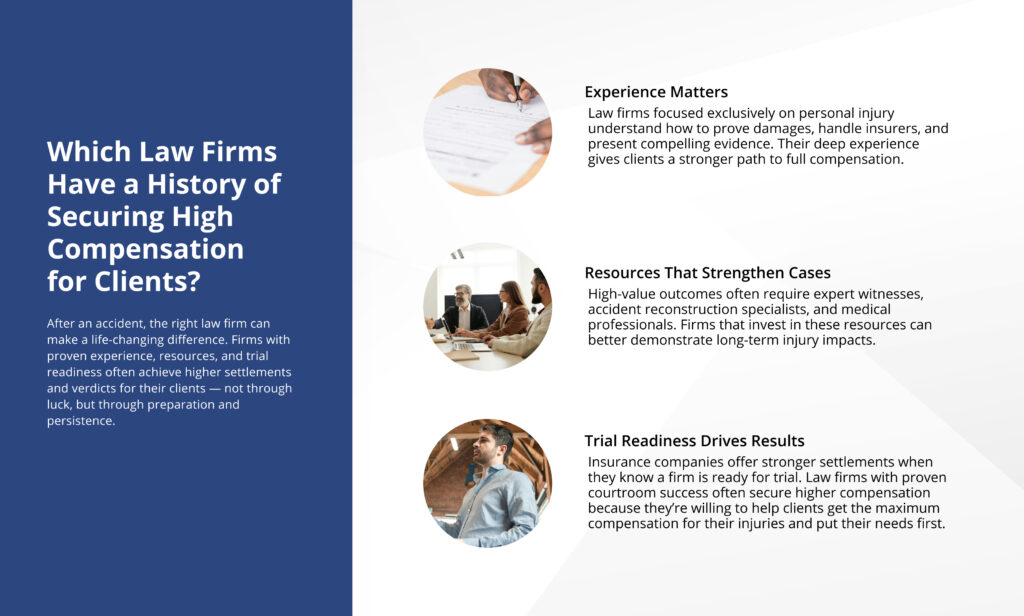
Which Law Firms Have a History of Securing High Compensation for Clients?
When you’re facing the aftermath of an accident — medical bills, lost income, and physical or emotional suffering — choosing the right law firm can make all the difference. While many law firms advertise their experience, only some have a track record of securing high compensation for clients. Understanding which firms have this history, and how to evaluate their claims, can help injury victims make informed decisions.
What Does “High Compensation” Really Mean?
In personal injury cases, “high compensation” refers to settlements or verdicts that fully cover the victim’s losses — not just medical bills, but also lost wages, long-term care, and pain and suffering. Some cases may involve millions of dollars when catastrophic injuries are involved.
According to the U.S. Department of Justice, damages awarded in tort trials vary widely:
“In tort trials, plaintiffs prevailed in about half (51%) of all cases. The median final award for plaintiffs was $31,000, but awards ranged into the millions in product liability, medical malpractice, and motor vehicle cases.”
— Bureau of Justice Statistics, U.S. Department of Justice
This shows that while not every case results in a large payout, certain firms — particularly those experienced in serious injury cases — have the skill and resources to maximize results.
Traits of Law Firms That Secure High Compensation
Law firms with a history of winning substantial awards usually share common traits:
- Experience in Personal Injury Law
Firms that exclusively handle personal injury tend to understand the complexities of medical evidence, insurance company tactics, and trial procedures. - Resources and Experts
High-value cases often require medical specialists, accident reconstruction experts, and economists to prove long-term damages. Firms with the resources to invest in these experts are often more successful. - Trial Readiness
Insurance companies often offer better settlements when they know a law firm is willing to go to trial. Firms that regularly litigate — not just settle — tend to secure higher payouts. - Proven Results
Past verdicts and settlements can be a strong indicator of a firm’s ability to achieve similar outcomes in the future.
Examples of Firms Known for High Compensation
While it’s impossible to provide an exhaustive list, several types of firms have reputations for securing significant results:
- National Firms with Experience in Mass Torts
Firms handling cases like defective medical devices or pharmaceuticals have secured billions in settlements. - Regional Personal Injury Leaders
In cities like New York, Chicago, or Los Angeles, some firms have built decades-long reputations for representing victims in catastrophic injury cases. - Trial-Oriented Local Firms
Even smaller firms with strong trial records can outperform larger competitors by focusing on quality representation and persistence.
When reviewing potential representation, clients should ask for specific case results, client testimonials, and references.
The Role of Settlements vs. Trials
It’s important to note that most personal injury cases never make it to trial. The Bureau of Justice Statistics reports that only about 3% of tort cases go to trial. The vast majority are resolved through settlement negotiations.
This doesn’t mean settlements are bad. In fact, they often spare clients the stress, expense, and uncertainty of trial. What matters is whether the law firm negotiates settlements that fully reflect the client’s damages. Firms with strong reputations and trial experience are often better positioned to secure higher settlements because insurers know they won’t hesitate to litigate if necessary.
Red Flags to Watch For
Not all claims of “high compensation” are created equal. Here are some warning signs:
- Unrealistic Promises: No ethical attorney can guarantee a specific outcome.
- Lack of Transparency: If a firm refuses to share examples of past case results, it may not have the track record it claims.
- Overemphasis on Volume: Some firms handle huge numbers of cases but may push for quick settlements instead of maximizing value.
How to Research a Law Firm’s Track Record
Prospective clients can research firms in several ways:
- Check Public Verdicts and Settlements: Many high-value cases are reported in legal journals or news outlets.
- Look for Client Testimonials: Authentic reviews can provide insight into how the firm supports clients.
- Ask About Trial Experience: A strong trial record can drive higher compensation even in settlements.
- Confirm Credentials: Membership in organizations like the American Association for Justice (AAJ.org) signals a focus on advocacy for injury victims.
Why Bigger Isn’t Always Better
While large national firms often advertise massive verdicts, local or regional firms can also secure excellent results. The key difference is personal attention. Some clients prefer a firm where their case won’t get lost in the shuffle and where attorneys are deeply invested in the local community.
For example, a smaller firm with experienced attorneys who personally manage each case may achieve higher client satisfaction — and still secure substantial compensation.
The Bottom Line on High Compensation Firms
Yes, some law firms have a history of securing high compensation for clients, particularly those that have experience with personal injury and backed by strong trial experience and resources. However, clients should be cautious about bold claims and focus on a firm’s track record, reputation, and transparency rather than flashy numbers.
The Department of Justice data reminds us that while most tort cases settle, substantial compensation is possible — especially when a law firm is skilled, persistent, and trial-ready.
Choose the Right Advocate
Choosing the right law firm after an accident can mean the difference between a modest settlement and full, life-changing compensation. Firms that have experience with personal injury, invest in expert resources, and show a willingness to go to trial consistently achieve better results for their clients.
If you’re seeking legal representation, remember to ask the right questions, research the firm’s history, and focus on proven outcomes — not just marketing claims. High compensation is possible, but it comes from preparation, persistence, and choosing the right advocate.