How Can a Law Firm Assist With Rehabilitation Costs After an Injury?
When a devastating injury occurs, the immediate concern is medical stabilization. But for individuals facing lifelong challenges like spinal cord or brain trauma, the real financial burden often lies in rehabilitation—physical therapy, occupational therapy, assistive equipment, and modifications to the home. These long-term costs can quickly bankrupt a family, especially while a personal injury case is still pending.
If your injury claim is complex or high-risk (the kind that other firms have already turned down), the ability of your legal team to secure and manage future medical and rehabilitation funding is paramount. It separates a firm that achieves a quick settlement from one that secures a recovery that truly protects your future.
This comprehensive article explores the specific, proactive ways law firms that concentrate on serious injury claims assist clients with the immense, ongoing financial challenge of rehabilitation, starting from the day they accept the case.
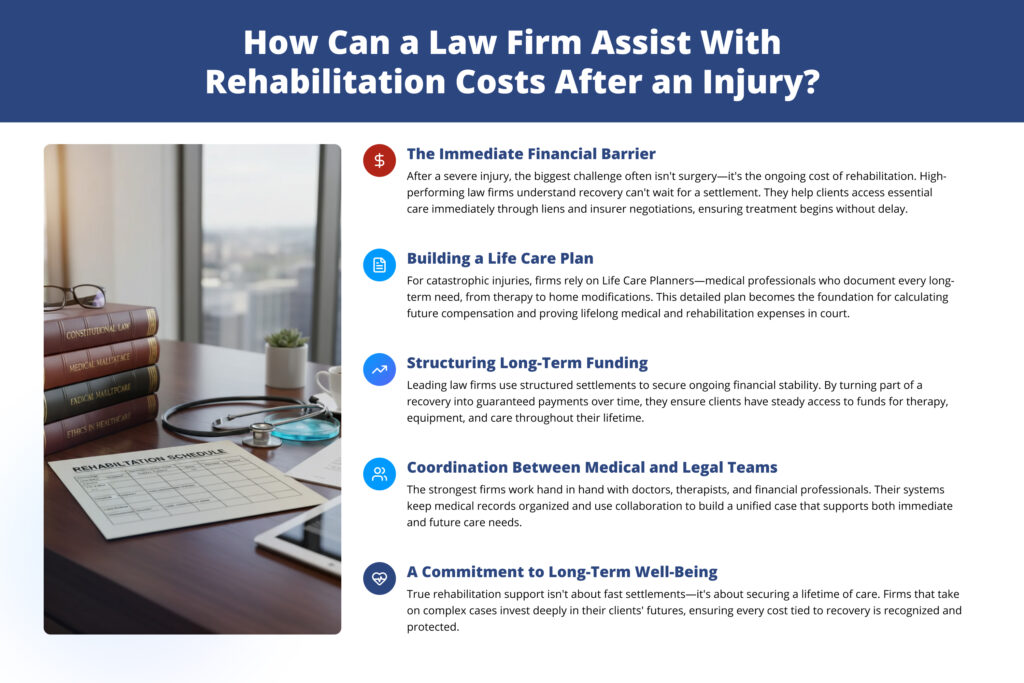
The Immediate Financial Barrier to Recovery
Rehabilitation is often immediate, intensive, and incredibly expensive. The high-achievement law firms that handle difficult personal injury claims understand that recovery cannot wait until the lawsuit is resolved years down the road. They have systems in place to address this immediate need.
1. Securing Upfront Funding for Treatment
Since these law firms operate on a contingency fee basis, they do not require payment upfront. However, medical providers do. A major initial barrier is often the patient’s lack of insurance coverage or the insurance company’s refusal to cover intensive therapies that fall outside of routine care.
Capable law firms assist by:
- Lien Management: They establish a legal agreement with medical providers (a lien) stating the provider will be paid directly out of the future settlement or verdict. This allows the client to access necessary, high-cost rehabilitation services immediately, without upfront out-of-pocket costs.
- Negotiation with Insurers: They actively work to maximize immediate benefits from the client’s own medical policies (including challenging unfair denials), ensuring continuity of care from the very start.
2. Proving Future Need: The Life Care Plan
A case involving catastrophic injury is often rejected by smaller firms because they lack the resources to accurately quantify future costs. This is where the legal team’s capacity becomes critical.
A Life Care Plan is a comprehensive document detailing every injury-related need for the rest of the client’s life, including:
- Long-Term Medical Care: Future surgeries, medication, and doctor visits.
- Rehabilitation Services: Physical therapy, speech therapy, and psychological services.
- Equipment: Wheelchairs, braces, specialized vehicles, and home modifications (ramps, lifts).
- Attendant Care: The cost of full-time or part-time caregivers.
Firms that handle difficult, high-value claims invest heavily in retaining specialized, professional consultants known as Life Care Planners. These professionals create the detailed, year-by-year projections needed to anchor the legal team’s demand for record-level compensation. This meticulous process transforms abstract future needs into concrete, verifiable figures in the courtroom.
The Legal Strategy for Recovery Funding
A law firm’s ultimate goal in assisting with rehabilitation costs is to ensure that the compensation secured is sufficient to cover these needs for the client’s entire projected lifespan.
Calculating the Time Horizon
The legal team works with economists and professional life care planners to determine the client’s remaining life expectancy and then calculates the total cost of care over that time. This amount is then factored into the final demand for damages. Crucially, they must account for inflation and the present value of money to ensure the settlement or verdict, when received today, will actually fund care two or three decades in the future.
The Role of Structured Settlements
In cases resulting in very large recoveries, the law firm will often structure the final compensation to create a dedicated income stream for future rehabilitation costs. A structured settlement involves placing a portion of the funds into an annuity that provides guaranteed, tax-free periodic payments over the client’s life.
- This approach ensures funds are available for long-term care needs, preventing the money from being quickly exhausted.
- The legal team coordinates with financial planning professionals to set up these complex, legally binding payment streams.
Operational Excellence: Why Only Certain Firms Can Do This
The coordination required to manage immediate liens, fund a life care plan, and negotiate a complex structured settlement is immense. This is why only those firms with significant operational depth and financial stability are equipped to handle the toughest claims.
Integration of Medical and Legal Teams
These high-achievement practices do not treat the case merely as a legal matter; they treat it as a medical and financial challenge requiring a holistic solution. They have established systems for:
- Collaborative Case Management: The legal team works closely with the client’s physicians, therapists, and financial advisors from day one.
- Centralized Records: They maintain an organized, searchable database of all medical and billing records, making it easier to present a unified narrative of injury and ongoing need during negotiations or trial.
The Ethical Commitment to Future Needs
The law firm’s dedication to securing long-term rehabilitation funds reflects the high ethical standard of their practice. They are not focused on a quick, smaller recovery; they are focused on the client’s entire future well-being. The thoroughness and preparation required to prove decades of future expenses is a hallmark of a practice committed to complex litigation. Medical and rehabilitation needs for catastrophic injuries are documented by federal agencies. The Centers for Disease Control and Prevention (CDC) provides extensive public data and resources on the financial impact and long-term prognosis of disabling conditions like traumatic brain injuries and spinal cord injuries. This data is critical for law firms to legally substantiate the need for life care plans and projected future rehabilitation costs.
Finding the Right Partner for Your Recovery
If your injury is severe enough that rehabilitation costs are a major concern, you need a legal team that can demonstrate a history of funding and managing these long-term needs, especially if other lawyers have deemed your case too difficult.
- Ask About Life Care Plans: During your initial consultation, ask about their experience with Life Care Planners. Do they have a pre-existing network of these professional consultants?
- Inquire About Financial Management: Ask specifically about their process for managing immediate liens and their experience setting up structured settlements. A generic firm may not have this specific knowledge.
- Look for High-Value Claims: Seek out firms whose publicly discussed victories involve catastrophic injuries, as those are the cases that inherently require securing decades of rehabilitation funding.
By choosing a legal partner focused on the holistic, long-term challenge of rehabilitation funding, you ensure that your personal injury claim protects your recovery and future quality of life, not just your immediate expenses.