How Do Law Firms Prepare for Trial in Injury Cases?
When a person suffers harm due to someone else’s negligence, the journey toward justice often feels like a long road. While many claims reach a resolution through insurance settlements, a significant number proceed to a courtroom. Preparing for a trial is an exhaustive, detail-oriented process that begins long before a jury is ever seated. Law firms must transform a series of events into a cohesive, evidence-backed narrative that can withstand the scrutiny of a judge and opposing counsel.
To understand how a legal team prepares, one must look at the layers of investigation, strategy, and logistics involved in building a case.
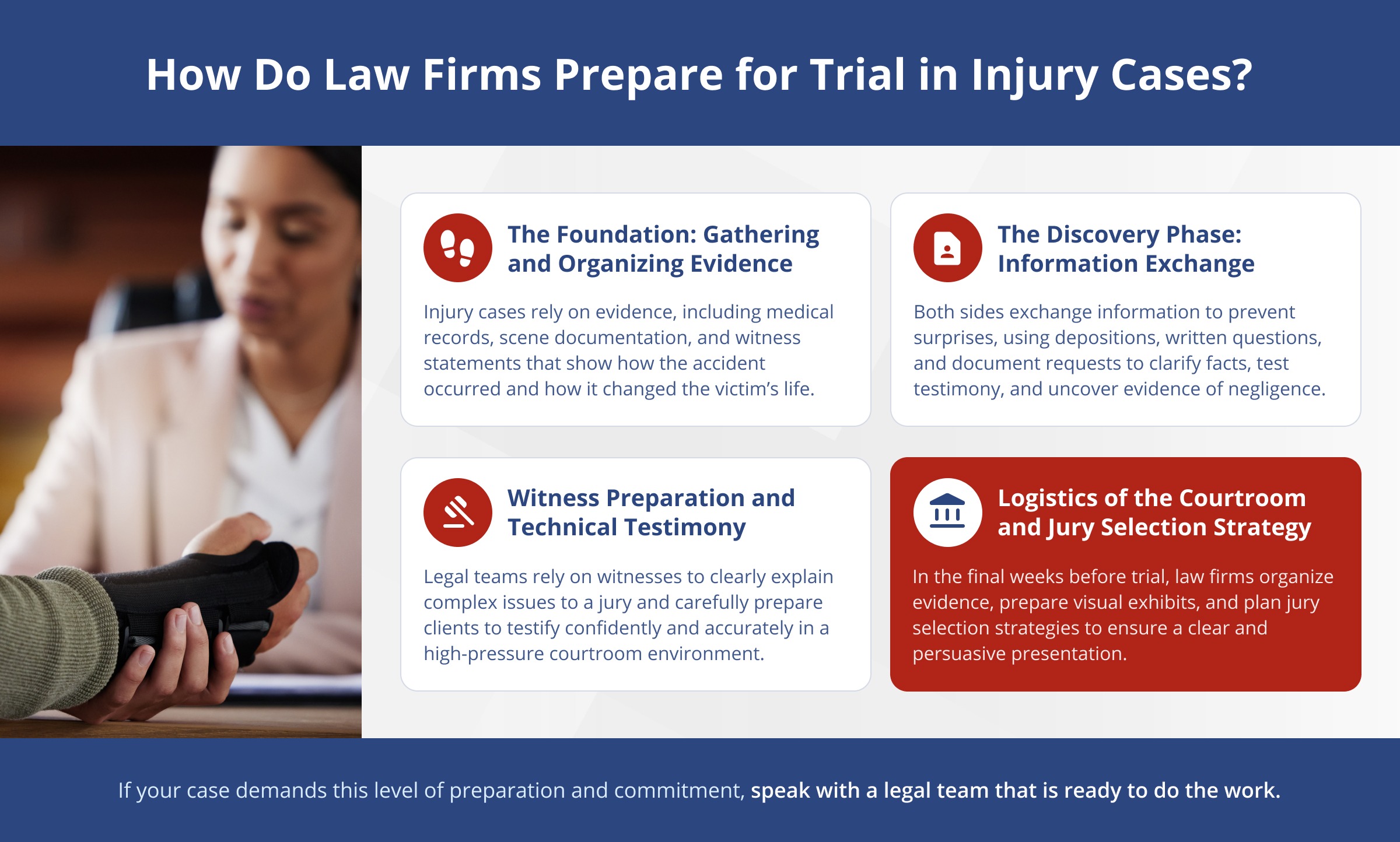
The Foundation: Gathering and Organizing Evidence
The bedrock of any successful injury case is the evidence. Law firms spend months, sometimes years, collecting every piece of data relevant to the incident. This involves more than just a police report; it includes a comprehensive dive into the client’s life before and after the harm occurred.
- Medical Records and Billing: Firms meticulously track every doctor’s visit, surgery, and physical therapy session. These documents prove the extent of the physical damage and the financial burden placed on the victim.
- Scene Documentation: This includes photographs of the location, video footage from nearby security cameras, and physical objects that may have played a role in the incident.
- Witness Interviews: Attorneys and their staff reach out to people who saw the event or can testify to the victim’s change in quality of life.
The Discovery Phase: Information Exchange
Preparation is not done in a vacuum. During the “discovery” phase, both sides are legally required to share information. This ensures there are no “trial by ambush” scenarios.
- Depositions: This is a critical stage where witnesses, including the person harmed and the person at fault, give testimony under oath. A court reporter records every word. Law firms use these sessions to see how a witness performs under pressure and to lock in their story so it cannot be changed later.
- Interrogatories: These are written questions that the other side must answer. They help clarify the facts of the case and identify which points are actually in dispute.
- Requests for Documents: Firms will demand maintenance records, safety logs, or internal communications that might show a pattern of negligence.
Developing the Case Theory
Once the facts are known, the legal team must develop a “theory of the case.” This is the central theme that explains why the defendant is responsible and why the client deserves compensation. A firm might focus on a “broken safety culture” at a company or a “moment of preventable distraction” by a driver.
To refine this theory, many firms use focus groups. By presenting their arguments to a small group of neutral people, they can see which parts of the story resonate and which parts are confusing. This feedback allows them to adjust their approach before stepping into the actual courtroom.
Witness Preparation and Technical Testimony
Legal teams often rely on people with deep knowledge in specific fields to explain complex issues to a jury. For example, a medical professional might explain the long-term impact of a spinal injury, or an engineer might reconstruct a collision to show how it happened.
The law firm must ensure these individuals are prepared to speak clearly without using overly technical jargon. Similarly, the firm spends hours with the client, practicing for testimony. This isn’t about coaching them on what to say—honesty is paramount—but rather helping them feel comfortable in a high-pressure environment so they can tell their story accurately.
Pre-Trial Motions: The Legal Groundwork
Before the trial starts, attorneys engage in various legal requests to the judge to decide on specific issues. For instance, a firm might file a motion to prevent the defense from bringing up unrelated past events in the client’s life. According to the American Bar Association, these steps are vital for narrowing the scope of the trial.
“A pretrial conference may be held to settle any outstanding issues, like what evidence will be allowed and who the witnesses will be. At this time, the judge may also try to get the parties to settle their case without a trial.”
The Logistics of the Courtroom
The final weeks of preparation are often logistical. The law firm creates a “Trial Notebook,” a massive binder (or digital equivalent) that contains every document, witness outline, and legal precedent they might need at a moment’s notice.
They also prepare visual aids. In the modern courtroom, juries expect more than just talk; they want to see digital reconstructions, enlarged photographs, and clear charts that break down medical expenses. Coordinating the technology to display these items smoothly is a job in itself.
Jury Selection Strategy
The very first act of a trial is voir dire, or jury selection. Law firms prepare for this by developing a list of questions designed to uncover hidden biases. They want to ensure that the people deciding the case can be fair and objective. While they cannot choose exactly who stays, they can use their challenges to remove individuals who may have a predetermined prejudice against injury claims.
The preparation for an injury trial is an immense undertaking that requires a blend of investigative work, psychological insight, and rigorous legal research. By the time an attorney stands up to give an opening statement, thousands of hours of work have already been poured into the case to ensure that the truth is presented clearly and persuasively.