How Do Contingency Fees Work for Personal Injury Lawyers?
For many, the aftermath of a serious accident is a time of immense financial strain. Between mounting hospital bills, the cost of vehicle repairs, and the sudden loss of income due to missed work, the idea of paying a lawyer hundreds of dollars per hour can seem impossible. This financial barrier is why the personal injury legal field operates almost exclusively on a contingency fee basis.
A contingency fee is an arrangement that allows an injured person to hire a legal team without paying a single dollar upfront. Instead of charging by the hour, the lawyer’s payment is contingent on the successful outcome of the case. In plain terms: if your lawyer does not win money for you, you do not owe them a fee for their services.
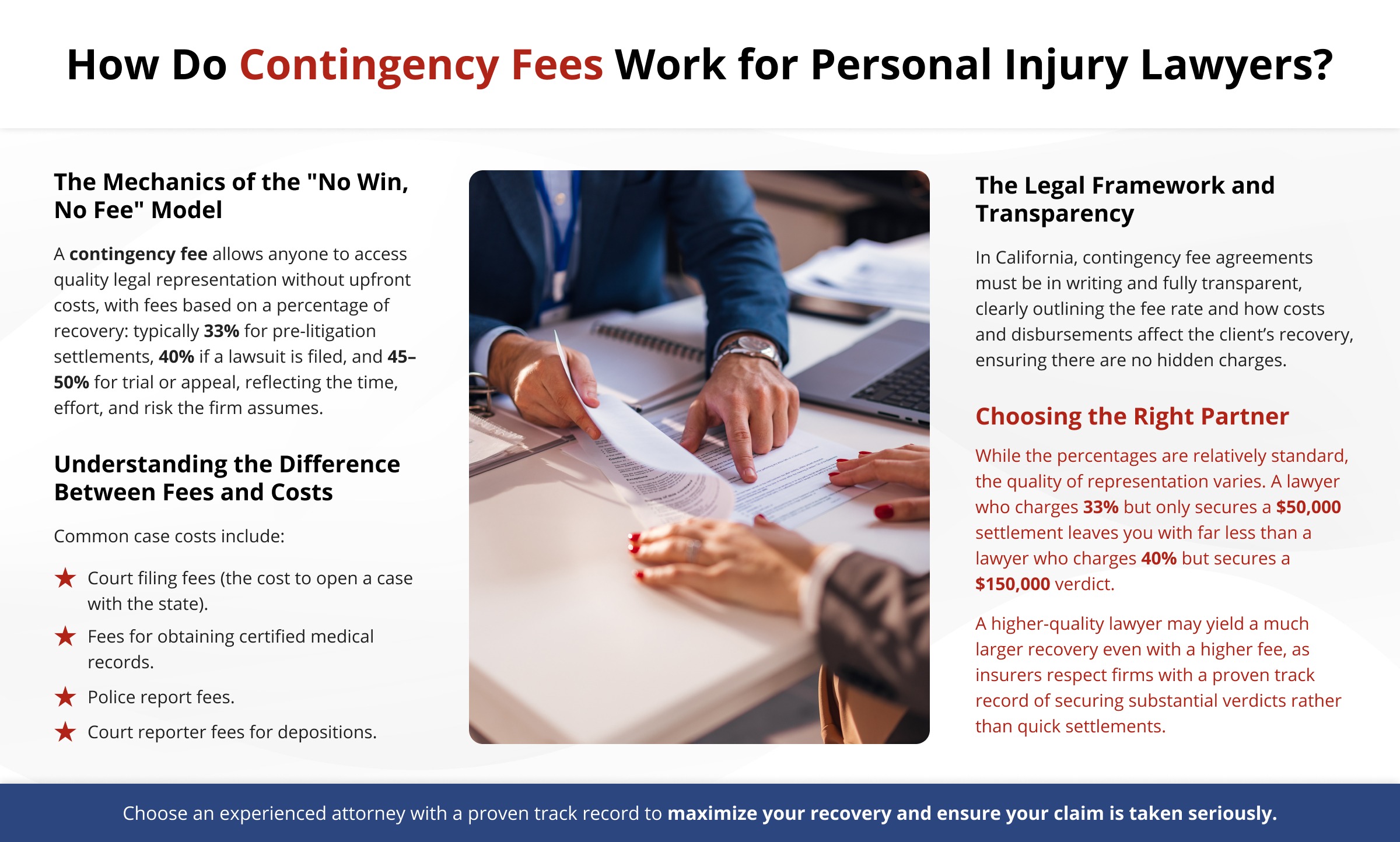
The Mechanics of the “No Win, No Fee” Model
The primary goal of a contingency fee is to provide access to justice. It levels the playing field, allowing an individual to go up against a massive insurance corporation with the same quality of legal representation that the corporation enjoys.
When you hire a personal injury firm, you sign a written agreement that outlines the percentage of the final recovery the lawyer will receive as their fee. This percentage typically follows a tiered structure based on how much work is required to resolve the case.
- Pre-Litigation Phase: If the case settles through negotiation with the insurance company before a lawsuit is officially filed, the fee is usually around 33% (one-third) of the total recovery.
- Litigation Phase: If the insurance company refuses to offer a fair settlement and your lawyer must file a formal complaint in court, the fee often increases to 40%. This accounts for the significant increase in labor, time, and financial risk the firm takes on during the discovery process.
- Trial and Appeal: Should the case proceed to a full jury trial or require an appeal, the fee may reach 45% or 50%, reflecting the intense resources required to manage a courtroom.
Understanding the Difference Between Fees and Costs
One of the most common points of confusion for clients is the distinction between “attorney fees” and “case costs.” While the fee is the payment for the lawyer’s time and knowledge, costs are the out-of-pocket expenses required to build the case.
Common case costs include:
- Court filing fees (the cost to open a case with the state).
- Fees for obtaining certified medical records.
- Police report fees.
- Costs for hiring accident reconstructionists or medical consultants.
- Court reporter fees for depositions.
In a standard contingency arrangement, the law firm advances these costs. They pay for everything upfront, so the client doesn’t have to. When the case is won, the firm is reimbursed for these exact expenses from the settlement funds, separate from their percentage fee.
The Legal Framework and Transparency
Because the contingency fee model involves a portion of a victim’s recovery, it is strictly regulated to ensure fairness. In California, these agreements are governed by specific statutes that mandate transparency.
According to the State Bar of California, these contracts must be in writing to be enforceable. The law ensures that clients are fully aware of how their money will be handled before they ever commit to a firm. As noted in the California Business and Professions Code:
“The contract shall be in writing and shall include… A statement of the contingency fee rate which the client and attorney have agreed upon [and] a statement as to how disbursements and costs incurred in connection with the prosecution or settlement of the claim will affect the contingency fee and the client’s ultimate recovery.”
This legal requirement ensures there are no hidden fees. Your lawyer must explain exactly how the math will work—whether the fee is taken from the “gross” recovery (the total amount) or the “net” recovery (the amount left after costs are paid).
How a Settlement is Distributed
To visualize how this works, consider a hypothetical $100,000 settlement with $5,000 in advanced costs and a 33% contingency fee.
| Step | Description | Amount |
| Total Recovery | The check issued by the insurance company. | $100,000 |
| Attorney Fee | 33% of the total settlement. | ($33,000) |
| Case Costs | Reimbursement for filing fees, records, etc. | ($5,000) |
| Medical Liens | Payment to doctors who treated you on credit. | ($15,000) |
| Net to Client | The final amount paid directly to the victim. | $47,000 |
Law firms often negotiate medical liens down. If your lawyer convinces a provider to accept $10,000 instead of $15,000, that extra $5,000 goes directly into your pocket.
Why This Model Aligns Interests
The contingency fee perfectly aligns the interests of the lawyer and the client. Because the lawyer only gets paid if you win—and because their pay is a percentage—they are highly motivated to secure the largest possible settlement. Unlike an hourly lawyer who might be tempted to prolong a case, a contingency lawyer wants to resolve the case efficiently and for the maximum value.
This model also acts as a quality filter. Because the law firm is essentially investing their time and money into your case, they will not take on a claim that they do not believe has merit. If a firm like Super Woman Super Lawyer accepts your case on a contingency basis, it is a strong signal that they believe in the strength of your claim.
Choosing the Right Partner
While the percentages are relatively standard, the quality of representation varies. A lawyer who charges 33% but only secures a $50,000 settlement leaves you with far less than a lawyer who charges 40% but secures a $150,000 verdict.
When you choose a firm with a history of high-value results, you are paying for the reputation that forces insurance companies to take your claim seriously. They know which firms are willing to go the distance and which ones are just looking for a quick settlement.