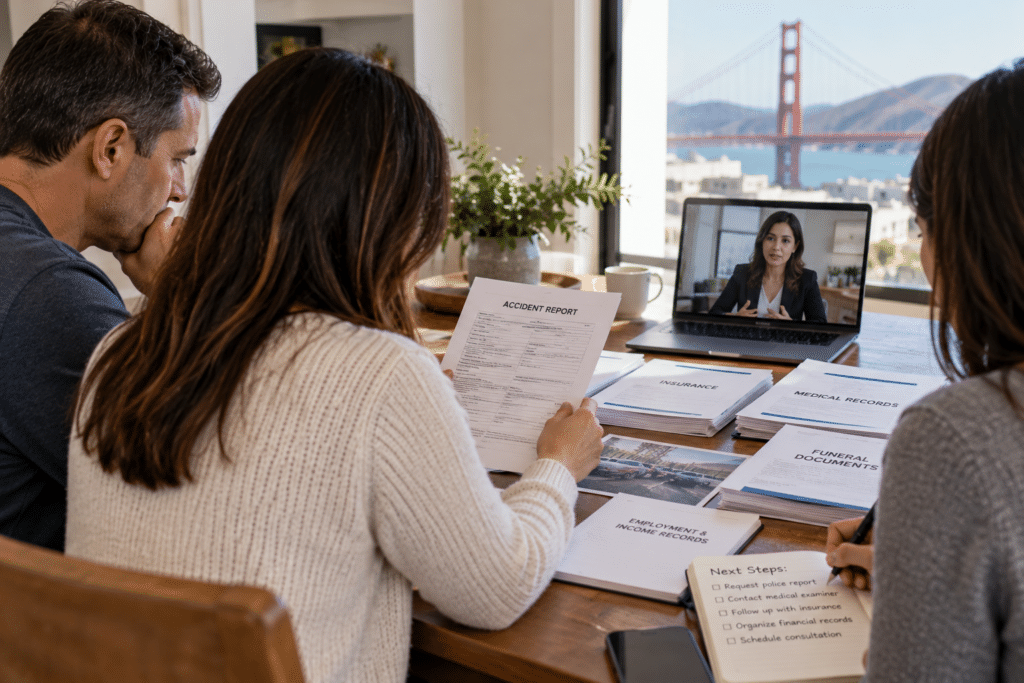
A San Francisco wrongful death claim can be difficult for any family to manage, but the practical challenges may increase when surviving family members live hundreds or thousands of miles outside California. Police records may need to be requested remotely. Hospital and medical examiner documents may come from different agencies. A damaged vehicle may remain at a San Francisco-area tow or storage facility while personal belongings are still inside. Insurance adjusters may begin calling family members in another time zone, and relatives may need to travel to California for funeral arrangements, property matters, or other responsibilities connected to the death.
Distance does not necessarily change which evidence matters, but it can make organization more important. A San Francisco wrongful death claim involving an out-of-state family may generate records from law enforcement, emergency responders, hospitals, the medical examiner, tow companies, insurers, employers, funeral providers, witnesses, and other organizations. Creating one central digital claim file can help family members coordinate those materials without relying on one person to remember every call, email, document request, and deadline.
California law identifies categories of people who may have standing to pursue a wrongful death action. California Code of Civil Procedure section 377.60 addresses who may bring a wrongful death action in California. Living outside California does not, by itself, answer whether someone qualifies; the person’s relationship and the statutory requirements must be evaluated based on the individual circumstances.
Families should also distinguish between the legal deadline for a San Francisco wrongful death claim and the much shorter practical life of certain evidence. Vehicle data, surveillance recordings, damaged property, tow records, and witness recollections may change or disappear while family members are still arranging travel and requesting official records. Preserving potentially time-sensitive evidence can therefore be important even when the family is coordinating the claim remotely.
If your family lives outside California after losing a loved one in a San Francisco motor vehicle collision, our San Francisco Wrongful Death Lawyer page provides additional information about how Super Woman Super Lawyer can evaluate accident evidence, insurance issues, financial documentation, and other records.
Connect with Super Woman Super Lawyer today through our Online Form, call 800.800.6916, or start a Live Chat. A San Francisco wrongful death claim can involve many moving parts, and a centralized record system may help an out-of-state family understand what has already been obtained, what remains outstanding, and which evidence may require prompt preservation.
Records Families May Need to Obtain Remotely
The first stage of organizing a San Francisco wrongful death claim often involves identifying which agencies and organizations possess relevant records. When relatives live elsewhere, it may be tempting to wait until someone can travel to California. Many records, however, can be requested remotely, while other evidence may require quicker attention because it is not preserved indefinitely.
A useful starting point is a document checklist identifying the organization, type of record, date requested, person contacted, response received, and any follow-up required. This approach can prevent several relatives from making duplicate requests while another important source is accidentally overlooked.
Police, Emergency Response, and Crash Investigation Materials
The appropriate law enforcement agency depends on where the fatal collision occurred. A crash within San Francisco may involve the San Francisco Police Department, while collisions on particular highways or in other jurisdictions may involve different agencies. The first task is therefore to identify the investigating agency rather than assume which department possesses the records.
The San Francisco Police Department provides information about requesting police reports and other records. For a San Francisco wrongful death claim, available materials may include a traffic collision report, diagrams, involved-party information, witness information, photographs, or other investigative records depending on what the agency created and what can legally be released.
Emergency response documentation may exist separately. Ambulance, fire department, or other emergency medical records may document the initial response to the collision. These materials can be particularly important when family members were not present in California and therefore did not personally observe what occurred after the crash.
Families should preserve the report or incident number associated with each agency. A San Francisco wrongful death claim can become difficult to organize if relatives retain only an officer’s or responder’s name without the corresponding case number, date, or agency.
Accident-scene photographs and video should also be preserved when available. Nearby businesses, homes, transit vehicles, dashcams, or other systems may have captured the collision. Because video can be overwritten, identifying potential sources promptly can matter more than waiting for the complete police file.
Hospital, Medical Examiner, and Funeral-Related Records
If the person received medical treatment before death, hospital and emergency records may form another part of the San Francisco wrongful death claim file. These records can document the person’s condition, treatment, diagnostic testing, procedures, and other care following the collision.
When a death falls within its jurisdiction, the Office of the Chief Medical Examiner for the City and County of San Francisco may possess records relating to its investigation. Families should verify which agency handled the death rather than assuming a medical examiner record necessarily exists in every case.
Access to a deceased person’s medical information can involve specific authorization and representative requirements. The U.S. Department of Health and Human Services provides information about health-information privacy and personal representatives. An out-of-state family pursuing a San Francisco wrongful death claim may therefore need to determine what documentation each healthcare provider requires before releasing records.
Funeral-related records should also be preserved. Contracts, invoices, burial or cremation documentation, transportation expenses, and related receipts may become part of the family’s financial file. California’s Cemetery and Funeral Bureau provides consumer information concerning funeral, cemetery, and cremation services.
Keeping hospital, medical examiner, and funeral documentation in separate digital folders can make the San Francisco wrongful death claim easier to navigate while still maintaining one master timeline.
Tow, Vehicle Storage, and Personal Property Information
A fatal collision can leave the damaged vehicle at a tow yard, storage facility, repair location, law enforcement facility, or another site while family members remain outside California. Identifying where the vehicle is located can be time-sensitive because storage charges may continue and the vehicle itself may contain important physical evidence.
A San Francisco wrongful death claim may require preserving photographs of the vehicle before it is repaired, sold, destroyed, or released. Depending on the circumstances, vehicle damage, event data, onboard cameras, personal electronics, or other evidence may become relevant to reconstructing the collision.
Personal belongings can create a separate practical concern. A phone, wallet, laptop, luggage, medication, keys, or other property may remain inside the vehicle. Families should document communications regarding retrieval and create an inventory when belongings are returned.
Do not assume that authorizing release or disposal of a damaged vehicle has no evidentiary consequences. If the vehicle may matter to the San Francisco wrongful death claim, its condition and location should be evaluated before irreversible decisions are made.
For additional information about preserving accident evidence before it changes, read What to Do After a Car Accident in California: What Actually Matters.
Organizing Insurance Communications From Another State
Insurance communications can become difficult to manage when family members live in different states. One relative may receive a telephone call while another receives an email, and a third may be handling paperwork. Without a shared system, the family can quickly lose track of which insurer requested information, what was provided, and whether several claim files exist.
A San Francisco wrongful death claim benefits from a centralized communication log. The family can record the date, company, adjuster, claim number, telephone number, email address, subject of the communication, documents requested, and any follow-up required. Copies of emails, letters, forms, and settlement documents should be stored alongside that log.
Claim Numbers, Adjuster Details, and Communication Logs
Each insurer or claim administrator may assign a separate claim number. If multiple vehicles were involved, the family could receive communications from several insurers. The deceased person’s own automobile coverage may also generate a separate file depending on the circumstances and available coverage.
For a San Francisco wrongful death claim, identify the company before discussing substantive issues. Record the adjuster’s full name, employer, telephone number, email, claim number, insured party, and the role the insurer appears to have in the collision.
A communication log can be particularly useful when family members are coordinating across time zones. Instead of relying on text messages among relatives, one shared record can show who spoke with an adjuster and what occurred.
The California Department of Insurance provides consumer resources concerning insurance in California. Those resources can help families understand general insurance processes, while the specific policies and facts determine what coverage may apply to a particular San Francisco wrongful death claim.
Recorded Statement and Medical Authorization Requests
An insurance adjuster may ask a family member for a recorded statement or request authorization to obtain medical records. These requests should be documented carefully. The family should identify which insurer is asking, what claim the request concerns, and what information the proposed authorization covers.
A medical authorization can differ in scope depending on its language. It may identify particular providers, categories of information, or periods of medical history. Family members should not assume every authorization is limited to records generated after the collision.
For a San Francisco wrongful death claim, keep copies of any authorization forms received and any signed forms returned. The same applies to recorded statement requests. Record the date, adjuster, insurer, subject, and whether the statement occurred.
This organizational approach can become especially important when several relatives live outside California and different insurers contact different family members. Centralizing requests reduces the risk of inconsistent responses or duplicate authorizations being signed without anyone realizing it.
Multiple Policies or Vehicles Creating Separate Claim Files
A fatal multi-vehicle collision can generate several insurance claims. Each involved vehicle may have separate liability coverage, while other available coverage may also need to be evaluated depending on the circumstances.
A San Francisco wrongful death claim involving several policies should keep each insurance file distinct. One digital folder might contain communications from Driver A’s insurer, another from Driver B’s insurer, and another for applicable first-party coverage. The master timeline can then link those separate files.
This approach also helps when settlement communications begin. A proposed resolution from one insurer should not automatically be assumed to resolve every claim or every policy. The effect of any release depends on its actual wording and the parties involved.
Families should preserve policy information, declarations when available, coverage correspondence, reservation-of-rights letters, settlement offers, releases, and other substantive insurance documents. The goal is to understand the complete insurance picture before important decisions are made.
Documenting Financial and Household Losses
A San Francisco wrongful death claim involves more than documenting how the collision occurred. Families may also need records showing the financial and household role the deceased person played before the death. Those records can be especially difficult to assemble remotely when employment, tax, banking, household, and family information is spread across different locations.
Before-and-after documentation can help. What income and benefits did the person receive? What household responsibilities did they regularly perform? Did they provide childcare, transportation, caregiving, home maintenance, financial support, or other services? What new expenses arose after the collision and death?
Income, Employment Benefits, and Tax Records
Employment records may include pay statements, W-2 forms, tax returns, employment contracts, bonus or commission documentation, retirement information, health benefits, pension information, or other compensation records depending on the person’s work.
For a San Francisco wrongful death claim, families should preserve original records rather than relying solely on an estimated annual income. Compensation can include more than base wages, and employment benefits may require separate documentation.
Employer communications may also identify job title, work history, compensation, benefits, or other relevant information. If the person was self-employed, business records, tax documents, invoices, contracts, or accounting information may become relevant instead.
California wrongful death damages involve specific legal rules, and not every financial record automatically translates into a recoverable loss. The purpose of collecting the evidence is to allow the family’s actual circumstances to be evaluated accurately.
Household Support, Caregiving, and Shared Expenses
Financial contributions are only one part of a household. The person who died may have regularly provided childcare, elder care, transportation, meal preparation, household maintenance, scheduling, shopping, or other forms of support.
A San Francisco wrongful death claim may therefore include calendars, childcare records, household expenses, caregiving schedules, or other documentation showing the person’s role before the collision. Family members can also identify specific responsibilities rather than relying on broad statements that the person “did everything.”
Shared expenses may change after the death. Housing, childcare, transportation, household services, or caregiving costs may need to be reorganized. Preserve records showing these changes as they occur.
The strongest before-and-after comparison is factual. It should show what the household looked like before the collision and what changed afterward without exaggerating or minimizing the deceased person’s contributions.
Travel and Other Accident-Related Family Costs
Out-of-state families may incur travel expenses that local families do not face. Airfare, lodging, rental vehicles, ground transportation, parking, meals, or other expenses may arise when relatives travel to San Francisco following the collision or death.
Preserve receipts and document why the trip occurred. A San Francisco wrongful death claim may involve travel connected to funeral arrangements, vehicle retrieval, personal property, meetings, or other accident-related responsibilities.
The existence of an expense does not automatically establish that it is legally recoverable. Documentation nevertheless allows the cost and its purpose to be evaluated rather than reconstructed months later.
Families may also incur costs obtaining records, shipping personal property, arranging services, or handling other logistical matters from another state. A dedicated expense folder can keep these items separate from medical and funeral documentation.
Creating a Central San Francisco Wrongful Death Claim Timeline
A central timeline can become one of the most useful organizational tools for an out-of-state family. Instead of storing police, medical, insurance, vehicle, witness, and financial records as unrelated documents, the timeline places significant events in chronological order.
A San Francisco wrongful death claim timeline might begin with the collision and emergency response, continue through medical treatment and death, and then include medical examiner activity, funeral arrangements, vehicle storage, insurer contacts, record requests, witness communications, and settlement correspondence.
Agency, Medical, Insurance, and Witness Communications
Each important communication can be entered into the timeline with the date, organization, person contacted, and subject. This does not require writing a detailed narrative of every phone call. A concise entry may be enough to show what happened and where the supporting document is stored.
For a San Francisco wrongful death claim, the timeline may include police report requests, hospital record requests, medical examiner communications, funeral arrangements, tow-yard calls, insurer contacts, employer communications, and witness interviews.
A shared cloud folder can be helpful for families living in different states, provided access is appropriately controlled. Folder names can correspond with timeline categories so relatives do not create multiple competing versions of the same claim file.
The timeline should distinguish facts from recollections. Official records can be identified as such, while a family member’s notes about a telephone conversation should be labeled as notes rather than presented as an agency record.
Digital Evidence and Vehicle Records
Digital evidence can include surveillance footage, dashcam recordings, photographs, phone data, vehicle data, navigation information, or other electronic records depending on the collision.
For a San Francisco wrongful death claim, some digital evidence may have a short lifespan. Business surveillance can be overwritten. Vehicle data can become unavailable if the vehicle is repaired or destroyed. Phones may be reset, damaged, or replaced.
Preserve original files when possible rather than relying solely on screenshots or compressed copies. Maintain information about where a file came from, when it was obtained, and who provided it.
Vehicle records may include tow documentation, storage invoices, photographs, repair estimates, total-loss communications, inspection records, or other information. Keeping these records with the digital evidence can help show what happened to the vehicle after the collision.
Settlement Documents Before the Full Loss Is Documented
Insurance settlement discussions may begin while an out-of-state family is still gathering records. A police investigation may remain incomplete, medical examiner records may still be pending, financial documentation may not be assembled, or additional insurance policies may still be under review.
Before signing a release in a San Francisco wrongful death claim, the family should understand what the document resolves and which parties or claims it covers. The effect of a release depends on its actual wording and circumstances.
Preserve every settlement offer and proposed release, including earlier versions. Changes between drafts can matter, and the final signed document should not be the only version retained.
Our article How Personal Injury Settlements Really Work in California provides additional information about documentation and settlement timing. Wrongful death claims present their own legal issues, so the specific San Francisco wrongful death claim should be evaluated independently.
Legal Deadlines and Remote Evidence Preservation
California imposes legal deadlines on wrongful death claims, but the precise deadline depends on the circumstances. The California Courts Self-Help Guide provides general information about statutes of limitations and cautions that different types of cases have different filing periods.
Special procedures can apply when a government entity is involved. California’s Government Claims Program provides information about claims involving the State of California. Claims involving local public entities may involve separate procedures. An out-of-state family should therefore not assume that one general deadline governs every San Francisco wrongful death claim.
Evidence preservation can be more urgent than any filing deadline. Surveillance footage, vehicle data, damaged property, tow information, and witness recollections may change or disappear in days, weeks, or months.
Distance makes this distinction particularly important. Waiting until the next trip to California may be too long for certain evidence. Photographs, preservation requests, record requests, and other appropriate steps can often begin while family members remain in their home states.
Serving Out-of-State Families After Fatal San Francisco Accidents
San Francisco’s transportation environment includes dense city streets, steep grades, freeway connections, commercial traffic, rideshare vehicles, bicycles, pedestrians, transit, and major routes such as U.S. 101 and Interstate 280. A fatal motor vehicle collision may therefore involve records from several agencies or organizations depending on where and how it occurred.
For a family living elsewhere, the challenge is often not simply obtaining one police report. A San Francisco wrongful death claim may require coordinating information from law enforcement, hospitals, the medical examiner, tow facilities, insurers, employers, witnesses, and funeral providers while relatives are in another state.
A centralized digital system can make that process more manageable. Police and agency records can occupy one folder, medical and medical examiner records another, insurance files another, financial documentation another, and vehicle evidence another. A master timeline can then connect them.
Super Woman Super Lawyer can help evaluate the available evidence and identify issues requiring additional investigation. For more information about local representation while your family remains outside California, visit our San Francisco Wrongful Death Lawyer page.
Frequently Asked Questions About a San Francisco Wrongful Death Claim for Out-of-State Families
Can I pursue a California wrongful death claim if I live in another state?
Living outside California does not by itself determine whether someone may pursue the claim. California law identifies categories of people who may have standing. California Code of Civil Procedure section 377.60 addresses who may bring a wrongful death action. Eligibility for a particular San Francisco wrongful death claim depends on the individual circumstances.
Do I have to travel to San Francisco to obtain the police report?
Not necessarily. Many record requests can begin remotely. The San Francisco Police Department provides information about requesting police reports. The appropriate procedure depends on the investigating agency and the particular record.
How do I obtain medical examiner records from another state?
First determine which agency handled the death. The San Francisco Office of the Chief Medical Examiner provides information about its services and records. A San Francisco wrongful death claim should verify the correct agency before requesting documents.
What if the damaged vehicle is still in California?
Identify its exact location and document communications with the tow yard, storage facility, insurer, or other custodian. If the vehicle may contain evidence relevant to a San Francisco wrongful death claim, consider preservation before authorizing repair, disposal, or other irreversible action.
Should we retrieve personal belongings from the vehicle?
Personal belongings may need to be retrieved, but document what is removed and preserve information about the vehicle’s condition. Phones, cameras, electronics, or other property may contain relevant information depending on the circumstances.
How should family members coordinate insurance calls from different states?
Use one shared communication log. Record the insurer, claim number, adjuster, contact information, date, subject, and follow-up. A centralized system can reduce confusion when several relatives are helping manage a San Francisco wrongful death claim.
Should I sign a medical authorization sent by an insurance company?
Read the authorization carefully and understand what records and time periods it covers before signing. Keep a copy of every authorization received or provided. The appropriate response depends on the individual San Francisco wrongful death claim and the information requested.
What financial records should families preserve?
Depending on the circumstances, records may include pay statements, tax returns, benefits information, retirement records, employment documentation, household expenses, and records showing services or support the deceased person provided. These materials can help document the family’s financial circumstances.
Can household support matter even if it was unpaid?
Household contributions may be relevant depending on the circumstances. Childcare, caregiving, transportation, meal preparation, home maintenance, and other services should be documented factually. The legal significance of those contributions depends on California wrongful death law and the individual claim.
Should out-of-state travel expenses be saved?
Yes. Preserve airfare, lodging, rental vehicle, transportation, parking, and other receipts associated with accident-related travel. Whether a particular expense is recoverable is a separate legal question, but a San Francisco wrongful death claim cannot evaluate an undocumented cost as effectively as one supported by records.
What if several insurance policies are involved?
Create a separate folder for each insurer or policy and use the master timeline to connect them. A San Francisco wrongful death claim involving multiple vehicles can generate several claim numbers and adjusters, so keeping the files distinct can prevent confusion.
Why should digital evidence be preserved quickly?
Surveillance footage may be overwritten, vehicle data can become unavailable, and electronic records may change. The practical preservation window for a San Francisco wrongful death claim may therefore be much shorter than the legal filing deadline.
Should we wait for every record before speaking with an attorney?
No particular set of records is required before seeking a consultation. Bring whatever is already available. Missing police, medical, vehicle, insurance, or financial records can then be identified and organized rather than delaying solely because the file is incomplete.
What should an out-of-state family bring to a consultation?
Bring available police information, medical and medical examiner records, insurance communications, vehicle and tow information, funeral documentation, employment and financial records, witness information, photographs, digital evidence, travel receipts, and a basic chronology. A San Francisco wrongful death claim consultation can then focus on what exists and what may still need to be preserved.
Call or Contact Super Woman Super Lawyer 24/7 for a Free Consultation and Pay Nothing Unless You Win
Managing a fatal accident claim from another state can place an additional administrative burden on a family already dealing with a profound loss. A San Francisco wrongful death claim may require coordination with police, hospitals, the medical examiner, tow facilities, insurers, employers, witnesses, funeral providers, and other organizations while surviving relatives remain far from California.
Super Woman Super Lawyer can help evaluate and organize the San Francisco wrongful death claim record, including crash evidence, agency records, medical documentation, medical examiner materials, vehicle information, insurance communications, financial records, household-loss documentation, travel expenses, and settlement correspondence. When evidence may disappear quickly, identifying preservation issues early can be particularly important for a family that cannot simply visit the scene or storage facility.
Super Woman Super Lawyer has recovered more than over $2 billion for clients. Past results do not guarantee a particular outcome, and every wrongful death claim depends on its individual facts, evidence, applicable law, and available insurance.
For additional information about representation for families inside or outside California, visit our San Francisco Wrongful Death Lawyer page.
Connect with Super Woman Super Lawyer today:
Online Form: Request a case review
Call Now: 800.800.6916
Live Chat: Speak with a legal professional instantly
 Maryam Parman