A Sacramento hit and run surveillance footage investigation often begins with one critical question: did anyone capture the collision on video? While drivers frequently think about dashcams after an accident, nearby businesses may have security cameras that recorded the moments leading up to the crash, the collision itself, or the vehicle leaving the scene. Depending on the location, surveillance footage may provide valuable information about the direction of travel, vehicle description, license plate details, traffic conditions, and the sequence of events before impact.
At Super Woman Super Lawyer, we understand that every hit-and-run collision presents unique challenges. Unlike many other car accidents, the at-fault driver may leave the scene before law enforcement arrives, making it more difficult to determine exactly what happened. A Sacramento hit and run surveillance footage investigation often involves much more than reviewing a single camera recording. Investigators may compare video evidence with witness statements, police reports, photographs, physical evidence from the roadway, vehicle damage, and other available documentation to build a clearer understanding of the collision.
Hit-and-run accidents occur throughout Sacramento, from busy downtown intersections and commercial shopping centers to neighborhood streets, freeway on-ramps, and parking lots. Areas with restaurants, retail stores, office buildings, gas stations, and apartment complexes frequently have multiple security cameras operating at the same time. While not every camera captures useful footage, nearby businesses sometimes record details that drivers themselves never see during the crash.
According to the National Highway Traffic Safety Administration (NHTSA), hit-and-run crashes remain a significant traffic safety concern throughout the United States. Leaving the scene of a collision may delay emergency medical care, complicate crash investigations, and make identifying the responsible driver more difficult. Because surveillance footage is often automatically overwritten after a short period, preserving available video quickly may become an important part of documenting what occurred.
This article explains how Sacramento hit and run surveillance footage may help investigators understand a collision, why nearby businesses sometimes possess valuable evidence, what California laws may apply after a hit-and-run accident, and why preserving surveillance video promptly may make a meaningful difference during an investigation.
Why Business Surveillance Cameras Can Become Important Evidence
Many commercial properties operate security cameras around the clock. Convenience stores, restaurants, shopping centers, office buildings, apartment complexes, banks, parking garages, warehouses, and gas stations frequently install surveillance systems to monitor entrances, parking lots, sidewalks, and surrounding streets. While these cameras are primarily intended for security purposes, they may also capture valuable evidence after a traffic collision.
A Sacramento hit and run surveillance footage investigation often begins by identifying every nearby business that may have recorded the incident. Even if one camera does not capture the impact itself, another may show the vehicle approaching the scene, turning onto another street, or leaving the area immediately afterward. Investigators frequently piece together multiple recordings to create a timeline of the driver’s movements before and after the collision.
Because camera angles vary from property to property, reviewing footage from several nearby businesses often provides a more complete understanding of what happened than relying on a single recording.
One Camera May Tell Only Part of the Story
Many people assume one surveillance camera will capture every detail of an accident. In reality, security cameras are installed for business operations—not accident reconstruction. Some cameras face entrances, others monitor parking lots, while others overlook sidewalks or loading areas.
A Sacramento hit and run surveillance footage investigation may therefore involve reviewing several different recordings collected from neighboring businesses. One camera may show the collision itself, while another captures the suspect vehicle moments before impact. A third camera may record the direction the driver traveled after leaving the scene.
When investigators compare multiple recordings together, they may identify details that would not have been visible from a single camera alone. Vehicle color, damage, travel direction, traffic signal phases, surrounding vehicles, and the approximate timeline of the collision often become easier to understand when viewed from multiple perspectives.
Surveillance Footage May Capture More Than the Collision
Business security cameras often begin recording well before the actual impact occurs. As a result, a Sacramento hit and run surveillance footage review may reveal how traffic was moving, whether another driver changed lanes unexpectedly, whether pedestrians were present, or whether road conditions affected the sequence of events.
Video captured before the collision may also help investigators understand whether a driver was speeding, failed to stop at a traffic signal, made an unsafe turn, or attempted to avoid another vehicle. Likewise, footage recorded after impact may show the suspect vehicle leaving the scene, providing additional details about its direction of travel or visible damage.
Because surveillance systems frequently record continuously, investigators often request footage covering several minutes before and after the reported collision rather than only the exact moment of impact.
Nearby Businesses May Have Different Camera Systems
Every business operates its surveillance equipment differently. Some systems continuously record throughout the day, while others activate only when motion is detected. Image quality also varies significantly between properties. One camera may capture high-definition footage capable of showing distinguishing vehicle features, while another records only general movement across the parking lot.
A Sacramento hit and run surveillance footage investigation therefore benefits from identifying as many nearby cameras as possible. Even lower-resolution video may help establish the direction a vehicle traveled or narrow the timeline of events when compared with footage from neighboring businesses.
For additional guidance on preserving important evidence immediately after a collision, read What to Do After a Car Accident in California: What Actually Matters. The article discusses practical steps drivers can take to document evidence while it is still available.
If you were injured in a hit-and-run accident, our Sacramento Car Accident Lawyer page explains how different forms of evidence—including surveillance footage, photographs, witness statements, and physical evidence—may become important during a personal injury investigation.
Why Surveillance Footage Should Be Preserved Quickly
One of the biggest challenges following a hit-and-run accident is that valuable video evidence may not remain available for very long. Unlike television recordings or cloud storage that remain accessible indefinitely, many commercial surveillance systems automatically overwrite older footage after a set period. Depending on the business and its recording system, footage may be deleted within days or even hours if no one requests that it be preserved.
Because of this, a Sacramento hit and run surveillance footage investigation often begins as quickly as possible after the collision. Identifying nearby businesses, documenting camera locations, and determining who manages the surveillance system may improve the chances of preserving valuable evidence before it is automatically erased.
Automatic Recording Systems May Overwrite Older Video
Many businesses use digital video recorders that continuously recycle storage space. Once the available memory becomes full, older recordings may automatically be replaced by newer footage without anyone reviewing the previous files.
A Sacramento hit and run surveillance footage investigation may therefore depend on how quickly investigators identify nearby businesses and determine whether video from the date and time of the collision is still available. Even if the collision occurred directly in front of a business, waiting too long to request the recording may result in the footage being permanently lost.
This is one reason investigators frequently encourage preserving every available source of evidence as early as possible rather than assuming security video will remain accessible indefinitely.
How Business Surveillance Footage May Help During a Hit-and-Run Investigation
When a driver leaves the scene of a collision, investigators often have limited information to work with. Witnesses may remember only portions of a license plate, the general color of the vehicle, or the direction the driver traveled after the crash. This is one reason a Sacramento hit and run surveillance footage investigation frequently becomes one of the most valuable parts of gathering evidence. Video recordings may capture details that no witness was able to observe during the stress of the collision.
Surveillance footage also allows investigators to review events multiple times rather than relying solely on memory. Different camera angles may reveal details that were initially overlooked, helping investigators build a more complete timeline of how the collision occurred and where the suspect vehicle traveled afterward.
Video May Help Identify the Vehicle
One of the primary goals of reviewing Sacramento hit and run surveillance footage is identifying the vehicle involved. Even if a camera does not capture the entire license plate, it may still record valuable identifying characteristics such as the vehicle’s make, approximate model year, body style, color, bumper damage, aftermarket accessories, business decals, or distinctive wheels.
Investigators frequently compare footage from multiple nearby businesses because one camera may provide a clearer view than another. A gas station located across the street may capture the front of the vehicle while a neighboring shopping center records its rear as it leaves the area. When these recordings are reviewed together, investigators may develop a much more complete description than any single camera could provide alone.
Surveillance Video May Establish the Timeline
Business security cameras often record continuously throughout the day. As a result, Sacramento hit and run surveillance footage may document events occurring several minutes before and after the collision instead of only the impact itself.
This additional footage can help investigators understand how traffic was moving before the accident occurred. It may show whether another vehicle suddenly entered the lane, whether traffic had already slowed, whether pedestrians were crossing nearby, or whether road construction affected normal traffic patterns. Video recorded after the collision may also document the suspect vehicle leaving the scene, turning onto another roadway, or stopping briefly before continuing to drive away.
By comparing footage from multiple businesses, investigators may be able to establish a timeline that connects several different camera systems together, allowing them to follow the vehicle’s path beyond the immediate accident scene.
Video Should Be Evaluated Together With Other Evidence
Although surveillance recordings can be extremely valuable, they rarely answer every question surrounding a collision. A Sacramento hit and run surveillance footage investigation is generally strongest when video evidence is compared with witness statements, physical evidence, police reports, photographs, vehicle inspections, and roadway conditions.
For example, surveillance footage may show a vehicle entering an intersection moments before impact, while photographs reveal damage patterns that help explain the angle of the collision. Witnesses may describe the driver’s behavior immediately before leaving the scene, providing additional context that is not visible on the video itself.
Understanding how different forms of evidence work together is an important part of any accident investigation. Our article How Personal Injury Settlements Really Work in California explains why preserving multiple sources of evidence often provides a more complete picture of what occurred following a serious collision.
California Laws That May Apply After a Hit-and-Run Accident
California law requires drivers involved in traffic collisions to stop and fulfill certain legal responsibilities following an accident. When a driver leaves the scene without complying with those obligations, investigators may review physical evidence, witness statements, and Sacramento hit and run surveillance footage to better understand what occurred and whether the vehicle involved can be identified.
California Requires Drivers to Stop After Certain Collisions
Under California Vehicle Code §20002, drivers involved in collisions resulting in property damage are generally required to stop and provide identifying information or otherwise comply with the statute’s reporting requirements.
When injuries or fatalities occur, California Vehicle Code §20001 establishes additional legal obligations that may apply depending on the circumstances of the collision.
During a Sacramento hit and run surveillance footage investigation, video evidence may assist investigators in determining whether the driver stopped, how long the vehicle remained at the scene, and the direction of travel after leaving the collision.
Witnesses and Surveillance Often Work Together
Witnesses frequently remember important details immediately following a hit-and-run collision, but stressful situations can affect memory. A person may accurately recall the vehicle’s color while forgetting the license plate, or remember the direction the driver traveled without identifying the vehicle model.
A Sacramento hit and run surveillance footage investigation allows investigators to compare witness observations with available video evidence. When both sources support one another, they may provide greater confidence regarding the sequence of events and the vehicle involved.
This comparison is particularly valuable in busy commercial areas where multiple businesses operate surveillance cameras covering different portions of the roadway.
Comparative Negligence May Still Apply
Even when one driver leaves the scene, investigators may still examine every factor that contributed to the collision itself. California follows a comparative negligence system, meaning responsibility for an accident may depend on the actions of more than one person.
A Sacramento hit and run surveillance footage investigation may therefore include reviewing traffic signals, roadway conditions, vehicle movements, weather, visibility, and the conduct of every driver involved before the collision occurred.
If you’re recovering from injuries after a collision, you may also find Should You Accept a Car Accident Settlement Before Finishing Medical Treatment in Newport Beach? helpful for understanding why preserving medical documentation and completing treatment may become important before resolving a personal injury claim.
What You Can Do Immediately After a Hit-and-Run Collision
The hours immediately following a hit-and-run accident are often the most important for preserving evidence. While law enforcement investigates the collision, drivers can often help document information that may later support the investigation. A Sacramento hit and run surveillance footage investigation becomes much stronger when video evidence is supported by photographs, witness information, and accurate documentation collected while the scene is still fresh.
Look for Nearby Businesses With Cameras
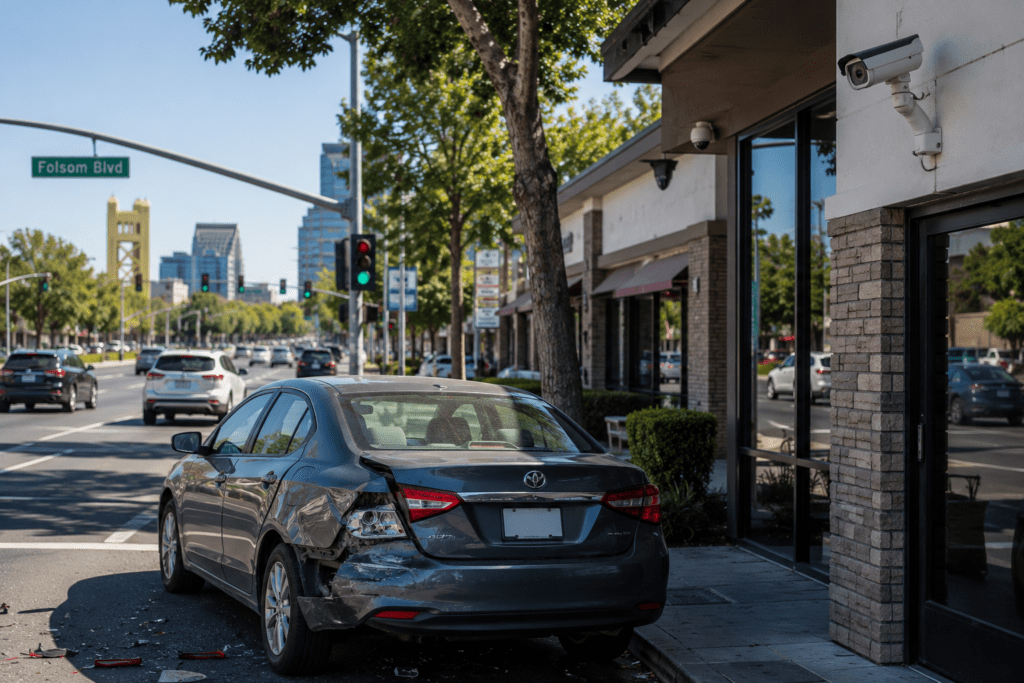
After ensuring everyone’s safety, take a moment to observe nearby businesses that may have surveillance systems. Restaurants, convenience stores, office buildings, apartment complexes, banks, hotels, shopping centers, and gas stations frequently operate exterior security cameras.
Photographing the locations of visible cameras may help investigators identify where valuable Sacramento hit and run surveillance footage could exist before recordings are automatically overwritten.
Preserve Your Own Evidence
Photograph vehicle damage, debris, skid marks, nearby traffic signals, lane markings, weather conditions, and the overall accident scene from multiple angles whenever it is safe to do so.
This documentation may later be compared with Sacramento hit and run surveillance footage, helping investigators understand how the physical evidence corresponds with what is visible on video recordings.
Frequently Asked Questions About Business Surveillance Cameras After a Hit-and-Run
Can business surveillance cameras identify a hit-and-run driver?
Sometimes. A Sacramento hit and run surveillance footage investigation may capture a license plate, vehicle description, direction of travel, or other identifying characteristics that assist investigators. Even when a camera does not record a complete license plate, footage from multiple nearby businesses may provide enough information to help identify the vehicle involved.
How long do businesses usually keep surveillance footage?
Every business uses different recording equipment and retention policies. Some systems automatically overwrite recordings after only a few days, while others store footage for several weeks. Because many systems recycle storage space automatically, a Sacramento hit and run surveillance footage investigation should begin as quickly as possible to improve the likelihood that recordings remain available.
Can surveillance footage prove who caused the accident?
Not by itself. Although Sacramento hit and run surveillance footage can provide valuable information about how a collision occurred, investigators generally compare video evidence with witness statements, police reports, roadway evidence, vehicle inspections, and photographs before reaching conclusions regarding liability.
What if no camera recorded the collision itself?
Even if the actual impact was not captured, nearby businesses may have recorded the vehicle entering or leaving the area. A Sacramento hit and run surveillance footage investigation often involves collecting video from multiple surrounding businesses to reconstruct the vehicle’s movements before and after the collision.
Should I tell police about nearby businesses with cameras?
Yes. If you notice nearby businesses with visible surveillance cameras, providing that information to responding law enforcement officers may help investigators identify potential sources of evidence before recordings are automatically overwritten.
A Sacramento hit and run surveillance footage investigation may provide valuable evidence that helps explain how a collision occurred and, in some cases, assists investigators in identifying a driver who left the scene. Business security cameras often record much more than the moment of impact. They may capture approaching traffic, nearby vehicles, traffic signal phases, pedestrian activity, and the suspect vehicle leaving the area immediately after the collision.
Although surveillance video can be extremely helpful, it represents only one part of a comprehensive investigation. Police reports, witness statements, photographs, roadway evidence, vehicle inspections, and medical documentation all contribute to understanding what happened. Reviewing these sources together frequently provides investigators with a more complete picture than relying on any single piece of evidence.
Because many commercial surveillance systems automatically overwrite older recordings, preserving available video as early as possible may improve the chances of retaining valuable evidence. Acting promptly, documenting the scene carefully, and identifying nearby businesses with cameras can all support the overall investigation following a hit-and-run collision.
Connect With Super Woman Super Lawyer
If you or someone you love has been injured in a hit-and-run accident, you may have questions about surveillance footage, insurance coverage, and the evidence available to investigate your claim. At Super Woman Super Lawyer, we help clients understand the types of documentation that may become important while guiding them through every stage of the claims process.
You can also learn more about our services by visiting our Sacramento Car Accident Lawyer page.
Connect with Super Woman Super Lawyer today.
Online Form: Request a case review
Call Now: 800.800.6916
Live Chat: Speak with a legal professional instantly
 Maryam Parman