A Sacramento e-bike accident driver turns across bike lane collision often happens in only a matter of seconds, yet the events leading up to the impact may become the focus of an extensive investigation afterward. Drivers sometimes report that they never saw the rider before beginning the turn, while bicyclists may believe they were clearly visible within the designated bike lane. Determining exactly what occurred frequently requires more than reviewing vehicle damage or reading a police report. Electronic bike data, photographs, roadway evidence, surveillance footage, and witness statements may all help investigators better understand how the collision developed.
At Super Woman Super Lawyer, we understand that e-bike accident investigations frequently involve both traditional collision evidence and newer forms of digital information generated by modern electric bicycles. A Sacramento e-bike accident driver turns across bike lane investigation may include GPS ride history, cycling applications, bike computer information, helmet camera footage, dashcam recordings, surveillance video, police reports, witness statements, roadway evidence, and photographs collected immediately after the collision. Looking at every available source together often provides a more complete understanding of how the accident occurred.
Sacramento has experienced significant growth in bicycle and e-bike transportation over the past several years. Riders regularly travel along J Street, Capitol Mall, Broadway, Freeport Boulevard, Folsom Boulevard, and the American River Parkway while using designated bicycle lanes, protected cycling facilities, and shared roadways. As more drivers and cyclists share the same intersections, collisions involving turning vehicles continue to present unique questions regarding visibility, right-of-way, and roadway positioning.
According to the National Highway Traffic Safety Administration (NHTSA), bicyclists remain among the most vulnerable roadway users because they have little physical protection during a collision with a motor vehicle. Preserving available evidence immediately after an accident may help investigators better understand how the crash occurred and what conditions existed before impact.
This article explains why a Sacramento e-bike accident driver turns across bike lane collision may be difficult to investigate, what electronic and physical evidence may become important, how turning-vehicle crashes are commonly evaluated, and why preserving documentation early may help create a more complete record of the collision.
Why Turning-Vehicle E-Bike Collisions Are Often Disputed
Many collisions between motor vehicles and e-bikes occur while a driver is making a left or right turn across a designated bicycle lane. Because both the driver and the rider are moving simultaneously, each person often has a different perspective regarding what happened immediately before impact.
A Sacramento e-bike accident driver turns across bike lane investigation frequently begins by examining where the rider was traveling, how the driver approached the turn, what traffic controls were present, and whether visibility was affected by surrounding conditions. Unlike rear-end collisions, where vehicle damage often tells a relatively straightforward story, turning collisions usually require investigators to compare multiple sources of evidence before reconstructing the sequence of events.
Because every intersection presents different traffic patterns, roadway design, and visibility conditions, investigators evaluate each collision individually rather than relying on assumptions.
Drivers Sometimes Report That They Never Saw the Rider
One of the most common issues in a Sacramento e-bike accident driver turns across bike lane investigation is a driver’s statement that the bicyclist was not visible before the turn began. This may occur for many reasons, including traffic congestion, visual obstructions, blind spots, changing traffic signals, or the presence of multiple vehicles approaching the intersection at the same time.
Investigators often compare these statements with surveillance footage, dashcam recordings, witness observations, roadway design, and the rider’s position within the bike lane. Looking at multiple sources together may help determine what each person could reasonably observe before the collision occurred.
Because visibility varies considerably from one intersection to another, no single factor typically explains every turning collision.
Bike Lane Position and Turning Movements Often Become Important
A Sacramento e-bike accident driver turns across bike lane investigation frequently includes reviewing where the rider was traveling relative to the marked bicycle lane, crosswalk, stop line, and intersection geometry. Investigators may compare roadway markings, photographs, surveillance footage, and physical evidence to better understand how the rider and vehicle approached the intersection.
Bike lane design also differs throughout Sacramento. Some intersections include protected bicycle lanes separated from traffic, while others transition into shared lanes, merge areas, or painted bike lanes before the intersection. These roadway differences often become relevant when investigators reconstruct vehicle and bicycle movements.
Questions About E-Bike Speed May Also Arise
Unlike traditional bicycles, electric bicycles provide pedal assistance that may affect travel speed depending on the class of e-bike, rider input, and roadway conditions. During a Sacramento e-bike accident driver turns across bike lane investigation, investigators may review electronic ride data, GPS history, bike computer information, or cycling applications when available to better understand the rider’s movements before the collision.
Electronic information does not determine fault by itself. Instead, investigators compare available ride data with surveillance footage, witness statements, roadway evidence, and photographs to evaluate how the collision developed.
Understanding how digital evidence can support an accident investigation has become increasingly important as connected transportation technology continues to evolve.
For additional guidance on preserving evidence immediately after a collision, read What to Do After a Car Accident in California: What Actually Matters. Many of the same evidence preservation principles discussed in that guide also apply following bicycle and e-bike accidents involving digital ride data and roadway evidence.
If you were injured while riding, our Sacramento Bicycle Accident Lawyer page explains how GPS records, bicycle data, surveillance footage, witness statements, and other forms of evidence may become important during the evaluation of a bicycle accident claim.
Bike and Device Evidence Riders Should Preserve
One of the most important aspects of a Sacramento e-bike accident driver turns across bike lane investigation is preserving available evidence before it changes or disappears. Unlike vehicle collisions where electronic data is often stored automatically, bicycle evidence may depend on maintaining the condition of the bicycle, electronic devices, and surrounding accident scene immediately after the collision.
Modern e-bikes often generate electronic information through onboard displays, mobile applications, GPS devices, and cycling computers. Combined with traditional evidence such as photographs, helmet damage, roadway markings, and witness statements, these records may help investigators better understand how the collision occurred.
E-Bike Display Data, GPS History, and Cycling App Records
Many modern electric bicycles include digital displays that record ride information such as speed, distance, battery status, trip duration, and other operating data. Some riders also use cycling applications or GPS devices that automatically document route history throughout the ride.
A Sacramento e-bike accident driver turns across bike lane investigation often begins by identifying what electronic information may have been recorded before the collision. Preserving available ride history early may improve the opportunity to compare digital records with photographs, surveillance footage, and other available evidence as the investigation progresses.
Scene Evidence That Can Help Reconstruct the Turn
A Sacramento e-bike accident driver turns across bike lane investigation rarely depends on electronic ride data alone. Although GPS history, cycling applications, and bike computers may provide valuable information, investigators generally compare those records with the physical evidence preserved at the collision scene. Roadway markings, vehicle damage, bicycle damage, debris, surveillance footage, and witness statements often help explain how the turning movement developed and where the rider was positioned before impact.
Because left-turn and right-turn collisions frequently occur within only a few seconds, preserving the scene before weather, traffic, or cleanup efforts alter the evidence may improve the overall investigation.
Photos of Bike Lane Markings, Turn Lanes, and Sightlines
Photographs taken immediately after a collision often become some of the most valuable evidence available. During a Sacramento e-bike accident driver turns across bike lane investigation, investigators may review photographs documenting bicycle lane markings, directional arrows, turn lanes, stop bars, crosswalks, traffic signals, and surrounding roadway conditions.
Visibility is another important factor. Trees, utility poles, parked vehicles, landscaping, construction barriers, or commercial signs may affect what a driver or rider could see before the collision. Photographing these conditions while they remain unchanged may help preserve important context that is no longer available once the roadway returns to normal traffic.
These photographs frequently complement electronic ride records by showing how the roadway actually appeared at the time of the collision.
Nearby Cameras, Dashcams, and Witness Statements
Many Sacramento intersections are surrounded by businesses, apartment buildings, parking garages, schools, and public facilities equipped with surveillance cameras. In addition, more drivers now operate vehicles equipped with dashcams that may record traffic conditions immediately before a collision.
A Sacramento e-bike accident driver turns across bike lane investigation may therefore include reviewing video from several different sources. Traffic approaching the intersection, the rider’s position within the bicycle lane, signal changes, and the turning movement itself may be visible from one or more cameras depending on the location.
Witness statements often provide additional context. Pedestrians, nearby cyclists, passengers, or motorists waiting at the intersection may have observed portions of the collision from angles not captured by cameras. Investigators frequently compare witness observations with available video to better understand the complete sequence of events.
Vehicle Damage, Bicycle Damage, Debris, and Final Resting Positions
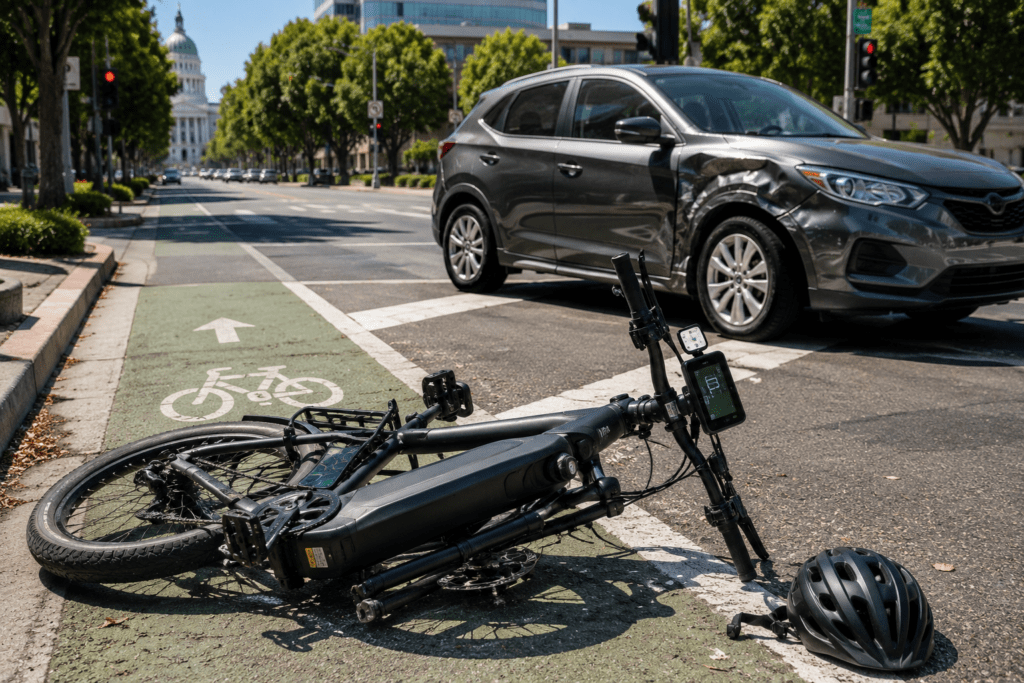
Physical evidence left behind after the collision often helps investigators evaluate how the impact occurred. During a Sacramento e-bike accident driver turns across bike lane investigation, investigators may examine damage to both the bicycle and the motor vehicle, the location of debris, scrape marks, damaged bicycle components, helmet damage, and where the rider and bicycle ultimately came to rest.
Rather than evaluating these items independently, investigators compare them with photographs, surveillance footage, GPS information, and witness statements. Looking at all available evidence together frequently provides a more complete understanding of the collision than relying on one source of information alone.
Understanding how multiple forms of evidence work together can also be helpful after any serious collision. Our article How Personal Injury Settlements Really Work in California explains why preserving photographs, medical documentation, witness statements, electronic records, and repair information often creates a stronger overall understanding of a personal injury claim.
Insurance Issues in Sacramento E-Bike Accident Claims
Insurance questions often arise soon after a collision involving an electric bicycle. A Sacramento e-bike accident driver turns across bike lane investigation may continue while insurance companies begin gathering photographs, medical records, witness information, repair estimates, and electronic evidence relating to the crash.
Because every collision presents different facts, insurance companies typically review multiple forms of evidence before evaluating the claim.
Attempts to Shift Fault Based on Speed or Visibility
One issue that sometimes develops during a Sacramento e-bike accident driver turns across bike lane investigation involves questions regarding rider speed or visibility. Drivers may report that they did not see the bicycle before beginning the turn or that the rider appeared unexpectedly within the intersection.
Investigators generally compare these statements with GPS information, bicycle data, surveillance footage, roadway evidence, and witness observations to better understand how the collision occurred. Looking at several independent sources often provides a more complete picture than relying on one person’s recollection alone.
Questions About Where the Rider Was Traveling Before Impact
Another issue that may arise involves the rider’s location immediately before the collision. A Sacramento e-bike accident driver turns across bike lane investigation may include reviewing whether the rider remained within the designated bicycle lane, entered a shared traffic lane, crossed an intersection, or was traveling through another marked area immediately before impact.
Photographs, roadway markings, surveillance footage, and electronic ride data frequently help investigators reconstruct these movements.
Settlement Discussions Before Device and Camera Evidence Is Reviewed
Electronic bicycle records, surveillance footage, dashcam recordings, and witness statements are not always immediately available following a collision. A Sacramento e-bike accident driver turns across bike lane investigation may therefore continue while additional evidence is still being gathered and reviewed.
Medical treatment may also continue throughout this period. Diagnostic imaging, follow-up appointments, specialist evaluations, and physical therapy often generate additional documentation as recovery progresses. If you’re recovering from injuries following a bicycle collision, you may also find Should You Accept a Car Accident Settlement Before Finishing Medical Treatment in Newport Beach? helpful for understanding why preserving medical documentation and completing treatment may become important before resolving a personal injury claim.
Frequently Asked Questions About E-Bike Turning Collisions
Why are turning-vehicle e-bike accidents often disputed?
A Sacramento e-bike accident driver turns across bike lane collision frequently involves different accounts of what happened immediately before impact. Drivers may report that they did not see the rider, while bicyclists may believe they were clearly visible within the designated bike lane. Investigators generally compare photographs, roadway markings, surveillance footage, electronic ride data, witness statements, and physical evidence before developing a complete understanding of how the collision occurred.
Can GPS or cycling app data become important after an e-bike accident?
Yes. Many modern e-bikes and cycling applications automatically record route history, trip duration, distance traveled, and other ride information. During a Sacramento e-bike accident driver turns across bike lane investigation, investigators may compare available GPS records with surveillance footage, witness statements, photographs, and roadway evidence to better understand the rider’s movements before the collision.
Does pedal-assist speed automatically determine fault?
No. A Sacramento e-bike accident driver turns across bike lane investigation evaluates many different forms of evidence rather than relying on speed information alone. Electronic ride data may provide valuable context, but investigators also consider roadway design, traffic controls, visibility, witness observations, physical evidence, and other documentation before evaluating how the collision occurred.
What evidence should riders preserve after an e-bike collision?
Following a Sacramento e-bike accident driver turns across bike lane collision, useful documentation may include photographs of the accident scene, bicycle damage, helmet damage, roadway markings, traffic signals, GPS ride history, cycling app records, witness information, police reports, and any available surveillance or dashcam footage. Preserving these records promptly may help document conditions before they change.
Why is documenting the scene quickly important?
Roadway evidence may disappear rapidly after a collision. Traffic, weather, cleanup efforts, and normal roadway use can alter or remove physical evidence within a short period of time. Maintaining photographs and preserving available electronic ride data following a Sacramento e-bike accident driver turns across bike lane collision may help ensure that investigators have access to the most complete documentation possible.
A Sacramento e-bike accident driver turns across bike lane collision often requires investigators to examine much more than vehicle damage or conflicting witness statements. Electronic ride data, GPS history, cycling applications, surveillance footage, dashcam recordings, roadway markings, photographs, and physical evidence may all contribute to understanding how the collision developed.
While digital bicycle records can provide valuable information, they represent only one component of a thorough investigation. Investigators generally compare electronic ride data with police reports, witness statements, photographs, roadway evidence, vehicle damage, bicycle inspections, and surveillance footage before developing conclusions regarding how the collision occurred. Looking at these sources together frequently provides a more complete understanding than relying on any single piece of evidence alone.
Because both electronic and physical evidence may change quickly after a collision, preserving available documentation promptly may improve the opportunity to review original information throughout the claims process. Whether the collision involves a traditional bicycle or a modern electric bicycle, maintaining organized records may become an important part of documenting the circumstances surrounding the accident.
Connect With Super Woman Super Lawyer
If you or someone you love has been injured in an e-bike collision, understanding what evidence may be available can feel overwhelming. At Super Woman Super Lawyer, we help clients understand how GPS records, bicycle data, surveillance footage, witness statements, roadway evidence, and other documentation may become important during the evaluation of a personal injury claim.
You can also learn more about our services by visiting our Sacramento Bicycle Accident Lawyer page.
Connect with Super Woman Super Lawyer today.
Online Form: Request a case review
Call Now: 800.800.6916
Live Chat: Speak with a legal professional instantly
 Maryam Parman