A Riverside chain reaction car accident fault investigation often becomes more complicated than a collision involving only two vehicles. Chain-reaction crashes may unfold in only a few seconds, yet involve three, four, or even several more vehicles striking one another in rapid succession. Drivers frequently remember different portions of the accident depending on where they were positioned in traffic, and each person may have a different explanation regarding which impact occurred first. As a result, investigators often rely on photographs, police reports, witness statements, vehicle damage, surveillance footage, and other evidence to better understand how the sequence of collisions developed.
At Super Woman Super Lawyer, we understand that multi-vehicle collisions frequently generate conflicting accounts of what happened. A Riverside chain reaction car accident fault investigation may include police report diagrams, photographs, witness interviews, Event Data Recorder (EDR) information, dashcam recordings, surveillance footage, roadway evidence, insurance correspondence, and vehicle inspections. Looking at all available evidence together often provides investigators with a more complete understanding of the collision than relying on any one driver’s recollection alone.
Chain-reaction collisions occur throughout Riverside every day, particularly along Interstate 215, State Route 91, Interstate 60, Van Buren Boulevard, Magnolia Avenue, University Avenue, and other heavily traveled roadways. Heavy commuter traffic, sudden congestion, construction zones, weather conditions, and limited visibility may all contribute to crashes involving multiple vehicles. Because each impact may influence the next, determining how the collision unfolded often requires careful review of both physical and electronic evidence.
According to the National Highway Traffic Safety Administration (NHTSA), rear-end and multi-vehicle collisions remain among the most common crash types nationwide. Thoroughly documenting roadway evidence, vehicle damage, witness information, and electronic records may help investigators better understand how a chain-reaction collision occurred.
This article explains why Riverside chain reaction car accident fault investigations often become disputed, what evidence may help reconstruct the sequence of impacts, what insurance issues commonly arise after multi-vehicle collisions, and why maintaining organized documentation may become important throughout the claims process.
Why Chain-Reaction Crashes Can Lead to Conflicting Fault Stories
Unlike a two-vehicle collision, a chain-reaction accident often involves several separate impacts occurring almost simultaneously. Drivers positioned at the front, middle, and rear of the collision frequently experience different events and may not observe how the initial impact occurred. Some drivers may only feel the final collision, while others witness only part of the sequence before their own vehicle is struck.
A Riverside chain reaction car accident fault investigation frequently begins by determining the order in which impacts occurred. Investigators compare photographs, roadway evidence, witness statements, police reports, and vehicle damage patterns to better understand how the collision developed before evaluating the available evidence as a whole.
Because every chain-reaction collision unfolds differently, investigators examine each accident individually rather than assuming responsibility based solely on the final resting positions of the vehicles.
Drivers Giving Different Versions of the Sequence of Impacts
One of the most common challenges following a multi-vehicle collision is that each driver often remembers different details. A driver at the front of the chain may describe being struck from behind without seeing the initial impact. A driver farther back may report sudden braking, another vehicle changing lanes, or traffic stopping unexpectedly.
A Riverside chain reaction car accident fault investigation frequently compares these different accounts with physical evidence, police reports, surveillance footage, dashcam recordings, and witness observations. Looking at multiple independent sources often helps investigators establish a more complete timeline than relying on one person’s recollection alone.
Differences in memory are common because each driver experiences the collision from a different location within the chain of events.
Disputes About Who Hit Whom First
Questions regarding which vehicle initiated the chain reaction often become central to the investigation. During a Riverside chain reaction car accident fault review, investigators may examine vehicle damage, debris fields, roadway markings, and available video evidence to determine whether one impact caused several additional collisions.
Because multiple impacts may occur within only moments of one another, photographs alone do not always explain the entire sequence. Investigators frequently compare physical evidence with witness statements and electronic documentation to better understand how each vehicle became involved.
Every chain-reaction collision presents unique circumstances, making careful documentation especially important.
Why Final Vehicle Positions May Not Tell the Whole Story
Many people assume that the positions where vehicles come to rest after a collision accurately reflect how the accident occurred. In reality, chain-reaction crashes often continue after the initial impact. Vehicles may be pushed into additional lanes, rotate after secondary impacts, or come to rest far from where the first collision occurred.
A Riverside chain reaction car accident fault investigation therefore evaluates much more than the vehicles’ final locations. Investigators may compare roadway evidence, debris patterns, surveillance footage, police report diagrams, witness statements, and vehicle damage to reconstruct the complete sequence of events rather than relying only on where each vehicle stopped.
For additional guidance on preserving important evidence immediately after a collision, read What to Do After a Car Accident in California: What Actually Matters. Many of the same documentation principles discussed in that guide also apply following chain-reaction collisions involving multiple drivers and several insurance companies.
If you were injured in a multi-vehicle collision, our Riverside Car Accident Lawyer page explains how police reports, vehicle inspections, surveillance footage, witness statements, and other evidence may become important during the evaluation of a personal injury claim.
Evidence That Can Help Reconstruct a Multi-Vehicle Collision
A Riverside chain reaction car accident fault investigation often depends on gathering as much physical and electronic evidence as possible before conditions change. Traffic resumes quickly after most collisions, vehicles are removed from the roadway, and weather or cleanup efforts may alter important evidence. Documenting the scene early frequently provides investigators with valuable information while conditions remain substantially unchanged.
Vehicle Damage Patterns, Debris Fields, and Resting Positions
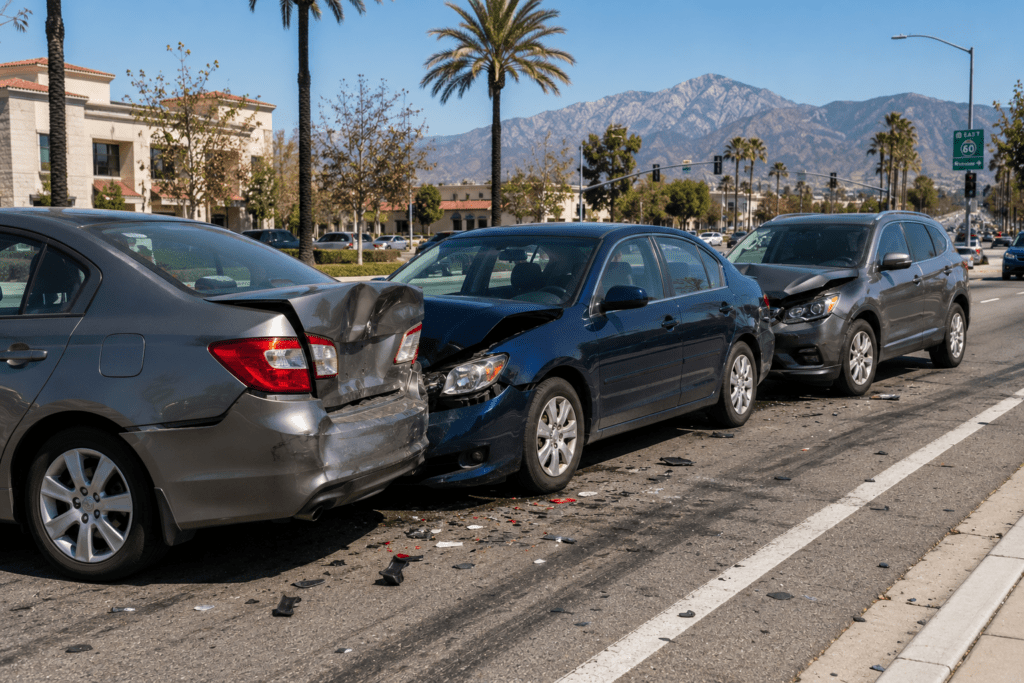
One of the first areas investigators often examine involves vehicle damage and the location of debris throughout the roadway. Different impact points, crushed body panels, broken lighting components, glass fragments, and vehicle fluids may all help investigators better understand how the sequence of collisions unfolded.
A Riverside chain reaction car accident fault investigation commonly begins by comparing vehicle damage patterns with photographs, roadway evidence, police reports, and witness statements before reconstructing the overall sequence of impacts.
Evidence That Can Help Reconstruct a Multi-Vehicle Collision
A Riverside chain reaction car accident fault investigation often depends on preserving both physical and electronic evidence before the collision scene changes. Vehicles are typically moved to restore traffic flow, debris is cleared from the roadway, weather conditions may alter physical evidence, and surveillance recordings may eventually be overwritten. Documenting the collision scene as early as reasonably possible may help investigators compare multiple sources of evidence while conditions remain substantially unchanged.
Unlike many two-vehicle accidents, chain-reaction collisions often require investigators to reconstruct several separate impacts occurring within only a few moments. Vehicle damage, roadway evidence, photographs, witness statements, and digital recordings frequently work together to establish a more complete sequence of events.
Vehicle Damage Patterns, Debris Fields, and Resting Positions
One of the first areas investigators frequently evaluate involves the physical evidence left behind by the collision. A Riverside chain reaction car accident fault investigation often includes reviewing damage to every vehicle involved, identifying debris fields, documenting roadway markings, and recording where each vehicle ultimately came to rest.
Damage patterns sometimes help investigators understand the order in which impacts occurred. Investigators may compare crushed body panels, broken lighting components, detached vehicle parts, shattered glass, roadway debris, and scrape marks with photographs and police reports to better understand how the collision unfolded.
Because multiple impacts may occur in rapid succession, physical evidence is generally evaluated together with witness statements and electronic documentation rather than independently.
Police Report Diagrams, Driver Statements, and Witness Names
Law enforcement officers responding to multi-vehicle collisions often prepare diagrams illustrating vehicle positions, roadway layout, traffic controls, and the reported sequence of events. Although these diagrams do not always capture every detail of the collision, they frequently provide investigators with an initial framework for understanding the accident scene.
A Riverside chain reaction car accident fault investigation may compare police report diagrams with driver statements, passenger accounts, independent witness observations, photographs, and roadway evidence. Investigators often evaluate where each person was positioned before the collision and whether different observations can be reconciled using the available physical evidence.
Witness information may become especially valuable when drivers remember only portions of the chain reaction or were unable to observe the initial impact.
Dashcams, Traffic Cameras, and Nearby Business Footage
Electronic video evidence has become increasingly important during multi-vehicle accident investigations. Traffic monitoring cameras, nearby business surveillance systems, residential security cameras, and privately owned dashcams may each capture different portions of the same collision.
A Riverside chain reaction car accident fault investigation frequently includes reviewing multiple recordings from different perspectives. One camera may capture the first impact, while another records secondary collisions farther along the roadway. Dashcams may preserve braking activity, traffic flow, lane changes, or other events occurring immediately before the crash.
Comparing several video sources together often helps investigators develop a more complete timeline than relying solely on photographs or witness recollections.
Understanding how different forms of evidence work together can also be helpful following any serious collision. Our article How Personal Injury Settlements Really Work in California explains why preserving photographs, medical documentation, witness statements, repair records, and electronic evidence frequently provides a stronger understanding of a personal injury claim.
Insurance Problems Injured Drivers May Encounter
Insurance questions often become more complicated following a multi-vehicle collision because several drivers, several insurance companies, and multiple versions of events may all be involved at the same time. A Riverside chain reaction car accident fault investigation frequently continues while adjusters gather documentation, review available evidence, and communicate with everyone involved in the collision.
Because each insurance company conducts its own evaluation, maintaining organized records throughout the process may help injured individuals better understand what information has been requested and what documentation has already been submitted.
Multiple Adjusters Calling About the Same Collision
Following a chain-reaction collision, injured drivers sometimes receive communications from more than one insurance company. Different adjusters may request police reports, photographs, repair estimates, medical documentation, witness information, or recorded statements while reviewing different aspects of the accident.
A Riverside chain reaction car accident fault claim often involves maintaining organized records of these communications, including claim numbers, adjuster contact information, letters, emails, and requests for additional documentation.
Keeping these materials together may make it easier to track the progression of the claim while several insurance companies continue their investigations.
Delays When Insurance Companies Disagree About Fault
Because chain-reaction collisions involve several drivers and multiple impacts, insurance companies sometimes require additional time to review the available evidence before reaching conclusions regarding how the collision occurred.
A Riverside chain reaction car accident fault investigation may continue while adjusters review police reports, witness statements, surveillance footage, dashcam recordings, vehicle inspections, roadway evidence, and repair documentation. Additional information may become available over time as investigators gather more evidence from the collision scene.
Maintaining organized documentation during this period may help injured individuals keep track of ongoing communications while the investigation continues.
Recorded Statement Requests Before the Crash Sequence Is Clear
Insurance companies sometimes request recorded statements shortly after a collision, even while investigators are still evaluating how the sequence of impacts developed.
A Riverside chain reaction car accident fault investigation may therefore continue alongside requests for photographs, repair estimates, medical records, police reports, and other documentation. Medical treatment may also continue throughout this period as additional injuries become apparent and physicians complete follow-up evaluations.
If you’re continuing treatment following a multi-vehicle collision, you may also find Should You Accept a Car Accident Settlement Before Finishing Medical Treatment in Newport Beach? helpful for understanding why preserving medical documentation and completing treatment may become important before resolving a personal injury claim.
Frequently Asked Questions About Chain-Reaction Car Accidents
Why are chain-reaction car accidents often more difficult to investigate?
A Riverside chain reaction car accident fault investigation often involves several separate impacts occurring within only a few seconds. Drivers positioned at different locations within the collision may remember different portions of the event, while vehicle damage alone may not clearly identify the sequence of impacts. Investigators generally compare police reports, photographs, witness statements, surveillance footage, dashcam recordings, and roadway evidence before developing a complete understanding of the collision.
What evidence is most helpful after a multi-vehicle collision?
A Riverside chain reaction car accident fault investigation often benefits from preserving photographs of vehicle damage, debris fields, roadway markings, police report information, witness names, dashcam footage, surveillance recordings, and traffic camera video when available. Together, these sources frequently provide investigators with a more complete understanding of how the collision developed.
Why might several insurance companies contact me?
Because multiple drivers are often involved in a chain-reaction collision, several insurance companies may conduct independent reviews of the accident. A Riverside chain reaction car accident fault claim may involve requests for police reports, photographs, medical records, repair estimates, or recorded statements from different adjusters while each insurer evaluates the available evidence.
Does the first vehicle struck automatically determine fault?
Not necessarily. A Riverside chain reaction car accident fault investigation evaluates many different forms of evidence rather than relying only on the order in which vehicles came to rest. Investigators generally compare physical evidence, witness statements, surveillance footage, dashcam recordings, roadway conditions, and police reports before determining how the sequence of impacts developed.
Why is it important to organize medical and financial records?
Medical documentation, repair estimates, rental vehicle receipts, employment records, and out-of-pocket expenses often continue accumulating throughout recovery. Maintaining organized records during a Riverside chain reaction car accident fault claim may make it easier to track treatment, expenses, insurance communications, and other documentation as the investigation progresses.
Medical and Financial Records to Keep Consistent
Following a multi-vehicle collision, documentation often continues developing long after the vehicles have been removed from the roadway. A Riverside chain reaction car accident fault investigation frequently includes not only accident-related evidence, but also medical records, repair invoices, insurance correspondence, employment documentation, and other records generated throughout recovery.
Keeping these materials organized may help create a more complete timeline while treatment and insurance reviews continue.
Emergency Care, Follow-Up Treatment, and Specialist Referrals
Medical treatment often begins with emergency room evaluations but may continue through follow-up appointments, diagnostic imaging, physical therapy, orthopedic consultations, pain management, or other specialist care depending on the injuries sustained.
A Riverside chain reaction car accident fault claim may therefore include preserving emergency medical records together with physician notes, imaging reports, therapy documentation, and specialist evaluations. Organizing these records chronologically often provides a clearer picture of the progression of treatment.
Repair Costs, Rental Issues, Missed Work, and Out-of-Pocket Expenses
In addition to medical documentation, many individuals maintain records relating to vehicle repairs, rental transportation, towing charges, prescription costs, employment absences, and other accident-related expenses.
A Riverside chain reaction car accident fault file frequently includes repair estimates, invoices, rental agreements, payroll records, employer correspondence, receipts, and insurance communications documenting these financial impacts as recovery continues.
Symptom Timelines Connecting Injuries to the Collision
Some injuries become more noticeable after the initial shock of the accident has passed. Maintaining a timeline of symptoms, medical appointments, treatment recommendations, and changes in daily activities may help organize the overall recovery process.
A Riverside chain reaction car accident fault investigation often benefits from preserving medical documentation consistently throughout treatment while maintaining records of how symptoms develop over time.
A Riverside chain reaction car accident fault investigation often requires far more documentation than a typical two-vehicle collision. Multiple drivers, several impacts, differing witness accounts, and several insurance companies may all contribute to a more complicated investigation. Police reports, vehicle damage, roadway evidence, witness statements, surveillance footage, dashcam recordings, and medical documentation frequently work together to help investigators reconstruct the sequence of events.
Because evidence may change quickly after a chain-reaction collision, preserving available documentation as early as reasonably possible may improve the opportunity to review original photographs, physical evidence, electronic recordings, and medical records while they remain available. Looking at these sources together often provides a more complete understanding than relying on any one form of evidence alone.
Whether the collision involved three vehicles or many more, maintaining organized records throughout the investigation and recovery process may help ensure that important documentation remains available as insurance companies continue evaluating the claim.
Connect With Super Woman Super Lawyer
If you or someone you love has been injured in a multi-vehicle collision, understanding how evidence, insurance reviews, and documentation work together can feel overwhelming. At Super Woman Super Lawyer, we help clients understand how police reports, vehicle inspections, medical records, witness statements, photographs, surveillance footage, and other evidence may become important during the evaluation of a personal injury claim.
You can also learn more about our services by visiting our Riverside Car Accident Lawyer page.
Online Form: Request a case review
Call Now: 800.800.6916
Live Chat: Speak with a legal professional instantly
 Maryam Parman