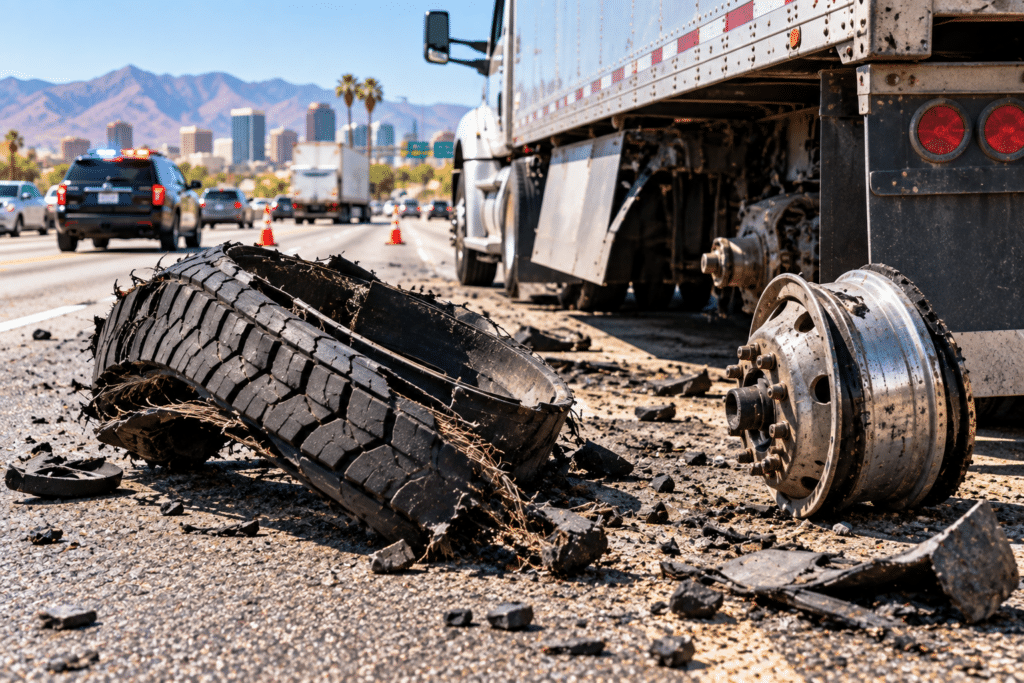
A Phoenix truck tire accident involving detached tread or wheel separation can create an evidence-preservation problem almost immediately. Pieces of tire, a wheel, rim components, fasteners, or other equipment may be scattered across several lanes. Traffic may continue moving around the scene, emergency crews may clear debris, the commercial truck may be towed, and the trucking company or its insurer may begin investigating before an injured motorist understands what evidence exists. Once those components are moved, discarded, repaired, or returned to service, reconstructing the equipment failure can become considerably more difficult.
The physical evidence can be especially important because not every Phoenix truck tire accident involving a tire or wheel occurs for the same reason. Investigators may need to consider tire condition, inflation, tread, wheel and rim components, installation history, maintenance, inspection records, roadway impact, loading, and other facts. A detached piece of tread does not, by itself, establish why the separation occurred, just as finding a wheel away from the truck does not automatically identify which person or company was responsible.
Federal commercial motor vehicle regulations provide important context. The Federal Motor Carrier Safety Administration’s tire requirements state that tires on commercial motor vehicles must meet safety standards concerning matters such as inflation, load restrictions, and specified defects. FMCSA also requires motor carriers to systematically inspect, repair, and maintain commercial vehicles under their control and keep parts and accessories in safe operating condition.
That regulatory framework can make company records particularly relevant after a Phoenix truck tire accident. Tire purchase and installation history, inspection records, maintenance documentation, driver-reported problems, vendor records, tractor and trailer ownership, and repair history may help establish what happened before the equipment separated. Federal rules also specifically identify tires, wheels, and rims among equipment drivers should be satisfied is in good working order before operating a commercial vehicle.
If you or someone you love was injured in a commercial truck collision, our Phoenix Truck Accident Lawyer page provides additional information about how Super Woman Super Lawyer can evaluate commercial vehicle evidence, company records, insurance issues, and injury documentation.
Connect with Super Woman Super Lawyer today through our Online Form, call 800.800.6916, or start a Live Chat. Following a Phoenix truck tire accident, preserving detached components, photographs, video, truck records, and electronic evidence early may help prevent important information from disappearing while the vehicles are being cleared and repaired.
Physical Evidence to Preserve After a Tire or Wheel Failure
Physical evidence may be at the center of a Phoenix truck tire accident investigation. A tire or wheel assembly contains multiple components, and the condition of those components may help qualified professionals evaluate what happened. Roadway debris can also document where separation occurred and how the equipment interacted with surrounding traffic.
The goal is preservation, not amateur diagnosis. An injured motorist should not attempt to collect dangerous debris from an active freeway or inspect a commercial truck mechanically. Photographs, law enforcement documentation, towing information, and appropriate professional inspection can preserve evidence without creating another safety risk.
Detached Tread, Tire Carcass, Wheel, Rim, and Related Components
A tire-tread separation can leave pieces of rubber at the scene while the remaining tire stays attached to the truck. Other incidents may involve the tire carcass, wheel, rim, hub-related components, or other equipment. A Phoenix truck tire accident involving a complete wheel separation can therefore create a different evidence pattern from one involving only detached tread.
When safe and appropriate, photographs should show the component where it came to rest before it is moved. Wider photographs can document its position relative to the roadway and truck, while closer images preserve visible condition.
If law enforcement, a tow company, trucking company, or another organization takes possession of detached equipment, identifying who has custody may become important. The component itself could later be inspected by an appropriately qualified professional.
FMCSA’s commercial tire rules address conditions under which tires may not be used on motor vehicles, while its broader maintenance regulations require carriers to keep equipment under their control properly maintained. A Phoenix truck tire accident investigation may therefore compare the physical component with inspection and maintenance records rather than treating either category of evidence in isolation.
Roadway Debris, Tire Marks, and Vehicle Damage
A separated tread or wheel can create several impacts. The component may strike another vehicle directly, cause a driver to swerve, damage the truck itself, or create a chain reaction involving multiple motorists.
After a Phoenix truck tire accident, roadway evidence may include pieces of rubber, metal components, scrape marks, tire marks, damaged barriers, fluid, or debris from other vehicles. Final vehicle positions may also help establish how drivers reacted after the failure.
Photographs should capture the broader scene whenever it can be done safely. A close-up of a piece of tire may show its condition, but a wider photograph showing where it landed relative to traffic lanes can provide additional context.
Damage to the injured person’s vehicle should also be documented before repair. If tread or a wheel struck the vehicle, impact marks may help establish the path of the detached equipment. If the driver crashed while avoiding debris, damage and roadway evidence may help reconstruct that sequence instead.
Photos and Video Before the Crash Scene Is Cleared
Phoenix freeways and major roads cannot remain blocked indefinitely while every potential piece of evidence is documented. Emergency responders and tow operators may need to clear lanes quickly for safety and traffic flow.
That makes early photographs and video especially valuable after a Phoenix truck tire accident. Images may preserve the semi-truck’s position, detached equipment, tire condition, trailer, roadway debris, damaged vehicles, lane markings, barriers, and final resting positions.
Video can add movement and timing. Dashcams, commercial truck cameras, nearby business systems, traffic cameras, or recordings from other motorists may show when the equipment separated and how surrounding drivers reacted.
Potential video sources should be identified promptly. Some systems overwrite recordings automatically. A practical evidence-preservation deadline may therefore be measured in days or weeks even though the legal filing deadline is much longer.
Truck Maintenance Records That May Need Review
A Phoenix truck tire accident involving equipment failure may require looking backward from the collision to determine how the tire, wheel, or related components were maintained before the trip.
Federal regulations require motor carriers to systematically inspect, repair, and maintain commercial motor vehicles under their control, and FMCSA states that parts and accessories must remain in safe and proper operating condition. The agency specifically identifies wheels and rims among components affecting safe operation.
The existence of maintenance requirements does not mean every tire failure proves a violation. The actual records and equipment must be reviewed.
Tire Purchase, Installation, Rotation, and Replacement History
Tire records may identify when a tire was purchased, installed, rotated, serviced, repaired, or replaced. Depending on the trucking operation, documentation may come from the motor carrier, fleet maintenance department, tire vendor, roadside service provider, leasing company, or another business.
A Phoenix truck tire accident file may therefore need records from more than one company. An invoice from a tire vendor could establish installation information, while carrier maintenance records document later inspections.
The exact tire should also be identified when possible. Tractor and trailer combinations contain numerous tires, and determining which position experienced the failure may be important. Vehicle identification, tire position, photographs, service records, and physical inspection can help connect records to the relevant equipment.
Prior complaints may also matter. If a driver previously reported vibration, pressure loss, visible damage, or another tire or wheel issue, those communications may help establish what was known before the Phoenix truck tire accident.
Pre-Trip Inspections and Driver-Reported Problems
Commercial drivers have responsibilities relating to vehicle condition before operation. FMCSA guidance on 49 CFR §§ 392.7–392.9 states that a vehicle may not be driven unless the driver is satisfied that specified parts and accessories are in good working order, expressly including tires, wheels, and rims.
A Phoenix truck tire accident investigation may therefore examine available pre-trip inspection documentation and driver communications. The specific records that exist depend on the carrier and applicable reporting requirements.
Driver-reported problems can appear in inspection records, maintenance requests, electronic fleet systems, text messages, dispatch communications, or other company documentation. A reported defect may lead to a repair record, while repeated complaints could create a longer history.
The evidence should be evaluated carefully. The absence of a recorded problem does not automatically prove that no defect existed, and the presence of an earlier maintenance entry does not automatically prove that it caused the later collision.
Maintenance, Repair, and Out-of-Service Records
Maintenance records can provide a broader history of the tractor and trailer. FMCSA requires systematic inspection, repair, and maintenance of commercial motor vehicles subject to its rules. Required records for covered vehicles can include identifying information and documentation showing maintenance operations performed.
A Phoenix truck tire accident investigation may look for work involving tires, wheels, rims, hubs, axles, suspension, or related systems when relevant to the failure being investigated.
Out-of-service or roadside inspection history may provide additional context when available. A prior inspection involving the same vehicle or equipment could identify conditions that were addressed before the collision.
These records should not be treated as interchangeable. A repair invoice shows work performed. An inspection report records observations at a particular time. A maintenance schedule shows planned service. Comparing the documents can help qualified investigators understand the equipment history more accurately.
Companies That May Be Connected to the Equipment
A semi-truck on a Phoenix highway may involve several companies even when only one name appears prominently on the cab. The motor carrier may not own the tractor. The trailer may belong to another company. Tires may be supplied or serviced by a vendor. Maintenance may be outsourced. Equipment may be leased.
A Phoenix truck tire accident investigation should identify these relationships rather than assuming the driver and carrier are the only relevant parties.
Motor Carrier, Tractor Owner, and Trailer Owner
The motor carrier operating the trip can be an important source of records concerning the driver, dispatch, maintenance, inspections, and trip. Ownership documents may separately identify who owns the tractor and trailer.
These distinctions matter because different entities may control different records or equipment. A tractor owner may maintain one set of service documents, while the carrier possesses driver communications and dispatch information.
FMCSA maintenance guidance recognizes that carriers may control vehicles they do not own and requires maintenance records for covered vehicles to identify the party providing or leasing the vehicle when applicable.
For a Phoenix truck tire accident, photographs of company names, USDOT information, license plates, tractor numbers, trailer numbers, and other identifying markings can help connect the physical vehicles to the appropriate records.
Maintenance Provider, Tire Vendor, or Leasing Company
Outsourced maintenance can add another layer. A carrier may rely on a third-party shop for routine service, a national tire vendor for replacement and roadside assistance, or a leasing company for equipment maintenance.
A Phoenix truck tire accident involving tread or wheel separation may therefore require records from a company that was not physically present at the collision.
Vendor invoices can potentially identify the tire installed, date of service, work performed, and vehicle involved. Maintenance providers may possess inspection or repair records. Leasing companies may have separate service schedules and equipment histories.
Identifying these relationships early can matter because each organization may have its own record-retention practices. A preservation request directed only to the motor carrier may not reach every business possessing relevant evidence.
Commercial Insurance Policies Connected to the Trip
Commercial truck collisions may involve multiple insurance policies depending on the carrier, equipment ownership, contractual relationships, and vehicles involved.
A Phoenix truck tire accident file should therefore keep insurance communications organized by carrier and claim number. The injured person may hear from a trucking company’s insurer, another vehicle’s carrier, a third-party administrator, or other insurance representatives.
The existence of several potentially relevant businesses does not mean each is legally responsible or each policy provides coverage. Those questions depend on the facts, contracts, policies, and applicable law.
Early insurance communications can also occur while physical and company evidence is still being collected. Preserving letters, emails, claim information, recorded-statement requests, and settlement correspondence can help maintain a clear chronology.
Reconstructing the Crash After Equipment Failure
Determining that a tire or wheel separated is only one part of reconstructing a Phoenix truck tire accident. Investigators may also need to understand what happened to the truck immediately afterward and how surrounding motorists reacted.
A tire failure may cause the truck to change direction, shed debris, strike another vehicle, or continue moving while other drivers attempt evasive maneuvers. A detached wheel may travel independently across lanes. The resulting crash can therefore involve several distinct movements.
Truck Movement Before and After the Separation
The truck’s path may help establish when the failure occurred and what effect it had on vehicle control. Roadway marks, truck damage, debris location, dashcam footage, witness accounts, and final positions may provide useful evidence.
For a Phoenix truck tire accident, investigators may examine whether the truck remained in its lane, moved toward another lane or shoulder, struck a barrier, or stopped some distance beyond the initial failure.
The location of detached tread or a wheel can also be compared with the truck’s path. A component found behind the truck may help establish one part of the sequence, while debris distributed over a larger area could indicate multiple contacts.
Crash reconstruction should be performed by appropriately qualified professionals when technical analysis is necessary. Photographs and records preserve the underlying evidence; they do not automatically answer every reconstruction question.
Dashcams, Telematics, Witnesses, and Driver Communications
Commercial trucks may generate substantial electronic evidence. Dashcams can capture the roadway. Telematics may record information about vehicle movement or operation depending on the system. Dispatch platforms can preserve communications between the driver and company.
A Phoenix truck tire accident may also be captured by another motorist’s dashcam. Witnesses may describe seeing tread detach, a wheel leave the truck, the truck move suddenly, or drivers take evasive action.
Driver communications can be particularly relevant if equipment concerns were discussed before the collision or immediately afterward. Dispatch messages, electronic logs, calls, maintenance requests, or other company systems may contain relevant information.
Electronic records can have retention limits. Identifying and preserving potential sources early may therefore be as important as photographing physical debris.
Injury Records and Early Contact From Commercial Insurers
While equipment evidence is being investigated, injured motorists may simultaneously be receiving medical treatment and calls from commercial insurers.
A Phoenix truck tire accident injury file should preserve emergency treatment, imaging, physician evaluations, specialist care, therapy, medications, and other medical documentation appropriate to the injuries. Medical diagnoses should come from qualified healthcare professionals.
Employment records may separately document missed work, reduced hours, or other financial effects. Vehicle damage, towing, rental expenses, and out-of-pocket costs should also be preserved.
Commercial insurers or investigators may contact injured people early. Before providing a recorded statement or signing documents, it is useful to identify who is requesting the information and which company or policy that person represents.
Arizona uses a comparative negligence system. Under Arizona Revised Statutes § 12-2505, a claimant’s damages can generally be reduced according to the claimant’s relative degree of fault when comparative negligence applies. The application of Arizona fault law to a particular Phoenix truck tire accident depends on the actual evidence and claims involved.
Legal Deadline Versus Evidence Preservation After a Phoenix Truck Tire Accident
Arizona law generally provides a two-year limitations period for actions involving personal injury, subject to exceptions and circumstances that can affect a particular claim. Arizona Revised Statutes § 12-542 addresses the limitations period for personal injury and certain related actions. A general article cannot determine the exact deadline for an individual case.
The evidence-preservation timeline after a Phoenix truck tire accident can be dramatically shorter. Detached tread can be discarded. A damaged tire can be replaced. A wheel assembly can be repaired. The tractor or trailer can return to service. Dashcam footage can be overwritten, and electronic fleet records may be subject to retention practices.
That is why the legal filing deadline should not be treated as permission to delay evidence preservation. A component that exists today may no longer exist in the same condition months from now.
Federal maintenance requirements also mean records may exist concerning the vehicle’s inspection and repair history. FMCSA requires carriers to systematically inspect, repair, and maintain covered commercial vehicles and maintain specified records for covered equipment.
Serving People Injured in Commercial Truck Accidents Throughout Phoenix
Phoenix has a major commercial transportation network connecting Interstate 10, Interstate 17, U.S. 60, Loop 101, Loop 202, State Route 51, industrial areas, distribution facilities, and routes carrying commercial traffic throughout the metropolitan area. Tire or wheel failure on a high-speed freeway can create risks extending far beyond the truck itself because detached components and evasive maneuvers may affect vehicles across several lanes.
A Phoenix truck tire accident should nevertheless be evaluated from its specific evidence rather than assumptions about commercial trucks generally. The tire or wheel component, roadway debris, truck maintenance history, driver inspections, carrier records, vendor documentation, dashcams, telematics, witnesses, and vehicle damage may each answer a different question.
The trucking company’s records may also identify other businesses connected to the equipment. Tractor ownership, trailer ownership, maintenance providers, tire vendors, leasing arrangements, and insurance relationships can all affect where evidence is located.
Super Woman Super Lawyer can evaluate these records together with medical documentation and financial losses. For additional information about representation after a commercial vehicle collision, visit our Phoenix Truck Accident Lawyer page.
Frequently Asked Questions About a Phoenix Truck Tire Accident
What should be preserved after a semi-truck tire separates?
When safely possible, identify and document the detached tread, tire carcass, wheel, rim, debris, truck, damaged vehicles, roadway marks, and final vehicle positions. A Phoenix truck tire accident may also require preservation of maintenance records, inspection documentation, video, telematics, and driver communications.
Should detached tire tread be saved?
Potentially. The physical component may contain information relevant to how the failure occurred. An injured motorist should not enter traffic to retrieve debris, but investigators may need to determine who took custody of the tread or tire after the Phoenix truck tire accident.
What if an entire wheel separated from the truck?
Preserve information about the wheel, rim, hub-related components, roadway position, and resulting damage. A wheel separation may involve different physical and maintenance questions from tread separation, so the components should not be treated as interchangeable.
Do federal regulations address commercial truck tires?
Yes. FMCSA’s commercial motor vehicle rules include tire safety requirements under 49 CFR § 393.75, and the agency’s guidance addresses inflation, load restrictions, and specified tire defects.
Do trucking companies have to maintain their vehicles?
FMCSA requires motor carriers to systematically inspect, repair, and maintain commercial vehicles under their control and keep parts and accessories in safe operating condition. The application of those requirements to a Phoenix truck tire accident depends on the carrier and equipment involved.
Are drivers expected to check tires before driving?
FMCSA guidance concerning equipment inspection states that drivers must be satisfied that specified parts and accessories—including tires, wheels, and rims—are in good working order before operation. Available inspection and driver-reporting records may therefore become relevant.
What maintenance records may matter?
Potential records include tire purchase and installation history, rotation or replacement records, inspection documentation, repair invoices, driver-reported defects, roadside service records, and broader tractor or trailer maintenance files.
Why does trailer ownership matter?
The tractor and trailer may belong to different companies. If the failed tire or wheel was on the trailer, the trailer owner, carrier, leasing company, or maintenance provider may possess relevant records. A Phoenix truck tire accident investigation should identify the actual equipment relationships.
Can a tire vendor’s records become important?
Yes. A tire vendor may have records showing installation, replacement, repair, roadside service, or other work. Whether those records are relevant depends on the tire and services involved.
Can dashcam footage show a tire failure?
Potentially. Truck dashcams, other motorists’ cameras, or surveillance may capture the separation, debris, truck movement, or surrounding drivers’ reactions. Video should be identified promptly because recordings may be overwritten.
What is truck telematics?
Telematics generally refers to electronic systems that can collect or transmit vehicle and fleet information. The specific data available varies by system. In a Phoenix truck tire accident, telematics may provide relevant information about the trip or vehicle movement, but its existence and meaning should not be assumed without examining the actual system.
Can more than one company be involved in the claim?
Yes. Depending on the facts, the motor carrier, tractor owner, trailer owner, maintenance provider, tire vendor, leasing company, or other entities may possess evidence or become relevant to the investigation. That does not mean every company is legally responsible.
How quickly should truck evidence be preserved?
As early as reasonably possible. Tires can be replaced, components discarded, vehicles repaired, and electronic records overwritten. The practical preservation window after a Phoenix truck tire accident can therefore be much shorter than Arizona’s general legal filing period.
What should I bring to a consultation?
Bring available crash photographs, video, police information, trucking company details, tractor and trailer numbers, witness information, medical records, vehicle damage documentation, insurance communications, employment records, and a basic timeline. A Phoenix truck tire accident consultation can then focus on identifying what evidence exists and what may still need to be preserved.
Call or Contact Super Woman Super Lawyer 24/7 for a Free Consultation and Pay Nothing Unless You Win
Tire tread or wheel separation from a commercial truck can create a complicated collision involving physical components, roadway debris, maintenance history, inspection records, multiple companies, and electronic evidence. A Phoenix truck tire accident may require investigation of the tire, wheel, rim, tractor, trailer, motor carrier, maintenance provider, tire vendor, dashcams, telematics, driver communications, and commercial insurance coverage.
Super Woman Super Lawyer can help evaluate the complete Phoenix truck tire accident record, including physical evidence, photographs, maintenance documentation, inspection records, company relationships, digital evidence, medical treatment, vehicle damage, missed work, and insurance communications. Preserving commercial truck evidence early can be particularly important because equipment may be repaired or returned to service quickly after a collision.
Super Woman Super Lawyer has recovered more than over $2 billion for clients. Past results do not guarantee a particular outcome, and every commercial truck accident claim depends on its individual facts, evidence, injuries, insurance coverage, and applicable Arizona and federal law.
For additional information about representation following a commercial vehicle collision, visit our Phoenix Truck Accident Lawyer page.
Connect with Super Woman Super Lawyer today:
Online Form: Request a case review
Call Now: 800.800.6916
Live Chat: Speak with a legal professional instantly
 Maryam Parman