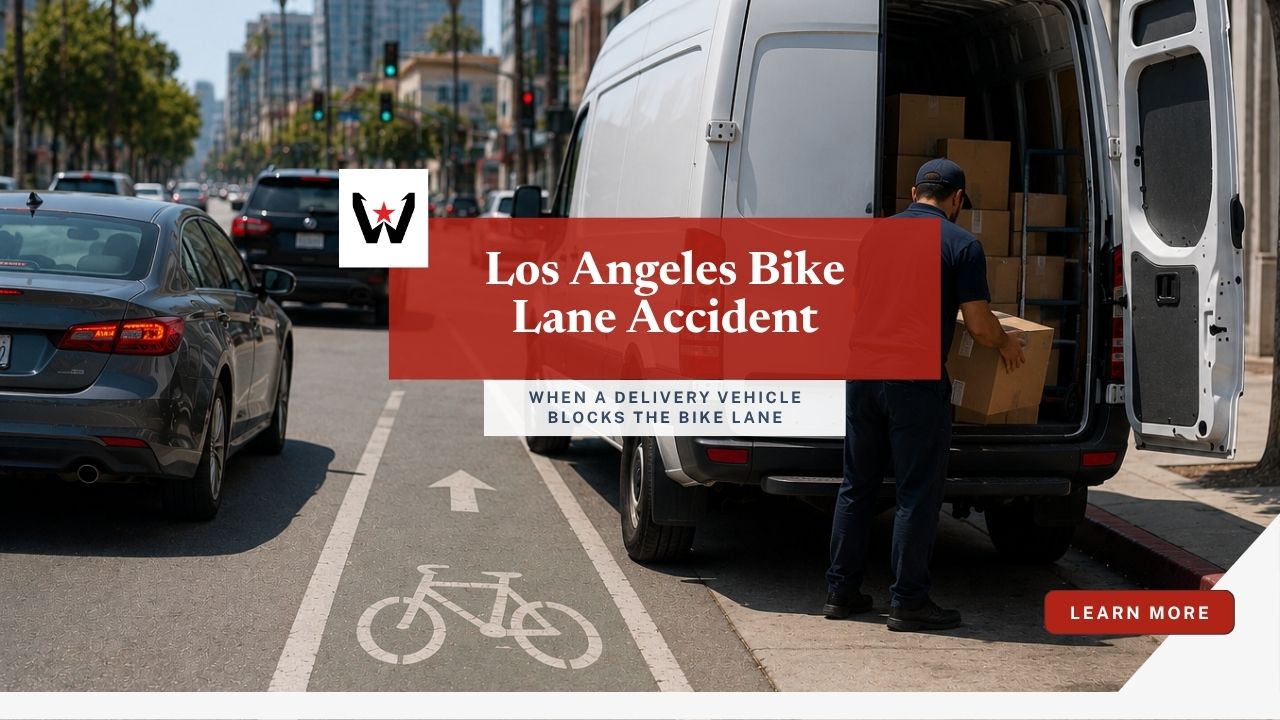
A Los Angeles bike lane accident can develop in seconds when a delivery vehicle stops in a bicycle lane and forces a rider to decide whether to slow abruptly, stop, move around the obstruction, or enter an adjacent traffic lane. The collision itself may occur beside the delivery vehicle, behind it, or after the cyclist moves into another travel path. Because the parked vehicle may be moved shortly afterward and the driver may complete the delivery and leave, photographs, video, witnesses, delivery records, and other evidence can become especially important for reconstructing what the cyclist encountered.
The specific issue in this type of Los Angeles bike lane accident is not simply that a commercial vehicle was present. Investigators may need to determine exactly where the delivery vehicle was positioned, whether it occupied part or all of the bicycle lane, what space remained available to the cyclist, what surrounding traffic was doing, and how the cyclist responded to the obstruction. California law contains specific rules governing stopping and parking in bicycle lanes, while local Los Angeles loading and parking environments can create additional factual questions about where and why a delivery driver stopped.
California Vehicle Code section 21211 generally prohibits stopping, standing, sitting, or loitering in a bicycle path or lane in a manner that impedes or blocks normal and reasonable bicycle movement, subject to statutory exceptions. Whether a particular delivery stop violated the law or contributed to a collision depends on the actual facts and should be evaluated using the available evidence rather than assumed from the presence of a vehicle alone.
For someone injured in a Los Angeles bike lane accident, the investigation may extend beyond the driver and vehicle. Delivery timestamps, route information, dispatch communications, employer records, vehicle ownership, surveillance footage, photographs, witness statements, medical documentation, and bicycle damage may all become relevant. Commercial delivery operations can generate records that do not exist after an ordinary collision between two privately owned vehicles.
If you were injured while riding, our Los Angeles Bicycle Accident Lawyer page provides additional information about how Super Woman Super Lawyer can evaluate bicycle accident evidence, commercial vehicle records, insurance issues, and injury documentation.
Connect with Super Woman Super Lawyer today through our Online Form, call 800.800.6916, or start a Live Chat. After a Los Angeles bike lane accident involving a delivery vehicle, preserving evidence promptly can matter because the vehicle may leave, surveillance may be overwritten, and electronic delivery records may become more difficult to obtain as time passes.
Reconstructing the Cyclist’s Path Around the Obstruction
Reconstructing a Los Angeles bike lane accident involving a blocked bicycle lane requires more than determining that a delivery vehicle was parked nearby. Investigators may need to understand the cyclist’s entire path approaching the obstruction. That includes where the cyclist was riding, when the delivery vehicle became visible, whether the bicycle lane remained partially usable, what traffic occupied the adjacent lane, and what movements occurred immediately before the collision.
This reconstruction can become particularly important when the cyclist and delivery driver describe the scene differently. Photographs, video, roadway markings, witness observations, vehicle positions, and physical damage may provide more reliable context than recollections alone.
Where the Delivery Vehicle Was Positioned
The precise location of the delivery vehicle can become one of the central pieces of evidence in a Los Angeles bike lane accident. A vehicle may be entirely inside a bicycle lane, partially overlapping it, positioned beside the lane with a door or equipment extending into it, or stopped in another location that still affects the cyclist’s travel path.
Photographs taken before the delivery vehicle moves can therefore be particularly valuable. Images should capture the entire roadway environment rather than only a close-up of the vehicle. Bicycle-lane markings, curb position, traffic lanes, parking spaces, loading areas, intersections, driveways, and nearby signs may all provide context.
California’s Department of Transportation Bicycle and Pedestrian Program provides statewide information concerning bicycle and pedestrian transportation, while the specific roadway design at the Los Angeles bike lane accident scene should be documented directly whenever possible.
Vehicle identification matters as well. Photographs may capture the vehicle type, license plate, unit number, company markings, or other information that helps identify the driver, employer, vehicle owner, or delivery operation. If the delivery vehicle leaves before police arrive, these details may become particularly important.
Whether the Cyclist Moved Into a Traffic Lane or Other Travel Path
A blocked bicycle lane may leave a rider with several possible responses, and the actual movement matters. A cyclist may slow or stop behind the obstruction, move into an adjacent vehicle lane, travel around the vehicle through another available space, or alter course in another way depending on roadway conditions.
For a Los Angeles bike lane accident, investigators may review lane markings, impact locations, skid or scrape marks, bicycle damage, vehicle damage, video footage, and witness statements to understand the rider’s path. Helmet-camera footage can be especially informative because it may show what the cyclist could see while approaching the obstruction.
The investigation should avoid assuming that the cyclist’s movement automatically establishes fault. The surrounding conditions matter. How much warning did the rider have? Was the adjacent lane occupied? Did the delivery vehicle obscure approaching traffic or sightlines? Did another vehicle become involved after the cyclist attempted to move around the obstruction? Responsibility depends on the complete evidence.
The California DMV Bicycle and Pedestrian Safety guidance discusses motorists’ responsibilities when sharing the roadway with bicyclists. Those general rules provide legal and safety context, but the specific Los Angeles bike lane accident still requires evidence showing what happened at that particular location.
Vehicle Traffic and Available Space Around the Obstruction
Available space can become a major issue when a delivery vehicle blocks a bicycle lane. A photograph showing only the parked van may not establish what options were realistically available to the cyclist. Wider images can show the width of the bicycle lane, adjacent traffic, parked cars, curb configuration, intersections, construction, and other conditions affecting the rider’s path.
In a Los Angeles bike lane accident, traffic volume and vehicle position immediately before the crash may also matter. A cyclist who encounters a blocked lane while an adjacent travel lane is empty faces a different physical situation from a rider who encounters the same obstruction beside continuous moving traffic.
Video can be particularly valuable because it captures movement rather than a single moment. Dashcams, helmet cameras, nearby business surveillance, residential cameras, or municipal systems may preserve portions of the approach and collision. Because many recording systems overwrite footage, locating potential cameras quickly can be more important than the longer legal deadline for filing a claim.
For broader guidance about documenting a collision before evidence changes, read What to Do After a Car Accident in California: What Actually Matters.
Delivery and Scene Evidence to Preserve
A Los Angeles bike lane accident involving a commercial delivery vehicle may generate two overlapping categories of evidence: evidence from the physical scene and records created by the delivery operation. The first category may include photographs, video, roadway markings, witnesses, and vehicle damage. The second may include route information, delivery timestamps, dispatch records, electronic messages, and company vehicle information.
Preserving both categories can help answer different questions. Scene evidence may show where the vehicle was positioned and how the cyclist moved. Delivery records may help establish why the vehicle was there, whether a delivery was active, who was driving, and what company or platform was connected to the stop.
Delivery Time, Route, Company, and Vehicle Information
Commercial deliveries often create electronic records. Depending on the business and delivery system involved, records may identify a scheduled stop, route sequence, delivery time, GPS location, driver assignment, vehicle assignment, proof-of-delivery timestamp, or communications with dispatch.
In a Los Angeles bike lane accident, those records may help establish whether the vehicle was actively performing a delivery at the time of the collision. They may also help identify the driver and companies connected to the trip.
Photographs taken at the scene can complement these records. Company markings, vehicle numbers, license plates, delivery equipment, or uniforms may help identify the commercial operation even if the driver leaves before all information is exchanged.
Commercial records should be preserved promptly when they may matter. Electronic systems can have retention schedules, and not every type of information remains available indefinitely. A preservation request may become important depending on the circumstances.
Business Cameras, Dashcams, Helmet Cameras, and Witnesses
Los Angeles commercial corridors frequently contain cameras on stores, apartment buildings, parking facilities, offices, homes, and vehicles. A Los Angeles bike lane accident near a delivery stop may therefore have been recorded from more than one angle.
A cyclist’s helmet camera may capture the approach to the obstruction and surrounding traffic. A delivery vehicle may have forward, rear, or side cameras. Another motorist’s dashcam may show the cyclist moving around the blocked lane. Nearby business cameras may capture the vehicle arriving, parking, and leaving.
Potential camera locations should be documented quickly. A photograph of the building or camera location can help investigators identify where footage may exist even if the cyclist is unable to obtain it personally.
Witness information should also be preserved. Pedestrians, customers, employees, other cyclists, passengers, or nearby drivers may have observed the delivery vehicle’s position or the collision. A factual witness account can become particularly useful when the parties disagree about whether the bicycle lane was blocked.
Photos of Lane Markings, Vehicle Position, and Sightlines
Photographs are often among the easiest forms of evidence to preserve immediately after a Los Angeles bike lane accident. Useful images may include the delivery vehicle’s position, bicycle-lane markings, curb, nearby signs, intersection layout, traffic lanes, sightlines, bicycle damage, debris, and final resting positions.
Photographs taken from the cyclist’s approach can be especially helpful. They may show when the obstruction would have become visible and whether another vehicle, landscaping, roadway geometry, or other feature limited the rider’s view.
The same applies to the delivery driver’s perspective. If visibility becomes disputed, photographs showing mirrors, vehicle orientation, nearby parked cars, and the surrounding roadway may help investigators evaluate what each person could potentially see.
The purpose is not to manufacture a particular version of the Los Angeles bike lane accident. The strongest scene documentation generally preserves the environment from multiple angles so the evidence can later be evaluated in context.
Questions About the Delivery Driver and Company
When a privately owned passenger car is involved in a collision, identifying the driver and registered owner may resolve many initial insurance questions. A commercial delivery vehicle can involve additional entities. The driver may work for a delivery company, contractor, retailer, logistics provider, or another business. The vehicle may be owned by the employer, leased, rented, or owned by a separate company.
A Los Angeles bike lane accident involving a delivery vehicle should therefore identify the relevant relationships rather than assuming the logo on the vehicle tells the entire story.
Whether the Vehicle Was Actively Making a Delivery
Whether the driver was actively performing a delivery can become relevant to understanding the trip and identifying available records. Delivery timestamps, app information, dispatch communications, route records, receipts, or witness observations may help establish what the driver was doing when the vehicle stopped.
For a Los Angeles bike lane accident, the timing of the stop may also help identify nearby surveillance. If electronic records show that a delivery occurred at a particular business at 2:17 p.m., investigators may have a more precise time window when requesting video from surrounding properties.
The fact that a driver was making a delivery does not automatically determine legal responsibility. It can, however, help identify the driver’s work status, the records generated by the trip, and the companies that may possess relevant evidence.
Driver Employer, Vehicle Owner, and Dispatch Information
The driver, employer, vehicle owner, and dispatching company may not always be the same entity. That distinction can matter when investigating a Los Angeles bike lane accident because different organizations may possess different evidence.
An employer may have personnel or route information. A vehicle owner may possess maintenance or camera records. A dispatch company may maintain GPS data or electronic communications. A delivery platform may have timestamps, app records, or proof-of-delivery information.
Only entities reasonably connected to the trip should be investigated. The purpose is not to add companies unnecessarily but to identify who controlled relevant aspects of the delivery operation and who may possess evidence concerning the stop.
Company Records Related to the Stop or Route
Company-side records may help reconstruct what happened before and during the delivery stop. Depending on the operation, these could include route records, GPS or telematics information, dispatch messages, delivery app data, driver logs, photographs confirming delivery, or timestamps.
A Los Angeles bike lane accident may also involve onboard camera footage if the commercial vehicle uses dashcams or side/rear cameras. Those recordings can be particularly valuable when the dispute centers on the position of the vehicle or cyclist.
Electronic evidence can disappear under routine retention policies. The lawsuit deadline may be measured much differently from the period during which delivery data or video remains available. That distinction is one reason evidence preservation can become important early.
Documenting the Cyclist’s Injuries and Property Loss
Fault evidence is only part of a Los Angeles bike lane accident claim. The cyclist may also need to document medical treatment, functional limitations, damage to the bicycle and protective equipment, missed work, and transportation expenses. An article focused entirely on where the delivery van was parked would therefore leave out an important part of the claim.
Medical and property documentation should remain accurate and separate. Bicycle damage can help reconstruct the collision, while medical records document injuries and treatment. One should not be treated as a substitute for the other.
Medical Care, Therapy, and Mobility Restrictions
Bicycle collisions can produce a wide range of injuries depending on the circumstances. Diagnosis should come from qualified healthcare professionals. Emergency records, physician evaluations, imaging, specialist care, physical therapy, occupational therapy, or other treatment may become part of the medical record.
For a Los Angeles bike lane accident, preserve documentation showing when treatment began, what symptoms were reported, what providers diagnosed, and what treatment or restrictions were recommended. If mobility limitations affect walking, driving, cycling, work, or household responsibilities, those limitations should be accurately discussed with treating providers.
The MedlinePlus medical records resource provides general information about the types of information contained in medical records. For an injury claim, the specific documentation needed will depend on the person’s actual injuries and treatment.
Treatment gaps may later generate questions, so records concerning appointment scheduling, referrals, or other circumstances affecting continuity of care may also become relevant. The goal is an accurate chronology rather than an artificially perfect treatment history.
Bicycle, Helmet, Gear, and Electronic Device Damage
The bicycle itself can be important evidence in a Los Angeles bike lane accident. Damage to wheels, frame components, handlebars, pedals, forks, or other areas may help document contact points and crash forces. Photographs should be taken before repairs when reasonably possible.
Helmets and protective equipment should also be documented. If the helmet was involved in the impact, photographs of its condition may become relevant. Damaged clothing, lights, bags, cycling computers, phones, cameras, and other equipment may represent property loss and, in some cases, provide evidence about the collision.
Electronic devices can contain useful information as well. A cycling computer, fitness app, GPS device, or helmet camera may preserve route, time, location, or video data. The meaning and reliability of any particular data should be evaluated appropriately rather than assumed.
Keep purchase receipts, repair estimates, replacement estimates, photographs, serial numbers, and other records when available. A complete Los Angeles bike lane accident property file can help distinguish collision evidence from the separate financial question of what equipment was damaged.
Missed Work and Alternative Transportation Costs
A cyclist may miss work because of medical treatment, physical limitations, or transportation problems after the collision. Employment records can help document those effects. Pay statements, time records, employer communications, leave documentation, or provider restrictions may become relevant depending on the circumstances.
Transportation expenses may also arise if the bicycle was the person’s primary means of commuting. A Los Angeles bike lane accident may lead to rideshare expenses, public transit costs, temporary vehicle use, bicycle rental, or other transportation arrangements while the rider recovers or the bicycle is repaired.
Preserve receipts and maintain an organized record rather than attempting to reconstruct expenses months later. Whether a particular cost is legally recoverable depends on the circumstances, but documentation allows it to be evaluated.
For additional information about how injury, wage, and other evidence can affect settlement evaluation, read How Personal Injury Settlements Really Work in California.
Legal Deadline Versus Evidence Preservation After a Los Angeles Bike Lane Accident
Legal filing deadlines and evidence-preservation deadlines should not be treated as the same thing. The California Courts Self-Help Guide provides general information about California civil statutes of limitations and cautions that different claims can have different deadlines. Special rules may apply in particular circumstances, including claims involving public entities.
The practical preservation period after a Los Angeles bike lane accident can be dramatically shorter. The delivery vehicle may leave within minutes. Business surveillance may be overwritten. Dashcam footage can disappear. Delivery app information and telematics may be subject to retention policies. Witnesses may become difficult to locate, and roadway conditions can change.
Preserving photographs, potential camera locations, witness information, delivery vehicle identification, and available digital records early can therefore matter even when no lawsuit is being filed immediately.
Serving Injured Cyclists Throughout Los Angeles
Los Angeles cyclists travel through an unusually varied traffic environment that includes major boulevards, neighborhood streets, commercial corridors, designated bicycle lanes, loading areas, rideshare activity, buses, and frequent delivery stops. Streets such as Sunset Boulevard, Venice Boulevard, Santa Monica Boulevard, Figueroa Street, and numerous neighborhood corridors can place cyclists alongside commercial vehicles making frequent stops.
A Los Angeles bike lane accident involving a delivery vehicle should still be investigated based on the specific scene rather than assumptions about Los Angeles traffic generally. Photographs of the actual bicycle lane, vehicle position, adjacent traffic, sightlines, and roadway markings may be more useful than generalized statements about congestion.
Local rules may also provide relevant context. The Los Angeles Department of Transportation publishes transportation information for the city, while California bicycle-lane rules are contained in the state Vehicle Code. The applicable facts, roadway configuration, and vehicle activity should be evaluated together.
Super Woman Super Lawyer helps injured cyclists evaluate accident evidence, medical documentation, property damage, and commercial vehicle records. If a delivery vehicle obstructed your travel path, our Los Angeles Bicycle Accident Lawyer page provides additional information about local representation following a Los Angeles bike lane accident.
Frequently Asked Questions About a Los Angeles Bike Lane Accident Involving a Delivery Vehicle
Can a delivery vehicle legally stop in a bicycle lane?
California law generally restricts stopping or parking in a bicycle lane in a manner that impedes normal and reasonable bicycle movement, subject to statutory exceptions. California Vehicle Code section 21211 provides the applicable statutory language. Whether a particular stop was lawful or contributed to a Los Angeles bike lane accident depends on the actual circumstances.
What should I photograph if a delivery vehicle is blocking the bike lane?
Photograph the vehicle’s position, bicycle-lane markings, license plate, company or unit information, curb, nearby signs, adjacent traffic lanes, sightlines, bicycle damage, and the broader scene when safely possible. In a Los Angeles bike lane accident, wider photographs can help show how much usable space remained rather than merely proving that a delivery vehicle was present.
What if the delivery driver leaves before police arrive?
Preserve whatever identifying information is safely available, including photographs, license plate information, company markings, unit numbers, witness details, and potential camera locations. A Los Angeles bike lane accident involving a commercial vehicle may also generate delivery, GPS, dispatch, or other company records that can help identify the trip.
Can delivery records show why the vehicle was stopped there?
Potentially. Depending on the company and delivery system, records may include route information, delivery timestamps, GPS data, driver assignments, proof-of-delivery information, or dispatch communications. These records may help establish whether the vehicle was actively making a delivery during the Los Angeles bike lane accident.
Can helmet-camera footage help?
Yes. Helmet-camera footage may show the cyclist’s approach, the delivery vehicle’s position, adjacent traffic, available space, and the rider’s movement around the obstruction. In a disputed Los Angeles bike lane accident, video may provide context that photographs taken afterward cannot capture.
What if I had to move into a traffic lane to get around the delivery vehicle?
The complete circumstances should be evaluated. Investigators may consider where the delivery vehicle was positioned, how much bicycle-lane space remained, surrounding traffic, sightlines, the cyclist’s movement, and the actions of other motorists. Moving around an obstruction does not by itself determine responsibility for a Los Angeles bike lane accident.
What if another vehicle actually struck me after I moved around the delivery van?
The involvement of another vehicle can make the investigation more complicated. Evidence may need to address the delivery vehicle’s obstruction, the cyclist’s path, and the actions of the vehicle that made contact. A Los Angeles bike lane accident can involve several potentially relevant parties and insurance policies depending on what occurred.
Should I preserve my damaged bicycle?
When reasonably possible, document the bicycle before repairs or disposal. Photographs of the frame, wheels, handlebars, pedals, and contact points may help preserve physical evidence from a Los Angeles bike lane accident. Repair estimates and purchase documentation may also help establish property loss.
Should I keep my damaged helmet?
A damaged helmet may be relevant evidence depending on the circumstances. Photograph it and avoid altering its condition unnecessarily before determining whether preservation is appropriate. The helmet may document an impact, while medical records separately document any diagnosed injury.
What company records may exist after a delivery vehicle accident?
Depending on the operation, records may include dispatch communications, route information, GPS or telematics, delivery timestamps, app records, driver assignments, proof-of-delivery information, and onboard camera footage. A Los Angeles bike lane accident involving a commercial delivery vehicle may therefore generate considerably more electronic evidence than a collision involving only private vehicles.
How do I document missed work after a bicycle accident?
Preserve work schedules, time records, payroll information, employer communications, leave documentation, and healthcare-provider restrictions when applicable. A Los Angeles bike lane accident claim involving lost work should be supported by actual employment and medical documentation rather than estimates based only on memory.
Can I document rideshare or transit expenses if I cannot ride my bicycle?
Yes. Keep receipts and records of transportation expenses incurred after the collision. Whether each expense is recoverable depends on the circumstances, but preserving the documentation allows those costs to be evaluated as part of the Los Angeles bike lane accident claim.
How quickly should camera footage be preserved?
As quickly as reasonably possible. Business cameras, vehicle dashcams, and other systems may overwrite recordings automatically. A Los Angeles bike lane accident may therefore have an evidence-preservation deadline measured in days or weeks even when the applicable legal filing deadline is much longer.
What should I bring to a consultation?
Bring available photographs, video, police information, witness contacts, delivery vehicle information, medical records, bicycle and equipment photographs, repair estimates, employment records, transportation receipts, insurer communications, and a basic timeline. A Los Angeles bike lane accident consultation can then focus on what evidence already exists and what may still need to be preserved.
Call or Contact Super Woman Super Lawyer 24/7 for a Free Consultation and Pay Nothing Unless You Win
A delivery vehicle blocking a bicycle lane can turn an ordinary ride into a complicated collision involving roadway evidence, commercial records, digital data, several insurance questions, and significant injuries. A Los Angeles bike lane accident investigation may need to determine exactly where the delivery vehicle was stopped, what route remained available to the cyclist, what surrounding traffic was doing, and whether delivery records or video can help reconstruct the event.
Super Woman Super Lawyer can help evaluate photographs, helmet-camera footage, surveillance video, witness information, delivery and dispatch records, GPS or telematics information, medical documentation, bicycle damage, employment records, transportation expenses, and other evidence relevant to the collision. Preserving Los Angeles bike lane accident evidence early may be particularly important when commercial electronic records or surveillance footage could disappear.
Super Woman Super Lawyer has recovered more than over $2 billion for clients. Past results do not guarantee a particular outcome, and every bicycle accident claim depends on its individual facts, evidence, injuries, insurance coverage, and applicable law.
For more information about representation after a bicycle collision, visit our Los Angeles Bicycle Accident Lawyer page.
Connect with Super Woman Super Lawyer today:
Online Form: Request a case review
Call Now: 800.800.6916
Live Chat: Speak with a legal professional instantly
 Maryam Parman