Left turn pedestrian crosswalk accident in Long Beach cases often happen in a matter of seconds, but understanding exactly how the collision occurred can take much longer. Many people assume these accidents are straightforward. A pedestrian is crossing the street, a vehicle turns left, and a collision occurs. In reality, the circumstances are often more complicated.
Drivers may be watching oncoming traffic while preparing to complete a turn. Pedestrians may be relying on a walk signal and assuming approaching vehicles will stop. Witnesses may have different perspectives on what happened. Traffic signals, vehicle speed, lighting conditions, and roadway design can all influence how the event unfolds.
Because multiple factors are frequently involved, investigators often focus heavily on evidence. Strong documentation can help explain what happened before the collision, where each person was positioned, and what conditions existed at the intersection. For families and accident victims, understanding the types of evidence commonly reviewed after a left turn pedestrian crosswalk accident in Long Beach can provide valuable insight into how these incidents are evaluated.
The sooner information is preserved, the easier it often becomes to answer important questions later.
Why Left-Turn Crosswalk Collisions Require Careful Reconstruction
Driver focus on oncoming traffic vs. pedestrians in the crosswalk
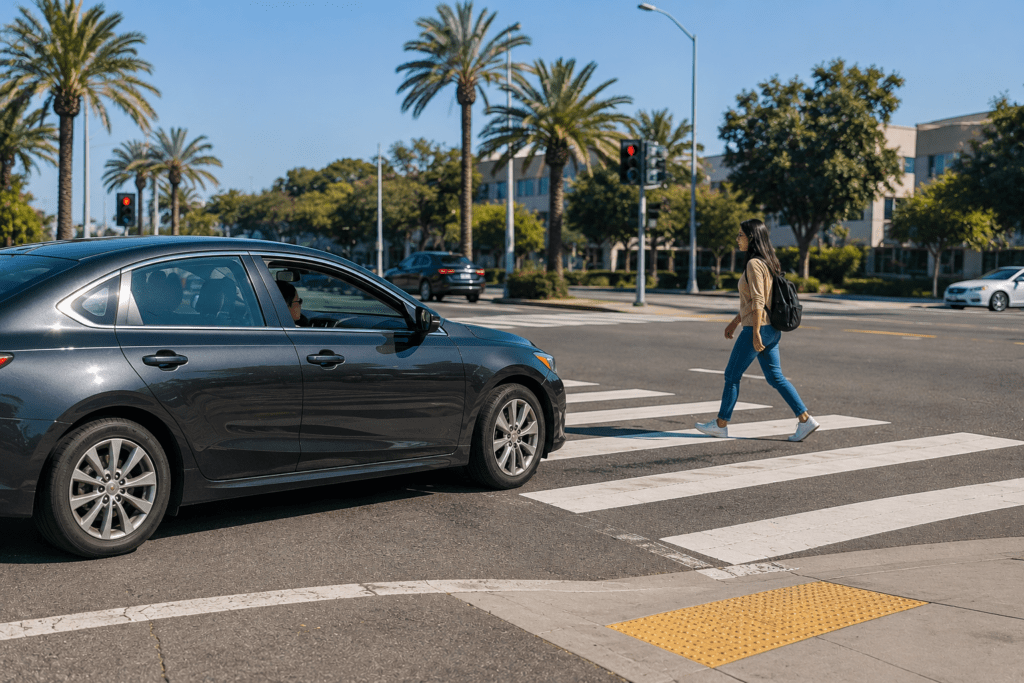
One of the most common factors in a left turn pedestrian crosswalk accident in Long Beach involves competing visual demands. Drivers preparing to turn left often divide their attention between several different things at once. They may be watching oncoming traffic, monitoring signal changes, checking surrounding vehicles, and looking for opportunities to complete the turn safely.
During that process, pedestrians can sometimes become less noticeable than drivers expect. This does not necessarily mean the pedestrian was hidden or difficult to see. Rather, it reflects the reality that drivers often focus heavily on approaching traffic while searching for a gap large enough to complete the turn. As a result, investigators frequently examine where the pedestrian was located, how long they were visible, and whether the driver had an opportunity to observe them before impact.
Strong evidence can help answer those questions. Witness statements, video footage, and scene photographs often provide important context regarding what both parties were able to see. Because visibility frequently becomes a point of dispute, preserving evidence early is especially important after a left turn pedestrian crosswalk accident in Long Beach.
Vehicle turning angle, speed, and line of sight
The physical movement of the vehicle can also play an important role. A left-turn collision does not occur in the same way every time. The turning angle may vary. Vehicle speed may differ. Roadway geometry can influence visibility and reaction time.
When evaluating a left turn pedestrian crosswalk accident in Long Beach, investigators often look closely at how the vehicle entered the intersection and how the turn was completed. A wide turn may create different visibility conditions than a tighter turning movement. Vehicle speed can affect how much time both the driver and pedestrian had to react.
Line of sight is another important consideration. Parked vehicles, landscaping, utility poles, signage, buses, and other visual obstructions can sometimes affect what each person could see. Photographs and video footage frequently become important because they help preserve those conditions before changes occur.
The goal is not simply to determine where the collision happened. The goal is to understand how the movements of both the driver and pedestrian interacted within the intersection. Strong documentation often provides valuable insight into those questions.
Walk signal timing, countdown signals, and traffic light sequence
Traffic control devices often become a major focus following a pedestrian collision. Many intersections include:
- walk signals,
- flashing countdown timers,
- protected turn phases,
- and standard traffic signals.
Understanding how those systems were operating at the time of the collision can help clarify what conditions existed for both the pedestrian and driver. For example, investigators may examine whether the pedestrian entered the crosswalk while the walk signal was active. They may also review whether the driver was operating under a protected turn signal or a standard green light. These details sometimes become important because they help establish the overall traffic environment.
After a left turn pedestrian crosswalk accident in Long Beach, traffic signal timing records, intersection design information, and video footage may all help explain how the signals were functioning when the collision occurred. Because many intersections operate using complex signal sequences, assumptions are not always reliable. Preserving objective evidence often provides a clearer understanding of the conditions that existed at the time.
Evidence at the Crosswalk That May Help Explain the Collision
Photos of lane markings, crosswalk paint, signals, and signage
One of the most valuable forms of evidence after any pedestrian collision is visual documentation of the intersection itself. Conditions at the scene can change quickly. Traffic resumes. Vehicles are moved. Lighting conditions change. Temporary construction activity may be removed. Photographs help preserve those details while they are still visible.
For a left turn pedestrian crosswalk accident in Long Beach, investigators often review photographs showing:
- crosswalk markings,
- lane configurations,
- traffic signals,
- pedestrian signals,
- roadway signs,
- and intersection layout.
These images provide important context regarding how the area was designed and how people were expected to move through it. Even details that seem minor at the time may later become relevant. The more thoroughly the scene is documented, the easier it often becomes to understand how the collision occurred. Photographs remain one of the simplest and most effective ways to preserve information before conditions change.
Evidence at the Crosswalk That May Help Explain the Collision
Location of impact, final vehicle position, and pedestrian belongings
After a left turn pedestrian crosswalk accident in Long Beach, investigators often begin by examining where the collision occurred and where everything came to rest afterward. The point of impact can provide important clues regarding the movements of both the driver and the pedestrian. For example, the location of debris, damaged vehicle components, personal belongings, and other physical evidence may help explain where contact occurred within the intersection.
The final resting position of the vehicle can also provide context. A vehicle that stopped immediately after impact may present a different picture than one that continued traveling before coming to a stop. Likewise, the position of the pedestrian after the collision may help investigators understand the dynamics of the crash.
Personal belongings sometimes become relevant as well. Items such as backpacks, purses, phones, shopping bags, bicycles, scooters, or other possessions may help establish location and movement patterns. For a left turn pedestrian crosswalk accident in Long Beach, these physical details often work together to create a more complete understanding of what happened. Because accident scenes change quickly, documenting these conditions early is often important. Photographs and video footage frequently become valuable because they preserve information before vehicles are moved and debris is removed.
Lighting, weather, parked vehicles, and visual obstructions
Environmental conditions can have a significant impact on how a collision unfolds. Lighting is often one of the first factors investigators review. Daylight, darkness, shadows, glare, and artificial lighting can all affect visibility for both drivers and pedestrians. Weather conditions may also influence what people were able to see. Rain, fog, smoke, or other environmental conditions sometimes affect reaction time and visibility within an intersection.
In addition, parked vehicles and other obstructions can create challenges. Large trucks, delivery vehicles, buses, landscaping, utility poles, construction equipment, and roadway signage may all affect sightlines. For a left turn pedestrian crosswalk accident in Long Beach, understanding these conditions often helps explain why a driver or pedestrian may not have observed one another as quickly as expected.
This is one reason scene photographs remain so valuable. Conditions that appear obvious immediately after the collision may be difficult to recreate later. Strong documentation helps preserve the environment exactly as it existed at the time of the accident.
Video and Witness Sources Near the Intersection
Business cameras, residential cameras, and dashcam footage
Video footage often becomes one of the most powerful forms of evidence after a pedestrian collision. Unlike witness recollections, video provides a visual record that can be reviewed repeatedly.
Many intersections contain more cameras than people realize. Businesses, apartment buildings, retail stores, parking structures, restaurants, and office buildings frequently operate surveillance systems that capture portions of nearby streets and sidewalks. Residential cameras may also become relevant. Doorbell cameras and home security systems often record activity near intersections, especially in urban areas. Dashcam footage provides another potential source of information.
Drivers traveling through the area may have captured the collision or the moments leading up to it. For a left turn pedestrian crosswalk accident in Long Beach, identifying these sources early can be extremely important because many systems automatically overwrite recordings after a period of time.
The sooner potential footage is identified, the more likely it remains available for review. Strong video evidence can often help clarify questions regarding vehicle movement, pedestrian location, traffic signals, and overall intersection conditions.
Bus, delivery, or rideshare vehicle cameras to research
Commercial vehicles often carry recording systems that people overlook. Buses, delivery vehicles, rideshare vehicles, utility trucks, and other commercial fleets may use cameras for operational and safety purposes. Because these vehicles frequently travel through busy intersections, they may capture valuable footage even when they are not directly involved in the collision.
For a left turn pedestrian crosswalk accident in Long Beach, nearby commercial vehicles sometimes provide perspectives unavailable from other sources. A delivery van waiting at a red light may have recorded the entire sequence of events. A rideshare vehicle approaching the intersection may have captured traffic signal activity or pedestrian movement.
The challenge is that many people do not realize these recordings exist until later. This is another reason early investigation often focuses on identifying every potential source of information before records are lost or overwritten. The more complete the evidence collection process becomes, the easier it is to understand what occurred.
Witness statements from drivers, pedestrians, passengers, and nearby workers
Witnesses frequently provide details that no camera captured. People standing on sidewalks, waiting at bus stops, crossing nearby streets, or working in surrounding businesses often observe portions of the event from unique perspectives. Passengers in nearby vehicles may also provide valuable observations.
Witnesses may remember:
- traffic signal conditions,
- driver behavior,
- vehicle speed,
- pedestrian movement,
- or events immediately before impact.
For a left turn pedestrian crosswalk accident in Long Beach, witness accounts often help fill gaps that physical evidence alone cannot answer. Of course, witness recollections are not always identical. Different people observe different aspects of the same event.
That is why investigators frequently compare witness statements with physical evidence, photographs, and video footage whenever possible. The strongest understanding of the collision often comes from combining multiple sources of information rather than relying on any single piece of evidence.
Fault and Comparative Responsibility Topics Writers Should Research
California driver duties at crosswalks and intersections
One of the central questions in a left turn pedestrian crosswalk accident in Long Beach is whether the driver fulfilled their responsibilities while approaching and moving through the intersection. Drivers are expected to pay attention to the roadway environment around them, including traffic signals, other vehicles, cyclists, and pedestrians. Intersections require particularly careful attention because multiple forms of traffic often occupy the same space at the same time.
A driver preparing to make a left turn must evaluate oncoming traffic while also remaining aware of people crossing the street. This is one reason left-turn collisions involving pedestrians occur so frequently. Drivers often focus heavily on finding a safe gap in traffic and may not immediately notice a pedestrian already using the crosswalk. When investigators evaluate a left turn pedestrian crosswalk accident in Long Beach, they frequently examine what information was available to the driver before the collision occurred.
Questions may include:
- Was the pedestrian visible?
- Were there any visual obstructions?
- How long was the pedestrian in the crosswalk?
- What traffic signals were active?
- What was the driver’s line of sight?
These issues often become important because they help explain what opportunities existed to recognize and avoid the collision. Strong evidence helps create a more complete understanding of these factors.
Pedestrian duties while crossing at signalized intersections
Pedestrians also have responsibilities when using intersections. While many discussions focus primarily on driver behavior, investigators often examine what the pedestrian was doing as well.
For a left turn pedestrian crosswalk accident in Long Beach, this may include reviewing:
- where the pedestrian entered the crosswalk,
- what signal indications were present,
- how the pedestrian moved through the intersection,
- and whether any unusual circumstances affected visibility or movement.
These questions are not necessarily about assigning blame. Rather, they help investigators understand the complete sequence of events. Many intersections operate with walk signals, countdown timers, and complex traffic patterns. Understanding how the pedestrian interacted with those systems often helps clarify what conditions existed at the time. Evidence such as surveillance footage, witness statements, and intersection signal timing records may all contribute to that analysis.
The goal is to understand how both the driver and pedestrian moved through the environment leading up to the collision.
How insurers may dispute visibility, timing, and right-of-way issues
Insurance companies frequently examine pedestrian collisions in significant detail. One reason is that left-turn accidents often involve competing explanations regarding visibility and timing. A driver may argue that the pedestrian was difficult to see. A pedestrian may believe they were clearly visible throughout the crossing. Witnesses may provide different perspectives based on where they were standing at the time.
As a result, issues involving right-of-way, visibility, signal timing, and reaction time often become central topics of discussion. For a left turn pedestrian crosswalk accident in Long Beach, insurers frequently review:
- intersection design,
- traffic signal timing,
- video footage,
- witness statements,
- and physical evidence from the scene.
The stronger the available evidence, the easier it becomes to evaluate those questions objectively. This is one reason preserving information early remains so important. Conditions change quickly after a collision. The sooner evidence is identified and preserved, the easier it becomes to understand what actually happened.
Contact Super Woman Super Lawyer for a Free Consultation — No Fee Unless We Win, Available 24/7
Why evidence often matters more than assumptions
Many people form opinions about pedestrian accidents immediately after they occur. Unfortunately, those early assumptions are not always accurate. A left turn pedestrian crosswalk accident in Long Beach may appear straightforward at first glance, but important details are often revealed only after evidence is reviewed carefully.
Photographs, traffic signal records, witness statements, vehicle positions, surveillance footage, and roadway conditions all help provide context. Without that information, conclusions may be based on incomplete observations. Strong evidence often helps answer questions that would otherwise remain disputed.
That is one reason preserving information as early as possible can be valuable.
Understanding how different forms of evidence work together
No single piece of evidence usually tells the entire story. A photograph may show the intersection layout. A witness may explain what they observed. A surveillance camera may capture vehicle movement. Traffic signal information may clarify how the intersection was operating. Together, these pieces help create a more complete understanding of what occurred.
For a left turn pedestrian crosswalk accident in Long Beach, combining multiple sources of evidence often provides the clearest explanation of the collision. This is similar to what we discuss in: How Personal Injury Settlements Work in California.
Strong documentation often creates a stronger understanding of the facts. The more complete the evidence, the easier it becomes to evaluate what happened and why.
Resources that may help explain pedestrian safety issues
Pedestrian safety remains an important topic throughout California.The California DMV provides educational information regarding pedestrian safety, crosswalks, and roadway responsibilities: https://www.dmv.ca.gov
These resources can help people better understand how pedestrian and vehicle traffic interact at intersections and why certain safety practices are emphasized. For individuals involved in a left turn pedestrian crosswalk accident in Long Beach, learning more about these topics often provides useful context regarding how collisions are evaluated.
Free consultation — No fee unless we win
Every pedestrian accident involves unique facts. Traffic conditions, visibility, signal timing, intersection design, and witness observations can all influence how the situation is understood.
If you have questions about a left turn pedestrian crosswalk accident in Long Beach, speaking with a Long Beach pedestrian accident lawyer can help provide clarity regarding the evidence that may be available and the factors that often influence these investigations. Most cases are handled on a contingency fee basis, meaning there are generally no upfront attorney fees.
Connect With Super Woman Super Lawyer
A left turn pedestrian crosswalk accident in Long Beach often raises important questions about visibility, traffic signals, right-of-way, and driver decision-making. Because multiple factors are usually involved, preserving evidence early can make a meaningful difference. Photographs, video footage, witness statements, traffic signal information, and physical evidence all help create a clearer picture of what occurred.
The stronger the documentation, the easier it becomes to understand how the collision happened and what information may be important moving forward.
Online Form: Request a case review
Call Now: 800.800.6916
Live Chat: Speak with a legal professional instantly
 Maryam Parman