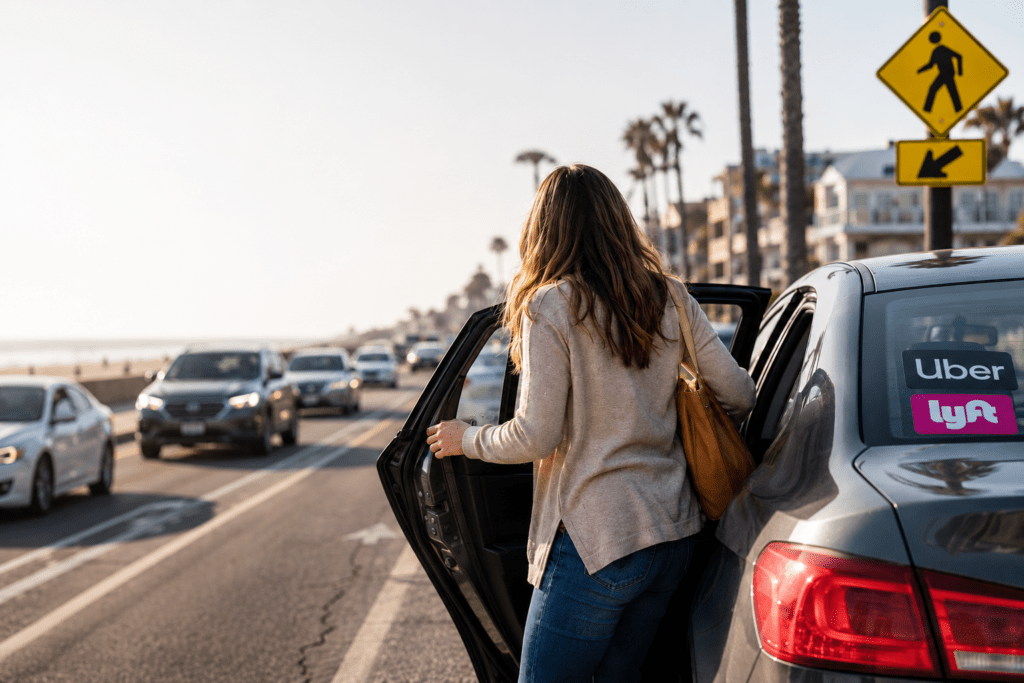
Being dropped off by a rideshare driver is something most people barely think about until something goes wrong. The trip ends, the vehicle pulls over, the passenger gathers their belongings, and the ride is over. For most people, it feels like the simplest part of the experience.
But not every drop-off location is safe.
In Newport Beach, rideshare drivers regularly pick up and drop off passengers near busy restaurants, hotels, shopping centers, entertainment districts, waterfront destinations, and residential neighborhoods. During busy hours, drivers may feel pressure to stop quickly, passengers may want to be dropped off as close as possible to a destination, and traffic conditions can make safe stopping locations difficult to find.
That combination creates situations where passengers sometimes exit vehicles into dangerous environments without realizing it.
Someone may step into an active traffic lane, walk directly into a bike lane, encounter a blocked sidewalk, or be forced to navigate around construction barriers. In other situations, poor lighting or limited visibility can create risks that are not obvious until after the passenger has already exited the vehicle.
For someone who was hurt after a Lyft or Uber drop-off in Newport Beach, the situation can feel confusing. Unlike a traditional car accident, there may be multiple factors involved. Questions often arise about whether the driver should have stopped somewhere else, whether the location itself was unsafe, and whether another party contributed to the circumstances that led to the injury.
Understanding how these incidents happen is the first step toward understanding why they can become more complicated than most people expect.
What makes a drop-off location unsafe?
Active traffic lanes
One of the most common issues in rideshare-related injury situations is being dropped off directly into active traffic.
Drivers are often focused on reaching the destination quickly and efficiently. Passengers are often focused on arriving at their destination. Unfortunately, neither party is always focused on what happens immediately after the vehicle stops.
In busy parts of Newport Beach, especially near restaurants, hotels, beach access points, and nightlife destinations, rideshare drivers sometimes stop in areas that were never intended for passenger loading or unloading. A vehicle may pull into a traffic lane, stop beside a bike lane, or pause in an area where other drivers do not expect someone to suddenly exit a vehicle.
For the passenger, this can create immediate danger.
The moment they step out, they may find themselves navigating moving vehicles, bicycles, scooters, or pedestrians. In some situations, there is little room to safely orient themselves before traffic begins moving around them.
We have seen situations where passengers exited rideshare vehicles believing they were stepping into a safe area only to discover they were standing directly in an active lane of traffic. Others found themselves stepping into bike lanes heavily used by cyclists traveling through Newport Beach’s coastal corridors.
These situations often happen quickly.
The rideshare driver may believe the stop was brief enough to avoid issues. The passenger may assume the location is safe because the driver chose it. Meanwhile, surrounding traffic continues moving as normal.
For someone who was hurt after a Lyft or Uber drop-off in Newport Beach, understanding exactly where the vehicle stopped often becomes one of the most important parts of understanding how the incident occurred.
Poor lighting or visibility
Not every unsafe drop-off location is dangerous because of traffic alone. For many people who were hurt after a Lyft or Uber drop-off in Newport Beach, visibility becomes one of the most important factors when trying to understand how the incident occurred. During daylight hours, many hazards are easy to identify. At night, however, conditions can change dramatically. Areas that appear safe during the day may become significantly more dangerous once lighting conditions change.
Newport Beach contains a mix of commercial areas, residential streets, coastal roads, and entertainment districts. Lighting conditions vary considerably between these environments. Some areas are brightly illuminated. Others rely on limited street lighting, creating shadows and visibility challenges for both pedestrians and drivers.
When a rideshare passenger exits a vehicle in a poorly lit area, several problems can occur simultaneously. Drivers approaching from behind may not immediately see the passenger. The passenger may have difficulty identifying hazards in the roadway. Sidewalk conditions, construction barriers, or uneven surfaces may not be obvious until the person is already moving through the area.
Visibility challenges become even more significant near intersections, coastal roads, and locations where parked vehicles limit sight lines. We have seen situations where passengers believed they were safely exiting onto the shoulder of a roadway only to realize they were still partially exposed to moving traffic. In other cases, a person leaving a rideshare vehicle attempted to cross the street and discovered too late that approaching drivers had limited visibility.
These situations highlight why visibility is often discussed in cases involving someone who was hurt after a Lyft or Uber drop-off in Newport Beach.
The danger is not always the location itself. Sometimes the danger comes from how difficult it is for others to see what is happening.
Construction zones or blocked sidewalks
Construction activity can transform an otherwise ordinary drop-off location into a hazardous environment. Throughout Orange County, roadwork, utility projects, building construction, and infrastructure improvements are common. These projects often alter pedestrian pathways and traffic patterns in ways that are not immediately obvious.
A rideshare driver may stop in a location that appears perfectly reasonable. However, once the passenger exits the vehicle, they may discover that sidewalks are blocked, pedestrian access routes have been redirected, or construction barriers force them into areas where they must share space with moving traffic.
In some situations, the driver may not realize construction conditions exist until the vehicle has already stopped. In others, the passenger may not notice the hazards until they begin walking. This is particularly important in areas where temporary barriers, fencing, cones, or equipment limit available walking paths.
A person attempting to reach a nearby destination may suddenly find themselves navigating around obstacles that were not visible from inside the vehicle. The safest route may require crossing additional streets, walking through active work zones, or entering areas where vehicles are moving close by.
We have seen situations where passengers exited rideshare vehicles expecting to walk directly onto a sidewalk only to discover that the sidewalk was completely inaccessible due to construction. Those unexpected conditions can contribute to falls, collisions, and other injuries.
For anyone who was hurt after a Lyft or Uber drop-off in Newport Beach, documenting roadway and construction conditions can be particularly important because those conditions often change quickly after an incident occurs.
Who may be responsible after a drop-off injury?
The rideshare driver
One of the first questions people ask after these incidents is whether the rideshare driver bears responsibility for where the passenger was dropped off.
The answer depends on the circumstances.
Drivers generally control where the vehicle stops. While passengers often request a specific destination, drivers still make decisions about where it is safe and appropriate to load or unload passengers.
In many situations, there may be safer alternatives nearby.
A driver may choose to stop in an active lane rather than continue a short distance to a designated loading area. They may stop beside a bike lane instead of using an available curbside location. They may pull over in an area with poor visibility when a safer location exists just ahead.
This does not automatically mean the driver is responsible.
However, the decision-making process surrounding the stop often becomes an important part of evaluating what happened.
We have seen situations where a passenger requested a specific drop-off location but the driver still retained the ability to choose a safer alternative. In other cases, traffic conditions may have limited the driver’s options.
Understanding the role of the driver is often a central part of understanding what happened when someone was hurt after a Lyft or Uber drop-off in Newport Beach.
The rideshare company’s policies
Because rideshare claims often involve multiple insurance policies and questions about app status, many people choose to speak with a rideshare accident lawyer to better understand how responsibility may be evaluated in situations involving Uber or Lyft vehicles.
Those policies do not automatically determine responsibility, but they can influence how incidents are evaluated.
Questions often arise regarding whether the trip was active at the time of the incident, whether the drop-off followed company guidance, and whether safety procedures were followed appropriately.
Many people assume that rideshare companies automatically become responsible whenever something happens during a trip.
The reality is often more complicated. Understanding how rideshare companies structure their services, how trips are documented, and how incidents are reviewed can become an important part of evaluating these situations.
Third parties contributing to unsafe conditions
Not every unsafe drop-off situation is caused solely by the driver or passenger. In some cases, outside conditions contribute significantly to what happens afterward.
Poor roadway design, blocked pedestrian pathways, construction activity, malfunctioning streetlights, improperly marked loading zones, or even the actions of other drivers can all influence the situation.
For example, a rideshare driver may stop in what appears to be a reasonable location, only for a nearby construction project to force pedestrians into active traffic. In another situation, a passenger may exit safely but immediately encounter a cyclist, scooter rider, or driver who is behaving unpredictably.
These outside factors are important because they can affect how responsibility is evaluated.
We have seen situations where an unsafe environment played a larger role in the injury than the actual drop-off itself. That is one reason these incidents often require a closer look at the full circumstances surrounding the event.
For someone who was hurt after a Lyft or Uber drop-off in Newport Beach, understanding whether outside conditions contributed to the situation can be an important part of understanding what happened.
What evidence can support this type of claim?
App trip data and GPS location
One of the most useful forms of evidence often comes directly from the rideshare platform.
The app itself records a significant amount of information, including pickup locations, drop-off locations, timestamps, routes, and trip status. These records can help establish where the vehicle stopped, when the passenger exited, and whether the trip was still active at the time of the incident.
That information becomes especially important when there are disagreements about where the vehicle was located or whether safer alternatives were available nearby.
We have seen cases where GPS data helped clarify details that neither the passenger nor the driver could remember accurately later.
Because rideshare records may become harder to access over time, preserving screenshots and trip information early can be extremely valuable.
For someone who was hurt after a Lyft or Uber drop-off in Newport Beach, trip records often become one of the most objective sources of information available.
Photos of the drop-off area
When someone is hurt after a Lyft or Uber drop-off in Newport Beach, photographs often provide some of the clearest evidence of the conditions that existed at the time.
A picture taken immediately after the incident may capture roadway conditions, visibility issues, bike lanes, construction barriers, traffic flow, and sidewalk access in a way that written descriptions cannot.
This is especially important because conditions change quickly.
Construction zones are modified. Vehicles move. Lighting conditions change. Temporary barriers disappear. What looked one way during the incident may look completely different days later.
Photos help preserve those details.
We have seen situations where a simple photograph clarified exactly why a drop-off location was unsafe. Without that image, the circumstances may have been much harder to explain later.
Understanding the environment surrounding the incident is often critical for someone who was hurt after a Lyft or Uber drop-off in Newport Beach.
Witness statements or nearby cameras
Witnesses can provide valuable information about what happened before, during, and after the incident.
Unlike the people directly involved, witnesses often have a broader view of the situation. They may have observed how the vehicle stopped, where traffic was moving, or whether conditions appeared unsafe.
Video footage can be equally important.
Many areas of Newport Beach contain security cameras, business surveillance systems, residential cameras, and traffic monitoring equipment. These sources sometimes capture details that would otherwise be difficult to reconstruct.
Without strong evidence, these situations can become competing versions of events.
That is why preserving witness information and identifying potential camera footage early can make a meaningful difference.
What injuries commonly occur in these situations?
Pedestrian impacts
One of the most serious outcomes occurs when a passenger exits directly into the path of an approaching vehicle.
Because rideshare drop-offs often happen in active traffic areas, there may be very little separation between the passenger and moving vehicles.
These incidents can result in significant injuries depending on vehicle speed, roadway conditions, and how the collision occurs.
Even relatively low-speed impacts can lead to injuries requiring extensive medical treatment and recovery time. For people who were hurt after a Lyft or Uber drop-off in Newport Beach, pedestrian impacts are often among the most severe scenarios.
Trip-and-fall injuries
Not every rideshare-related injury involves another vehicle. Sometimes the hazard comes from the environment itself.
Uneven pavement, construction materials, blocked sidewalks, poor lighting, loose debris, or unexpected elevation changes can all contribute to falls after exiting a rideshare vehicle. These incidents may seem minor at first, but they can result in fractures, head injuries, shoulder injuries, and other significant medical issues.
We have seen situations where a passenger stepped out expecting a normal sidewalk and instead encountered conditions that immediately created a risk of injury.
Because these incidents do not involve a traditional collision, people sometimes underestimate how serious they can become.
Secondary collisions
We have seen situations where people were hurt after a Lyft or Uber drop-off in Newport Beach because avoiding one hazard placed them directly into another dangerous situation.
A person may step away from traffic and into a bike lane. They may avoid an approaching vehicle but collide with a cyclist or scooter rider. They may move around a construction barrier and enter another hazardous area. These secondary collisions are one reason rideshare drop-off incidents can become surprisingly complicated.
The injury may not occur directly because of the vehicle itself. Instead, it may result from the chain of events created by the unsafe location.
Understanding those circumstances is often an important part of evaluating what happened.
What steps should you take after being injured?
Seek medical attention
Medical care should always be the first priority. Even when symptoms appear minor, injuries can develop over time. Some conditions may not become fully apparent until hours or days after the incident.
Prompt medical evaluation also helps create documentation connecting the injury to the event itself. We have seen situations where delays in treatment later created unnecessary questions about how the injury occurred.
For anyone who was hurt after a Lyft or Uber drop-off in Newport Beach, medical documentation often becomes one of the most important parts of the overall picture.
Report the incident through the app
Most rideshare platforms provide mechanisms for reporting safety incidents directly through the app. Creating a report establishes an official record and helps preserve important details while the information is still fresh. Many people focus only on medical treatment and forget that documenting the event itself can also be important.
Even if additional steps are taken later, creating an initial report often helps establish a timeline.
Document the location and conditions
The sooner documentation begins, the better. Photographs, screenshots, witness information, app records, and notes about roadway conditions can all become valuable later.
Many of the same principles apply after any injury-causing incident.
If you have not already, we also recommend reading: How Personal Injury Settlements Work in California. That article explains how documentation, evidence, and early decisions can affect how claims are evaluated later.
Similarly, our guide on: What to Do After a Car Accident in California explains why preserving evidence early often matters more than people realize.
How Can You Get Help After a Rideshare Injury?
Free consultation for passengers
Many people simply want to understand what happened and whether they have options moving forward.
Getting information early can often provide clarity and reduce uncertainty.
No fee unless you win
Most personal injury cases are handled on a contingency fee basis.
That means there are generally no upfront legal fees required to begin evaluating a situation.
Understanding this structure often helps people feel more comfortable asking questions and learning about their options.
24/7 availability to reach out
Questions rarely arrive at convenient times. Whether someone was hurt after a Lyft or Uber drop-off in Newport Beach yesterday or several days ago, having access to information can make a meaningful difference.
If you are trying to understand what happened and what factors may affect the situation moving forward, speaking with a Newport Beach rideshare accident lawyer can help provide guidance and clarity.
California also provides public information about how civil claims move through the legal system: https://selfhelp.courts.ca.gov/civil-lawsuit
Understanding how these processes work can help reduce uncertainty and make it easier to navigate what comes next.
Connect With Super Woman Super Lawyer
If you were hurt after a Lyft or Uber drop-off in Newport Beach, understanding the circumstances surrounding the incident is often the first step toward understanding your options.
Super Woman Super Lawyer is part of Avrek Law Firm and provides educational resources designed to help people make informed decisions after accidents and injuries.
Online Form: Request a case review
Call Now: 800.800.6916
Live Chat: Speak with a legal professional instantly
 Maryam Parman