A Glendale rear end accident event data recorder may preserve important electronic information from a vehicle in the moments leading up to a collision. While many people still refer to this technology as a vehicle’s “black box,” an Event Data Recorder (EDR) is designed to capture specific crash-related information that may help investigators better understand how a collision occurred. Depending on the vehicle and the severity of the crash, the system may record details such as vehicle speed, brake application, throttle position, seat belt status, steering input, and the timing of airbag deployment.
At Super Woman Super Lawyer, we understand that no single piece of evidence automatically determines fault after a rear-end collision. A Glendale rear end accident event data recorder is only one component of a broader investigation that may also include witness statements, police reports, surveillance footage, dashcam recordings, photographs of vehicle damage, roadway conditions, and physical evidence from the scene. Reviewing all available evidence together often provides a more complete picture than relying on one source alone.
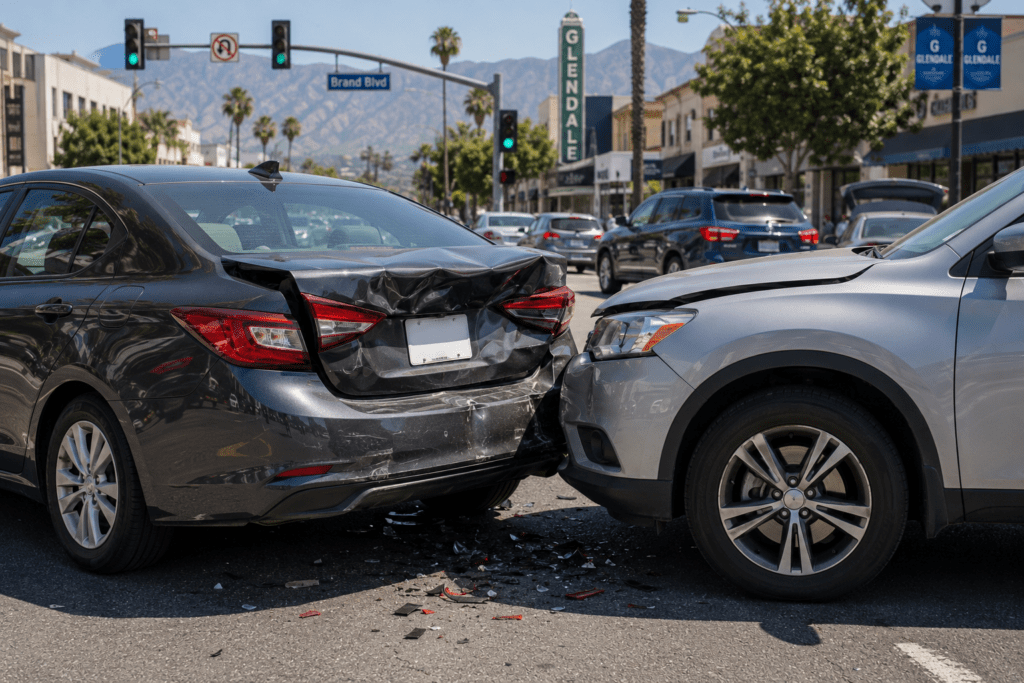
Rear-end accidents occur every day throughout Glendale, including on heavily traveled roads such as Brand Boulevard, Colorado Street, Glenoaks Boulevard, Central Avenue, and portions of State Route 134 and Interstate 5. These crashes may happen in stop-and-go traffic, at traffic signals, near freeway entrances, or while vehicles slow unexpectedly because of congestion or pedestrians. Although rear-end collisions are sometimes viewed as straightforward cases, the facts surrounding each accident can vary significantly. Questions may arise regarding sudden braking, chain-reaction crashes, mechanical failures, distracted driving, or unexpected roadway hazards.
Modern vehicles contain sophisticated electronic systems that can preserve valuable information for a limited period after certain collisions. According to the National Highway Traffic Safety Administration (NHTSA), Event Data Recorders (EDRs) installed in many passenger vehicles are intended to capture technical crash information immediately before, during, and after qualifying crash events. These systems help improve crash investigations and vehicle safety research rather than continuously monitoring driver activity.
This article explains how a Glendale rear end accident event data recorder may function, what information it can sometimes preserve, why this evidence should be documented promptly, how California law may affect preservation of electronic crash data, and what additional evidence may help investigators understand the circumstances surrounding a rear-end collision.
Understanding How Event Data Recorders Work
Many drivers are surprised to learn they have been driving a vehicle equipped with an Event Data Recorder for years without realizing it. Unlike an aftermarket dash camera mounted to the windshield, an Event Data Recorder is typically integrated into the vehicle’s airbag control module or another onboard electronic system. Its purpose is not to monitor every mile driven or record every action behind the wheel. Instead, the system is designed to capture a short snapshot of technical information when certain crash conditions occur.
A Glendale rear end accident event data recorder generally preserves only a few seconds of information surrounding a qualifying collision. The exact amount of information depends on the manufacturer, the vehicle’s design, and the severity of the crash. Some systems collect relatively limited data, while others record additional information that may assist engineers and crash investigators.
Understanding these differences is important because no two vehicles record identical information. Investigators often begin by determining what type of Event Data Recorder the vehicle contains before attempting to retrieve any electronic evidence.
Event Data Recorders Capture Technical Vehicle Information
The purpose of an Event Data Recorder is to preserve technical crash information—not video footage or continuous driving history. A Glendale rear end accident event data recorder generally records information directly related to vehicle operation immediately before and during a qualifying collision.
Depending on the manufacturer, this information may include vehicle speed, brake application, throttle position, steering input, engine revolutions, seat belt usage, airbag deployment timing, and changes in vehicle speed during impact. These measurements help engineers understand how the vehicle responded during a collision, but they rarely tell the complete story by themselves.
For example, electronic data may indicate that the driver applied the brakes one second before impact. However, the system cannot explain why the driver reacted at that exact moment. Investigators still need to determine whether traffic suddenly stopped, another vehicle merged unexpectedly, debris entered the roadway, or weather conditions reduced visibility. This is one reason electronic crash data should always be evaluated together with the surrounding evidence rather than interpreted independently.
Every Vehicle Records Different Information
Not every Event Data Recorder functions the same way. A Glendale rear end accident event data recorder installed in one manufacturer’s vehicle may preserve different information than a system installed by another manufacturer. Even different model years from the same automaker may record additional—or fewer—data elements depending on the technology available when the vehicle was built.
Because of these differences, investigators often rely on specialized software designed for particular manufacturers when retrieving electronic crash data. Understanding what information is available is often the first step before evaluating how that information fits into the broader accident investigation.
Federal performance standards for many Event Data Recorders are outlined in 49 CFR Part 563, which establishes technical definitions and reporting standards for crash data recorded by many passenger vehicles.
This is also why electronic crash evidence should never be viewed as a complete reconstruction of the accident. It is one valuable source of technical information that gains meaning only when compared with physical evidence, photographs, roadway measurements, and witness observations.
Not Every Rear-End Collision Triggers an Event Data Recorder
One of the biggest misconceptions surrounding Event Data Recorders is that every collision automatically creates a permanent electronic record. In reality, many low-speed impacts never trigger the system at all.
A Glendale rear end accident event data recorder generally activates only when a collision meets the manufacturer’s recording threshold. Minor parking lot impacts, slow-moving bumper contacts, or very low-speed collisions may not generate any stored event. Likewise, older vehicles may contain more limited recording capabilities than newer models equipped with advanced safety technology.
This limitation makes other forms of documentation equally important. Photographs taken immediately after the collision, police reports, surveillance footage, witness statements, roadway markings, and vehicle inspections frequently provide valuable context that electronic systems alone cannot capture.
For additional guidance on preserving evidence immediately after a collision, read What to Do After a Car Accident in California: What Actually Matters, which explains practical steps drivers can take to document important information while the scene is still fresh and avoid common mistakes that could affect an insurance claim or personal injury case.
If you suffered injuries in a rear-end collision, our Glendale Car Accident Lawyer page explains how different forms of evidence—including electronic crash data, witness statements, photographs, accident reconstruction, and Event Data Recorder information—may become important when investigating a personal injury claim.
What Information an Event Data Recorder May Capture Before and During Impact
A Glendale rear end accident event data recorder is designed to preserve technical information about the vehicle during the moments immediately surrounding a qualifying collision. Although many people think of it as a “black box,” it functions much differently than the flight recorders used in aviation. Instead of continuously monitoring a driver’s behavior, an Event Data Recorder typically captures only a brief snapshot of electronic vehicle data before, during, and immediately after a crash.
The information recorded depends on the vehicle manufacturer, model year, and the type of impact. Some systems collect only a handful of data points, while others preserve additional information about how the vehicle responded in the seconds leading up to the collision. For that reason, investigators rarely rely on the Event Data Recorder alone. Instead, they compare its findings with vehicle damage, roadway evidence, witness statements, surveillance footage, photographs, and police reports to better understand the sequence of events.
Vehicle Speed Before Impact
One of the most frequently discussed pieces of information preserved by a Glendale rear end accident event data recorder is vehicle speed immediately before impact. Depending on the manufacturer, the system may record changes in speed during the final seconds leading up to a collision, allowing investigators to compare those readings with physical evidence from the scene.
However, recorded speed should never be viewed in isolation. A driver traveling below the posted speed limit may still be unable to avoid a collision if another vehicle suddenly changes lanes or traffic unexpectedly comes to a complete stop. Likewise, a vehicle traveling slightly above the speed limit may not necessarily be the primary cause of a rear-end collision if another driver reverses unexpectedly or enters traffic without sufficient space.
Electronic speed information becomes most valuable when it is evaluated alongside photographs of the vehicle damage, skid marks, roadway measurements, witness observations, and any available surveillance video. Together, these forms of evidence often provide a far more complete understanding of the collision than any individual data point alone.
Brake Application May Help Explain Driver Response
Another important function of a Glendale rear end accident event data recorder is documenting whether the brake pedal was applied before impact. Depending on the vehicle, the system may indicate when braking began, how long the brakes were applied, and whether braking pressure changed during the final moments before the collision.
Although this information can be useful, it should not automatically be interpreted as proof of negligence or safe driving. A driver who brakes immediately may still be unable to avoid a collision if traffic conditions change suddenly, while another driver who appears to brake late may have been responding to circumstances that are not reflected in the electronic data alone.
Investigators frequently compare brake application information with roadway conditions, traffic flow, weather, visibility, vehicle spacing, and physical crash evidence to better understand whether the driver had sufficient time and distance to react. These factors often work together to provide context that the Event Data Recorder cannot capture by itself.
Accelerator Position and Steering Inputs
Some manufacturers also configure their systems to preserve accelerator pedal position and steering inputs before impact. A Glendale rear end accident event data recorder may therefore indicate whether the driver was accelerating, maintaining speed, or attempting to steer immediately before the collision occurred.
These electronic measurements may help investigators understand whether evasive actions were attempted before impact. For example, steering input combined with braking information may suggest that a driver attempted to avoid striking another vehicle, while consistent accelerator input may indicate a different sequence of events.
Even so, investigators avoid reaching conclusions based solely on these measurements. Driver actions must always be interpreted alongside the physical evidence available from the crash scene because electronic data cannot explain every circumstance that influenced a driver’s decisions during the collision.
Seat Belt Status and Airbag Deployment
Many Event Data Recorders also preserve information regarding occupant restraint systems. A Glendale rear end accident event data recorder may indicate whether seat belts were fastened and when airbags deployed during the crash sequence.
This information often assists engineers and investigators in evaluating how the vehicle’s safety systems responded during the collision. It may also help explain crash severity when compared with the damage sustained by each vehicle.
While restraint system information can provide valuable technical insight, it does not determine who caused the accident. Questions involving liability generally require a much broader review of all available evidence before conclusions are reached.
Why Electronic Crash Data Should Be Preserved Quickly
One of the most important characteristics of electronic crash evidence is that it may not remain available forever. Many drivers assume the information contained within their vehicle will always be accessible after an accident, but that is not necessarily the case. Depending on the manufacturer and the design of the system, certain information recorded by a Glendale rear end accident event data recorder may eventually be overwritten, replaced, or become unavailable after repairs or subsequent qualifying events.
Because electronic evidence can change over time, documenting available information as early as reasonably possible often becomes an important part of preserving the overall accident investigation.
Vehicle Repairs May Affect Available Electronic Evidence
Following a rear-end collision, many vehicles require repairs before they can safely return to the road. Airbag replacement, electronic module replacement, battery disconnection, or other repairs may affect the availability of information stored by a Glendale rear end accident event data recorder.
This does not mean necessary repairs should be delayed. Instead, it illustrates why documenting the vehicle and preserving available evidence before significant repairs begin may help maintain an accurate record of the vehicle’s condition immediately after the collision.
Photographs of the damaged vehicles, repair estimates, diagnostic reports, and inspection records may all become valuable pieces of documentation when viewed together with electronic crash data.
Electronic Data Is Only One Part of the Investigation
Although Event Data Recorders receive significant attention in many accident investigations, they rarely tell the complete story. A Glendale rear end accident event data recorder provides technical measurements about vehicle operation, but it cannot explain every circumstance surrounding the collision.
For example, the system generally cannot determine why traffic suddenly stopped, whether another driver merged unexpectedly, if debris entered the roadway, whether glare affected visibility, or what nearby witnesses observed before impact. Those questions are answered by comparing electronic information with every other available source of evidence.
Understanding how different forms of documentation work together can also be helpful after a collision. Our article How Personal Injury Settlements Really Work in California explains why preserving photographs, medical records, repair documents, witness information, and other evidence often creates a stronger and more complete picture of a personal injury claim.
California Laws That May Become Relevant During a Rear-End Collision Investigation
California law requires investigators to evaluate the specific facts surrounding every collision instead of making assumptions based solely on the type of accident. While a Glendale rear end accident event data recorder may provide valuable technical information, questions involving negligence and liability generally require a review of California traffic laws, roadway conditions, witness statements, and physical evidence.
Drivers Must Operate Their Vehicles at a Reasonable Speed
California’s Basic Speed Law (Vehicle Code §22350) requires motorists to operate their vehicles at a speed that is reasonable and prudent for existing traffic, weather, visibility, roadway conditions, and other surrounding circumstances.
A Glendale rear end accident event data recorder may provide speed-related information that investigators compare with vehicle damage, skid marks, and roadway measurements to determine how the collision developed. However, electronic speed data is only one factor among many considered during a crash investigation.
Following Distance May Become an Important Question
Rear-end collisions often involve questions about whether drivers maintained an adequate following distance. California expects motorists to leave enough space to stop safely if traffic slows or comes to an unexpected stop.
When reviewing a Glendale rear end accident event data recorder, investigators may compare braking information with roadway evidence, vehicle spacing, traffic congestion, and witness observations to determine whether the available stopping distance was sufficient under the circumstances.
Comparative Negligence May Affect Certain Claims
California follows a comparative negligence system, meaning more than one party may share responsibility for a collision depending on the evidence. Although rear-end crashes frequently involve the trailing vehicle, investigators may also evaluate sudden lane changes, mechanical failures, disabled vehicles, roadway hazards, chain-reaction collisions, or other contributing factors.
A Glendale rear end accident event data recorder provides only one piece of this larger investigation. Medical records, photographs, repair documentation, and other evidence often play an equally important role.
If you’re recovering from injuries following a collision, you may also find Should You Accept a Car Accident Settlement Before Finishing Medical Treatment in Newport Beach? helpful for understanding why completing treatment and preserving medical documentation can be important before resolving a personal injury claim.
How Event Data Recorder Evidence Is Combined With Other Types of Crash Evidence
Although electronic crash information can provide valuable insight, investigators rarely rely on a Glendale rear end accident event data recorder by itself. Every collision leaves behind multiple forms of evidence, and each piece helps explain a different part of what happened. Electronic vehicle data may establish how the vehicle responded during the final seconds before impact, but it cannot describe everything that occurred around the driver or explain why certain decisions were made.
For that reason, a thorough rear-end collision investigation typically compares Event Data Recorder information with photographs, roadway evidence, police reports, witness statements, surveillance footage, dashcam recordings, vehicle inspections, and medical records. When these sources support one another, they often create a much clearer understanding of how the accident unfolded.
Photographs and Video Can Preserve the Scene
Photographs taken immediately after a collision often capture details that disappear within minutes. Skid marks may fade, vehicles may be moved, debris may be cleared from the roadway, and weather conditions may change before investigators return to the scene.
A Glendale rear end accident event data recorder may indicate that braking occurred before impact, while photographs may show the actual length of skid marks, the resting positions of the vehicles, roadway damage, or visibility conditions. Video footage from nearby businesses, traffic cameras, or dashboard cameras may further illustrate how traffic was moving before the collision occurred.
Whenever possible, photographs should include the overall accident scene, vehicle damage, roadway markings, nearby traffic control devices, weather conditions, and any obstructions that may have affected visibility.
Witness Statements Provide Important Context
Electronic crash data records what the vehicle was doing—but not necessarily what the driver saw. Witnesses often provide information that cannot be measured electronically.
For example, witnesses may describe sudden traffic congestion, an unsafe lane change, debris in the roadway, an emergency vehicle approaching the intersection, or another driver’s unexpected actions before the collision. These observations may help explain why a driver braked suddenly or attempted to avoid another vehicle.
A Glendale rear end accident event data recorder becomes much more valuable when its technical information is considered alongside credible witness testimony instead of replacing it.
Vehicle Inspections May Identify Mechanical Issues
Sometimes investigators discover that vehicle maintenance or mechanical failures contributed to a collision. Brake components, tires, steering systems, suspension parts, lighting equipment, or electronic safety systems may all become relevant depending on the circumstances.
While a Glendale rear end accident event data recorder may record braking activity, it generally cannot determine whether worn brake pads, damaged tires, or another mechanical issue reduced the vehicle’s ability to stop safely.
Comparing electronic information with a professional vehicle inspection often provides investigators with a more complete understanding of whether equipment performance affected the collision.
What You Can Do After a Rear-End Collision
The moments immediately following a rear-end collision are often stressful and confusing. While every accident is different, preserving available evidence early may make it easier to understand what happened later. A Glendale rear end accident event data recorder may contain useful technical information, but it represents only one part of the overall investigation.
Taking practical steps immediately after a collision can help preserve important documentation while memories remain fresh and the accident scene has not significantly changed.
Document the Scene Safely
If it is safe to do so, photograph the vehicles from multiple angles before they are moved. Capture the surrounding roadway, lane markings, nearby intersections, traffic signals, weather conditions, debris, and any visible skid marks.
These photographs may later be compared with information preserved by a Glendale rear end accident event data recorder, helping investigators understand how the physical evidence corresponds with the electronic crash data.
Obtain Witness Information
Independent witnesses often leave the scene quickly. If someone observed the collision, ask for their name and contact information before they depart.
Even brief observations regarding traffic conditions, weather, or the movement of the vehicles may later provide valuable context when investigators compare witness testimony with the electronic information preserved by a Glendale rear end accident event data recorder.
Seek Medical Attention Promptly
Some injuries associated with rear-end collisions do not become fully apparent until hours or even days after the accident. Neck pain, headaches, back injuries, and soft tissue damage may develop gradually following the initial impact.
Seeking appropriate medical evaluation not only supports your health but also creates documentation that may become relevant during the overall investigation.
For additional guidance on documentation after an accident, read What to Do After a Car Accident in California: What Actually Matters, which discusses practical steps for preserving important evidence following a collision.
If you would like to learn more about the types of cases our firm handles, visit our Glendale Car Accident Lawyer page for additional information.
Frequently Asked Questions About Rear End Accident Event Data Recorder
Does every vehicle have an Event Data Recorder?
Not necessarily. Many newer passenger vehicles contain an Event Data Recorder, but the technology varies by manufacturer, model, and model year. A Glendale rear end accident event data recorder may record different information depending on the vehicle involved.
Does an Event Data Recorder record conversations?
No. In general, an Event Data Recorder does not function like a dashboard camera or voice recorder. Most systems preserve technical vehicle information associated with qualifying crash events rather than continuous audio or video recordings.
Can an Event Data Recorder prove who caused the accident?
Not by itself. A Glendale rear end accident event data recorder may provide valuable technical information, but investigators typically compare it with photographs, witness statements, police reports, roadway evidence, and other documentation before determining how the collision occurred.
Can low-speed rear-end collisions trigger an Event Data Recorder?
Sometimes, but not always. Every manufacturer establishes different recording thresholds. Some minor impacts may not generate stored electronic crash data.
Why is preserving evidence important?
Electronic crash information may be only one part of the investigation. Photographs, witness information, vehicle inspections, medical documentation, and surveillance footage often provide valuable context that helps investigators understand the complete sequence of events.
A Glendale rear end accident event data recorder may preserve valuable technical information during the moments immediately before and after a collision, including vehicle speed, brake application, steering inputs, seat belt status, and airbag deployment timing. Although this information can provide meaningful insight into how a vehicle responded during a crash, it should never be viewed as the sole source of evidence.
Rear-end collisions often involve multiple contributing factors, including traffic conditions, driver behavior, roadway design, visibility, weather, vehicle maintenance, and the actions of other motorists. Investigators generally compare Event Data Recorder information with photographs, witness statements, surveillance footage, police reports, vehicle inspections, and physical crash evidence to develop a more complete understanding of the collision.
Preserving available documentation as early as possible can help maintain important evidence before conditions change. Whether electronic data ultimately becomes relevant or not, thorough documentation frequently provides investigators with the best opportunity to accurately reconstruct what occurred.
Connect With Super Woman Super Lawyer
If you or someone you love has been injured in a rear-end collision, questions about electronic evidence, insurance claims, and liability can quickly become overwhelming. At Super Woman Super Lawyer, we help clients understand the types of evidence that may become important while guiding them through every stage of the claims process.
You can also learn more about our services by visiting our Glendale Car Accident Lawyer page.
Online Form: Request a case review
Call Now: 800.800.6916
Live Chat: Speak with a legal professional instantly
 Maryam Parman