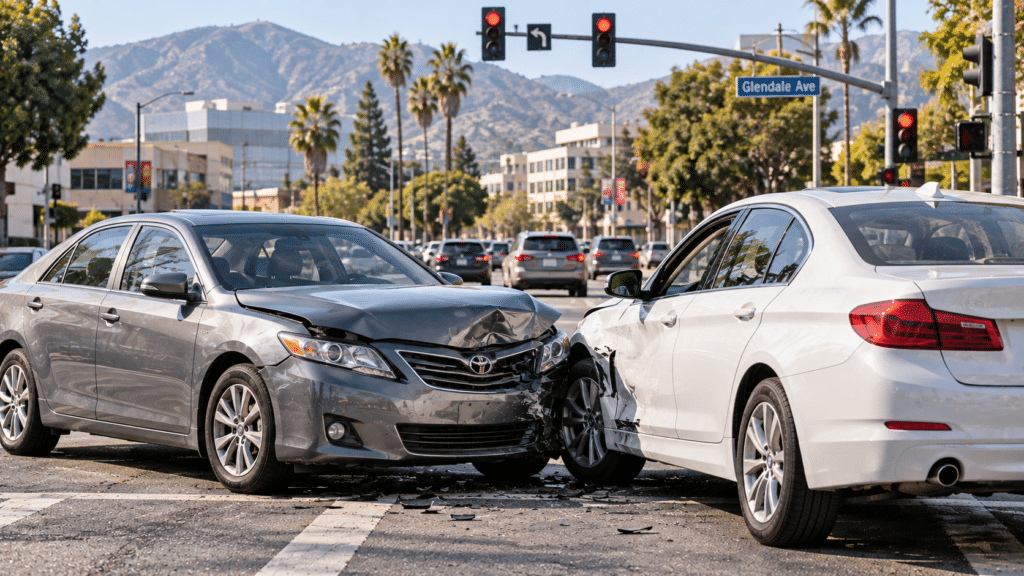
A Glendale left turn accident can become particularly difficult to investigate when the drivers and witnesses disagree about who had the right of way. One driver may report waiting for a protected green arrow before turning, while the oncoming driver insists the traffic light was green in their direction. A witness may remember seeing a yellow signal, another may describe the turning vehicle entering the intersection suddenly, and a third may have observed only the impact. These conflicting accounts can make it difficult to establish the sequence without examining the physical evidence, intersection design, and available recordings.
Left-turn collisions often involve several movements occurring within seconds. The turning driver may enter the intersection while waiting for an opening in oncoming traffic, begin the maneuver as a signal changes, or complete a turn under a protected arrow. The oncoming vehicle may be traveling straight, changing lanes, slowing, or approaching at a speed that becomes disputed. Following a Glendale left turn accident, investigators may need to reconstruct the position and movement of both vehicles before determining which explanation is supported by the evidence.
California law provides important context. Under California Vehicle Code section 21801, a driver intending to turn left generally must yield to approaching vehicles that are close enough to constitute a hazard, subject to the statute’s terms. Traffic signals can affect the applicable duties, particularly when protected left-turn arrows are involved. The legal analysis therefore requires more than simply determining which vehicle was turning.
An insurer may argue that the turning driver failed to yield. Another insurer may claim the oncoming vehicle entered against a red light or approached too quickly. A Glendale left turn accident investigation should compare those arguments with video, signal information, vehicle damage, witness positions, and other evidence rather than treating one driver’s recollection as definitive.
For injured motorists seeking local assistance, Super Woman Super Lawyer provides information about representation through its Glendale personal injury lawyer page. The firm’s car accident lawyer service page also addresses broader collision investigations, insurance disputes, and injury claims.
Preserving evidence promptly after a Glendale left turn accident can be important because vehicles may be repaired, witnesses may become difficult to contact, and surveillance footage may be overwritten before the conflicting accounts are resolved.
Reconstructing the Left-Turn Sequence
Understanding how the vehicles approached and entered the intersection is central to a Glendale left turn accident. The point of impact alone may not establish whether the turning driver had a protected arrow, whether the oncoming vehicle was already within the intersection, or whether the traffic signal changed during the maneuver.
Investigators may need to examine the turning lane, opposing lanes, signal configuration, intersection dimensions, and final vehicle positions. Photographs, video, police diagrams, and witness statements can help establish the sequence, but each source has limitations.
Turning Vehicle Position and Direction
The turning vehicle’s position before the collision can help explain the maneuver. A driver may have been stopped behind the limit line, waiting within the intersection, or already turning when the oncoming vehicle approached.
After a Glendale left turn accident, photographs should document the left-turn lane, stop line, lane arrows, median, crosswalks, and intersection geometry. The location of these features can help establish where the vehicle began moving and how it traveled toward the collision point.
Vehicle damage may provide additional context. A collision involving the turning vehicle’s passenger side may raise different reconstruction questions from one involving its front bumper or rear quarter panel. The meaning of those patterns should be evaluated alongside the vehicles’ movements rather than treated as conclusive by themselves.
The driver’s statement about when the turn began should also be preserved accurately. A person may remember the traffic light but not the precise location of the vehicle when the signal changed. Other evidence may help clarify those details.
Oncoming Traffic and Available Gaps
A permissive left turn may require the driver to evaluate the speed and distance of oncoming traffic before entering its path. A Glendale left turn accident involving a disputed gap can therefore require examination of where the oncoming vehicle was positioned when the turning driver began moving.
Witnesses may disagree about whether the gap was sufficient. A driver may report seeing an approaching vehicle at a distance and believing there was time to turn, while the oncoming motorist may say the turn began unexpectedly.
Video and roadway reference points may help qualified investigators evaluate vehicle movements and available reaction time. Witness estimates can provide useful context, but they should not automatically be treated as precise speed or distance measurements.
California Vehicle Code section 21801 addresses yielding during left turns. Whether a driver complied depends on the circumstances, including the position and movement of approaching traffic.
Signal Phase and Intersection Configuration
Traffic signal operation may become one of the most important issues in a Glendale left turn accident. Some intersections use protected left-turn arrows, while others allow permissive turns under a circular green indication. Certain intersections may use combinations of protected and permissive phases.
Investigators should identify the actual signal configuration rather than assume every intersection operates the same way. The California Vehicle Code section 21451 addresses the meaning of green traffic indications and green arrows.
The SWSL article Anaheim Protected Left-Turn Signal Evidence: How Traffic Signal Records May Help Explain a Collision explains how signal timing plans, controller information, and other records may be compared with video and witness accounts. These principles can also help guide a Glendale left turn accident investigation when the signal phase is disputed.
Not every intersection system stores the same information, and the existence of a computerized signal does not guarantee that a historical record of the collision moment is available. Investigators should identify the equipment and records actually maintained for the location.
Evidence That May Clarify a Glendale Left Turn Accident
When witnesses disagree about a Glendale left turn accident, objective evidence can help determine which accounts are consistent with the collision. Video may show when the vehicles entered the intersection, while photographs and physical damage can help identify their paths. Signal records may explain the intersection’s programmed operation, and witness statements may provide details that cameras did not capture.
These sources should be evaluated together. A camera may show the vehicles but not the signal heads. A witness may see the light change but lose sight of one vehicle. Physical evidence may help locate the impact but provide limited information about what happened several seconds earlier.
Dashcams, Traffic Cameras, and Nearby Surveillance
Dashcams can be valuable after a Glendale left turn accident because they may capture the approach, traffic signals, lane positions, and movements immediately before impact. A recording from one of the involved vehicles may show only part of the intersection, while footage from another motorist could provide a different angle.
Nearby businesses, parking facilities, apartment buildings, and other properties may have cameras overlooking the intersection. Investigators should document potential camera locations promptly because surveillance systems may overwrite recordings.
Traffic-management cameras should not automatically be assumed to store historical footage. The availability of recordings depends on the agency, equipment, and retention practices. Even when video is unavailable, signal timing plans and roadway design information may provide useful context.
Original video files should be preserved when possible. Compression, missing frames, or unsynchronized timestamps can affect the interpretation of a recording. A Glendale left turn accident involving a disputed signal change may require careful comparison of footage with the actual traffic-control sequence.
Witness Statements and Their Viewing Positions
Witnesses can offer valuable information, but their ability to observe a collision depends on where they were positioned and what they were watching. A pedestrian waiting at the corner may have a clear view of one traffic signal but not the oncoming vehicle’s approach. A driver stopped behind the turning car may observe its movements but not the opposing signal.
A Glendale left turn accident investigation should record each witness’s location, direction of travel, viewing angle, and description of what they personally observed. These details can help distinguish direct observations from assumptions made after hearing the impact.
Witnesses may also describe timing differently. One person might remember the signal turning yellow before the vehicle entered, while another recalls the turning driver moving during a green indication. Both statements should be preserved without forcing them into agreement.
The SWSL article San Jose Traffic Signal Timing Records: What They May Reveal After an Intersection Accident discusses how timing information can supplement eyewitness accounts. A Glendale left turn accident may benefit from the same evidence-based approach when witness recollections differ.
Vehicle Damage, Debris, and Final Resting Positions
Vehicle damage can help investigators evaluate how two vehicles came into contact. Photographs should document all sides of both vehicles, including dents, broken lights, bumper damage, wheel damage, and other visible conditions.
In a Glendale left turn accident, the location of damage may help identify the angle of contact. A front-to-side collision can produce different physical evidence from a front-to-front impact. However, damage patterns should not be interpreted in isolation when determining speed or fault.
Roadway debris may also provide context. Broken glass, plastic, vehicle components, fluid, tire marks, and scrape marks may help locate the impact area. Final vehicle positions can provide additional information, although vehicles may have been moved by responders or drivers before photographs were taken.
Preserve towing records and repair estimates as well. Supplemental repair documentation may reveal damage that was not visible during the initial inspection, while vehicle photographs can preserve its original post-collision condition.
Evaluating Conflicting Driver Statements
A Glendale left turn accident may generate several competing explanations. The turning driver may claim to have had a green arrow, while the oncoming driver insists the light was green for through traffic. Another account may involve a yellow indication, a speeding allegation, or disagreement about whether a vehicle was already inside the intersection.
The investigation should separate each factual claim and identify the evidence that might support or contradict it. A driver’s confidence in their recollection does not necessarily establish accuracy, particularly when the collision occurred within seconds.
Claims About Yellow or Red Traffic Signals
A yellow indication may become central to a disputed Glendale left turn accident. One driver may say the light was yellow when entering the intersection, while another may remember a red indication immediately before impact. The relevant question is not simply what color a witness remembers, but which signal applied to each vehicle and when the movement occurred.
California Vehicle Code section 21452 addresses steady yellow signals, while section 21453 addresses red indications. These rules should be applied to the actual signal configuration and the vehicles’ positions.
Signal timing plans can show programmed phases, but they do not necessarily prove what a particular signal displayed at a precise moment. Available controller logs, malfunction records, video, and witness accounts may need to be reviewed together.
A Glendale left turn accident involving conflicting red-light claims may also require identifying whether one driver was completing a movement already begun or entering the intersection after a signal changed. Those circumstances should be reconstructed from evidence rather than assumed.
Speed and Reaction-Time Allegations
An insurer may argue that the oncoming vehicle approached too quickly for the turning driver to judge the available gap. The oncoming driver may respond that the turning vehicle entered unexpectedly and left insufficient time to brake.
A Glendale left turn accident involving disputed speed may require video, roadway measurements, vehicle damage, witness accounts, and potentially electronic vehicle information. Speed estimates from witnesses should be treated as observations rather than precise measurements.
California’s basic speed law requires motorists to operate at speeds reasonable for prevailing conditions. Whether a particular speed was unreasonable depends on the actual circumstances.
Reaction time is also influenced by visibility, traffic, distance, and when a hazard becomes apparent. Technical reconstruction may be appropriate when the available time to avoid contact is disputed.
Differences Between Witness Estimates and Physical Evidence
Witness accounts may describe a vehicle as traveling quickly, turning abruptly, or entering the intersection at the last moment. Those descriptions can be useful, but they should be compared with physical evidence.
A Glendale left turn accident investigation may find that damage locations, video, or vehicle data provide a more detailed account of movement than a witness could observe. Conversely, a witness may describe a traffic signal or obstruction that was outside the camera’s view.
Some vehicles contain event data recorders capable of storing limited information about certain crashes. The available data depends on the vehicle and recording conditions. SWSL’s Glendale Rear-End Accident Event Data Recorder article explains how electronic vehicle information may supplement photographs, witness accounts, and other evidence.
An event data recorder does not generally establish what traffic signal the driver saw or whether the driver correctly judged a gap. Its information should be interpreted within the broader Glendale left turn accident investigation.
Insurance and Injury Documentation After a Glendale Left Turn Accident
An injured person may be receiving medical treatment while insurers continue to dispute the cause of the collision. A Glendale left turn accident can involve competing fault allegations, requests for recorded statements, vehicle inspections, and settlement discussions before every witness or video source has been reviewed.
Organizing collision evidence separately from medical and financial documentation helps preserve a clear record of both the accident and its consequences.
Competing Fault Positions From Insurers
An insurer representing the turning driver may argue that the oncoming vehicle was speeding or entered against a red signal. The other driver’s insurer may contend that the left-turning motorist failed to yield or began the maneuver without sufficient clearance.
A Glendale left turn accident claim should preserve each insurer’s correspondence, claim number, adjuster information, and explanation of its position. An early denial or fault assessment should be evaluated against the evidence rather than assumed to be the final legal determination.
California follows comparative-fault principles. Responsibility may be allocated between parties when the evidence supports negligence by more than one person. The effect on a particular claim depends on the circumstances and applicable law.
When several insurers or parties are involved, maintaining separate communication records can help prevent confusion about which company requested particular documents or made a settlement offer.
Medical Treatment and Vehicle Damage Records
Medical documentation may begin with emergency care, urgent care, or another initial evaluation. Depending on the injuries, treatment may involve imaging, specialist appointments, medication, therapy, or rehabilitation.
After a Glendale left turn accident, preserve clinical records showing the symptoms reported, evaluations performed, diagnoses made, and treatment recommended. Medical conclusions should come from qualified healthcare professionals rather than assumptions about the apparent severity of vehicle damage.
Repair estimates, photographs, towing invoices, and supplemental repair documentation may establish property losses. The location of damage can also help investigators understand the collision mechanics.
Employment records may document missed work, reduced hours, modified duties, or time away for treatment. Provider restrictions, schedules, pay information, and employer communications may help establish the financial impact.
A Glendale left turn accident file should connect these records through an accurate chronology while keeping medical conclusions separate from technical crash reconstruction.
Settlement Timing Before Video or Witness Evidence Is Reviewed
Settlement offers may arrive before all evidence has been collected. An insurer may evaluate the claim based on its driver’s statement, a preliminary police report, or photographs without having reviewed every available recording.
A Glendale left turn accident involving conflicting witnesses may require particular care when considering an early settlement. Before signing a release, the injured person should understand which parties and claims it covers and whether important medical or liability evidence remains incomplete.
The scope of a release depends on its language. Settling one part of a claim may have consequences that should be understood before the agreement is signed.
Preserve settlement offers, releases, demands, medical authorizations, and substantive insurer communications. These records can help establish what information was available during negotiations.
November Visibility and Evening Intersection Conditions in Glendale
November’s shorter daylight hours can create different lighting conditions during evening commutes in Glendale. An intersection that was brightly illuminated during a summer commute may be in twilight or darkness at the same clock time later in the year.
For a Glendale left turn accident occurring near sunset, investigators may need to consider glare, streetlighting, headlights, shadows, and whether the vehicles or traffic signals were clearly visible. These conditions should be established from the actual collision time and evidence.
Seasonality should not replace the factual investigation. A midday collision with clear visibility presents different questions from one occurring during an evening commute. The existence of November darkness does not prove that it contributed to the crash.
Photographs taken at approximately the same time of day may provide useful context, but weather, traffic, camera exposure, and lighting conditions may differ from the original scene.
Legal Deadlines and Evidence Preservation
California generally provides a two-year limitations period for personal injury lawsuits under Code of Civil Procedure section 335.1, subject to exceptions. Claims involving public entities may have separate claim-presentation procedures and shorter deadlines.
The practical evidence-preservation period after a Glendale left turn accident can be much shorter. Surveillance footage may be overwritten, vehicles repaired, and witnesses become difficult to contact. Traffic signal systems may also have different recordkeeping capabilities and retention practices.
Preserving photographs, original video, vehicle information, witness contacts, medical records, and insurance correspondence promptly can help maintain a reliable record.
A legal filing deadline should not be treated as an evidence-preservation schedule. The appropriate deadline for an individual case depends on its circumstances.
Serving Injured Drivers Throughout Glendale and Los Angeles County
Glendale includes residential neighborhoods, commercial corridors, shopping areas, and major transportation connections. Streets such as Brand Boulevard, Central Avenue, Glendale Avenue, Colorado Street, and Glenoaks Boulevard contain intersections where turning and through traffic interact.
A Glendale left turn accident may occur at a signalized commercial intersection, a residential crossing, or another roadway configuration. Each location may have different traffic signals, lane markings, sightlines, and camera sources.
The investigation should identify the actual intersection rather than rely on general assumptions about Glendale traffic. A protected turn arrow, permissive signal, or unusual lane configuration can affect how the collision should be evaluated.
Super Woman Super Lawyer’s Glendale personal injury lawyer page provides local representation information, while the firm’s car accident lawyer service page addresses broader collision claims. A Glendale left turn accident involving conflicting witnesses may require connecting both areas of representation with detailed evidence preservation.
Frequently Asked Questions About Glendale Left-Turn Accidents
Who is responsible for a left-turn collision in California?
Responsibility depends on the traffic signals, vehicle movements, right-of-way rules, and evidence. California Vehicle Code section 21801 generally requires a left-turning driver to yield to approaching traffic close enough to constitute a hazard, subject to the statute’s terms. A Glendale left turn accident should be evaluated according to the actual circumstances rather than an automatic assumption that the turning driver was responsible.
What if both drivers say they had a green light?
Investigators may review the signal configuration, available controller records, video, witness accounts, and roadway evidence. A Glendale left turn accident may involve different signal indications for different lanes or movements, so the actual intersection operation matters.
Can a protected green arrow affect responsibility?
Yes. A protected left-turn arrow may establish a different permitted movement from a permissive turn under a circular green signal. The actual indication and vehicle movements must be established from the evidence.
Can traffic signal records show which light was green?
Sometimes. Signal timing plans and certain controller records may provide information about signal operation, but not every system stores historical event data. A Glendale left turn accident investigation should determine which records actually exist.
What if witnesses disagree about the traffic signal?
Record each witness’s account and viewing position. Compare the statements with available video, signal information, and physical evidence rather than selecting an account solely because the witness appears confident.
Can dashcam footage help resolve a left-turn dispute?
Potentially. Video may show the vehicle’s approach, signal indications, lane positions, and collision sequence. The recording’s camera angle, quality, and timestamps should be considered.
What if the oncoming driver was speeding?
Speed may become relevant when evaluating the available gap and reaction time. An allegation should be supported by evidence such as video, physical reconstruction, or other reliable information.
Does a yellow light automatically make a left turn unsafe?
No single signal color determines the entire collision. The applicable traffic-control rules, vehicle positions, timing, and movements must be considered together.
Can vehicle damage establish the direction of impact?
Damage may help identify contact points and collision angles, but it should be compared with photographs, roadway evidence, witness statements, and video. Technical reconstruction may be necessary.
What if my vehicle was moved before photographs were taken?
Document its later position and identify any earlier photographs from witnesses, law enforcement, tow operators, or other sources. A Glendale left turn accident can still be investigated using other available evidence.
Can electronic vehicle data help?
Potentially. Some vehicles record limited crash-related data, depending on their equipment and the circumstances. Such data may supplement but not replace witness accounts, traffic signal information, and physical evidence.
Can both drivers share responsibility?
Yes. California comparative-fault principles may apply when the evidence supports negligence by more than one person. The allocation depends on the facts.
Should I accept a settlement before witness disputes are resolved?
The appropriate decision depends on the claim. Before signing a release, understand its scope and whether important liability, medical, or financial information remains incomplete.
How quickly should I preserve intersection evidence?
As early as reasonably possible. Video recordings, witness information, vehicle condition, and temporary roadway features may change long before the legal filing deadline.
Call or Contact Super Woman Super Lawyer 24/7 for a Free Consultation and Pay Nothing Unless You Win
A Glendale left turn accident involving conflicting witnesses can raise difficult questions about traffic signals, turning movements, oncoming vehicle speed, visibility, and right of way. The investigation may require photographs, dashcam footage, surveillance, signal information, witness statements, vehicle damage, and police records.
Super Woman Super Lawyer can help evaluate the complete Glendale left turn accident record, including collision evidence, medical treatment, repair documentation, employment losses, and insurance communications. When witnesses disagree, preserving objective evidence early may help clarify what happened before important information becomes unavailable.
For local assistance, visit our Glendale personal injury lawyer page. You can also learn more about our car accident representation services.
Super Woman Super Lawyer offers free consultations. You pay no attorney fees unless you win, subject to the representation agreement. Past results do not guarantee a particular outcome.
Connect with Super Woman Super Lawyer today:
Online Form: Request a case review
Call Now: 800.800.6916
Live Chat: Speak with a legal professional instantly
 Maryam Parman