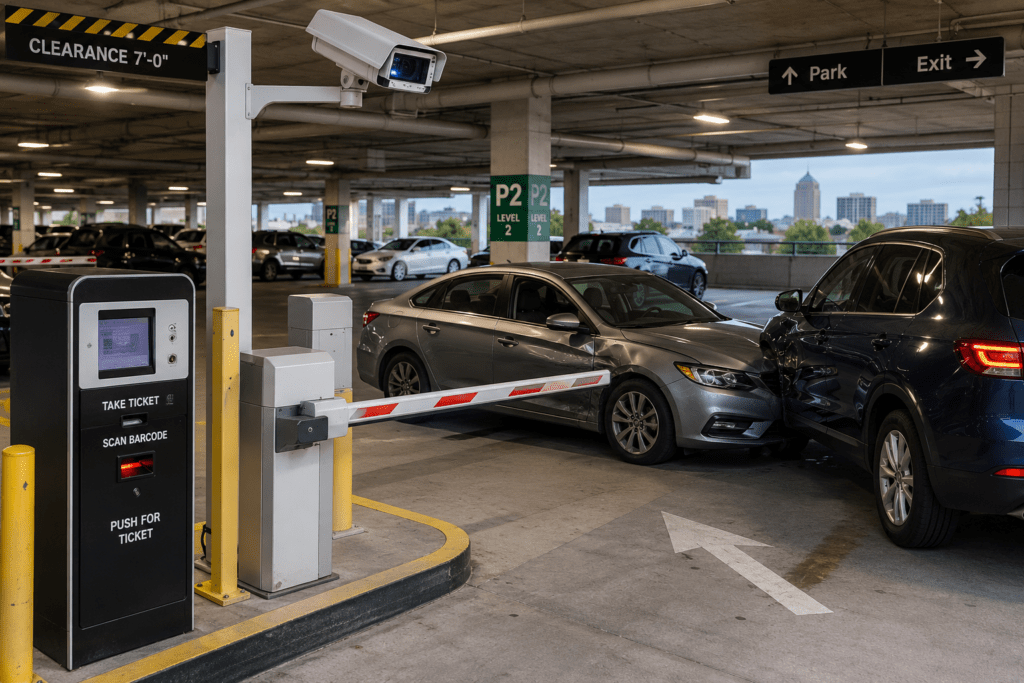
A Fresno parking garage accident access records investigation may involve much more than reviewing vehicle damage or speaking with witnesses. Modern parking garages frequently use automated entry gates, ticket dispensers, license plate recognition systems, keycard readers, payment kiosks, and digital access control software that record vehicles entering and leaving the facility throughout the day. Depending on the parking system installed, these electronic records may help establish when a vehicle entered the garage, how long it remained inside, which entrance or exit was used, and whether multiple vehicles were present at the time of a collision. Although these records do not determine fault by themselves, they may become valuable pieces of evidence during a parking garage accident investigation.
At Super Woman Super Lawyer, we understand that collisions occurring inside parking structures often require a different type of investigation than accidents on public roadways. A Fresno parking garage accident access records review may be compared with surveillance footage, witness statements, police reports, photographs, vehicle damage, garage maintenance records, lighting conditions, and roadway markings inside the structure. Looking at every available source of evidence together often provides investigators with a more complete understanding of how the collision occurred.
Parking garage accidents occur throughout Fresno at hospitals, office buildings, shopping centers, entertainment venues, hotels, apartment complexes, universities, and municipal parking structures. Unlike traditional streets, parking garages often include limited visibility around corners, narrow travel lanes, pedestrian crossings, ramps, blind spots, controlled entrances, and automated gate systems. Because vehicles enter and exit through designated access points, electronic entry records sometimes provide information that simply does not exist following accidents occurring on ordinary roadways.
According to the National Highway Traffic Safety Administration (NHTSA), low-speed crashes occurring in parking facilities can still result in serious injuries, particularly when pedestrians, bicyclists, or multiple vehicles are involved. Thoroughly documenting available evidence—including electronic records maintained by parking facilities—may assist investigators in understanding how an accident occurred.
This article explains how Fresno parking garage accident access records may become part of a collision investigation, what types of electronic information parking facilities sometimes maintain, why these records should be preserved promptly, and how investigators compare access records with other available evidence.
Why Parking Garages Generate Valuable Electronic Evidence
Many drivers do not realize how much information modern parking facilities automatically collect. While entry gates appear to perform a simple task—raising and lowering as vehicles arrive—the systems controlling them often record detailed electronic information throughout the day. Depending on the facility, automated software may document ticket issuance, keycard access, payment transactions, license plate recognition, vehicle entry times, exit times, and gate operation logs.
A Fresno parking garage accident access records investigation often begins by determining what type of parking management system controls the facility. Some garages rely on paper tickets with electronic timestamps, while others use RFID credentials, mobile applications, proximity cards, or license plate recognition cameras that automatically record vehicle movements without requiring drivers to stop.
Because every parking facility operates differently, investigators first determine which electronic systems were installed before evaluating what information may still be available following the collision.
Entry Gate Systems Often Record Precise Timestamps
One of the most valuable aspects of a Fresno parking garage accident access records investigation is the ability to review electronic timestamps generated automatically by the parking system. Depending on the equipment installed, every vehicle entering or leaving the facility may create a digital record documenting the date, time, entry lane, and method of access.
These timestamps may later be compared with surveillance footage, witness statements, payment records, and photographs to establish whether a vehicle entered the garage shortly before the collision or had already been parked for an extended period. While timestamps alone cannot determine liability, they frequently help investigators establish a more accurate timeline than witness memory alone.
Because these records are generated automatically, they may provide an objective source of information regarding vehicle movements inside the facility.
License Plate Recognition Systems May Record Vehicle Movement
Many modern parking garages now use License Plate Recognition (LPR) technology rather than traditional paper tickets. Cameras positioned at entrances and exits automatically photograph license plates while software records the vehicle’s arrival and departure.
A Fresno parking garage accident access records investigation may therefore include reviewing LPR records to determine when a particular vehicle entered the garage, which entrance was used, and whether multiple vehicles entered the facility within a similar timeframe.
Although LPR systems primarily assist with parking management, they may also become valuable sources of evidence after a collision. Investigators often compare these records with surveillance footage and witness statements to better understand vehicle movements before and after the accident.
Payment Systems May Also Create Electronic Records
Many parking garages now rely on automated payment kiosks, mobile applications, QR code systems, or cashier stations that record transaction histories electronically. Depending on the facility, payment records may include timestamps, payment methods, ticket numbers, or other information associated with a particular parking session.
A Fresno parking garage accident access records investigation may compare payment records with gate logs, surveillance video, and access control information to determine when a vehicle exited the garage or whether a driver remained inside the facility after the reported collision.
Because payment records are often synchronized with gate activity, investigators may be able to compare multiple electronic systems together when reconstructing the sequence of events.
For additional guidance on preserving important evidence after a collision, read What to Do After a Car Accident in California: What Actually Matters. Many of the same documentation principles discussed in that guide also apply following parking garage collisions, particularly when electronic records and surveillance footage may be available.
If you were injured in a parking garage collision, our Fresno Car Accident Lawyer page explains how access control records, surveillance footage, photographs, witness statements, and other forms of evidence may become important during the investigation of a personal injury claim.
Why Access Control Records Should Be Preserved Quickly
One of the most important aspects of a Fresno parking garage accident access records investigation is recognizing that electronic parking records may not remain available indefinitely. Parking management companies often maintain automatic retention schedules that archive, overwrite, or delete electronic information after a certain period. Surveillance footage may also be stored separately from access control records, meaning different systems may preserve information for different lengths of time.
Because every parking operator follows its own retention policies, investigators often work to identify available electronic records as early as reasonably possible after a collision. Acting promptly may improve the opportunity to preserve entry logs, payment histories, license plate recognition data, and surveillance footage before routine system maintenance or automated retention schedules remove older records.
Different Parking Operators Use Different Management Systems
Not every parking garage uses the same technology. Hospitals, airports, office buildings, universities, apartment complexes, and municipal parking facilities frequently contract with different parking management companies, each operating unique software platforms and retention procedures.
A Fresno parking garage accident access records investigation often begins by identifying who owns or manages the facility, what access control system is installed, and how long electronic records are typically maintained. Understanding those procedures early may help investigators determine what evidence remains available before routine system maintenance affects the original records.
How Access Control Records May Help During a Parking Garage Accident Investigation
A Fresno parking garage accident access records investigation often involves comparing multiple electronic systems rather than relying on a single source of information. Modern parking facilities frequently integrate entry gates, payment kiosks, license plate recognition cameras, surveillance systems, elevator access controls, and management software into one centralized platform. When investigators review these records together, they may be able to reconstruct the sequence of events leading up to a collision with greater accuracy than would be possible using witness statements alone.
Electronic records are particularly valuable because parking garage collisions often occur in confined spaces where visibility is limited. Curved ramps, structural columns, low ceilings, parked vehicles, and narrow drive aisles can make it difficult for drivers to observe one another until the last moment. Access control records may help establish when vehicles entered the garage, how long they remained inside, and whether other electronic records correspond with the reported time of the accident.
Entry and Exit Records May Help Establish a Timeline
One of the primary reasons investigators review Fresno parking garage accident access records is to establish a reliable timeline. Unlike witness recollections, which naturally become less precise over time, electronic gate systems automatically record activity as it occurs.
Depending on the parking facility, investigators may compare entry timestamps, exit logs, ticket issuance records, payment transactions, and surveillance footage to determine whether a vehicle entered the garage immediately before the collision or had been parked inside the structure for an extended period. These electronic records may also help investigators understand whether multiple vehicles arrived at similar times or whether another vehicle left the garage shortly after the accident occurred.
Although electronic timestamps alone do not establish fault, they frequently provide valuable context when evaluated together with the surrounding evidence.
License Plate Recognition Cameras May Document Vehicle Movement
Many commercial parking facilities use License Plate Recognition (LPR) cameras to automate parking operations. These systems photograph license plates as vehicles enter and exit while simultaneously recording the date, time, lane location, and other operational information.
A Fresno parking garage accident access records investigation may include comparing LPR records with surveillance footage, witness statements, and vehicle damage to determine how vehicles moved throughout the facility before the collision. In some situations, investigators may also identify additional vehicles that entered or exited the garage during the same timeframe, helping establish a more complete sequence of events.
Because LPR systems are designed for parking management rather than accident reconstruction, investigators generally compare this information with other available evidence before reaching conclusions.
Surveillance Cameras and Access Records Often Work Together
Parking garages frequently operate multiple security cameras covering entrances, exits, payment stations, elevators, stairwells, pedestrian walkways, and vehicle travel lanes. A Fresno parking garage accident access records investigation may therefore involve synchronizing surveillance footage with electronic gate records to determine exactly when vehicles entered or exited the facility.
For example, entry gate timestamps may confirm when a vehicle entered the garage, while surveillance footage documents where the vehicle traveled afterward. When investigators compare these systems together, they may better understand the movements of the vehicles involved before and after the collision.
Understanding how different forms of evidence work together is an important part of any accident investigation. Our article How Personal Injury Settlements Really Work in California explains why preserving photographs, electronic records, witness statements, repair documentation, and medical records often provides a more complete understanding of a personal injury claim.
California Laws That May Become Relevant During a Parking Garage Accident Investigation
Although Fresno parking garage accident access records may provide valuable electronic information, determining responsibility for a collision requires investigators to evaluate all available evidence. Parking garages present unique driving conditions that differ from open roadways, yet California traffic laws still require motorists to operate their vehicles safely and reasonably under the circumstances.
Drivers Must Operate Their Vehicles at a Reasonable Speed
California’s Basic Speed Law (Vehicle Code §22350) requires motorists to drive at a speed that is reasonable and prudent based upon traffic, visibility, roadway conditions, and other surrounding circumstances.
Inside parking garages, limited visibility, blind corners, pedestrian crossings, parked vehicles, and confined driving lanes often require drivers to travel more cautiously than they would on public streets. During a Fresno parking garage accident access records investigation, investigators may compare electronic access records with surveillance footage, vehicle damage, roadway design, and witness observations when evaluating how the collision occurred.
Property Conditions May Also Be Evaluated
Unlike many traffic collisions that occur on public roadways, parking garage accidents frequently take place on privately owned property. Depending on the circumstances, investigators may examine lighting conditions, visibility around structural columns, pavement markings, directional signage, mirrors installed at blind corners, pedestrian walkways, gate operation, and the overall design of the facility.
A Fresno parking garage accident access records investigation may therefore include reviewing maintenance records, surveillance footage, photographs, and access control information together with the physical layout of the garage. Determining responsibility often requires evaluating both driver conduct and the conditions present within the facility at the time of the collision.
Comparative Negligence May Still Apply
California follows a comparative negligence system, meaning investigators evaluate the actions of everyone involved rather than assuming one driver is automatically responsible. Parking garage collisions may involve multiple contributing factors, including limited visibility, confusing traffic patterns, pedestrian activity, mechanical failures, roadway design, or the conduct of more than one driver.
For that reason, a Fresno parking garage accident access records investigation represents only one component of the broader analysis. Electronic gate records, surveillance footage, photographs, witness statements, vehicle inspections, and physical evidence all contribute to understanding how the collision occurred.
If you’re recovering from injuries following a collision, you may also find Should You Accept a Car Accident Settlement Before Finishing Medical Treatment in Newport Beach? helpful for understanding why preserving medical documentation and completing treatment may become important before resolving a personal injury claim.
What You Can Do to Help Preserve Parking Garage Evidence
Because electronic parking records and surveillance footage may not remain available indefinitely, documenting available evidence as early as reasonably possible may improve the overall investigation. A Fresno parking garage accident access records investigation often benefits from preserving both the electronic records maintained by the parking operator and the physical evidence present at the scene.
Photograph the Entire Garage Environment
If it is safe to do so, photograph not only the damaged vehicles but also the surrounding environment. Capture entry gates, ticket machines, payment kiosks, directional signs, lane markings, structural columns, mirrors, lighting fixtures, pedestrian crossings, ramps, and nearby surveillance cameras.
These photographs may later be compared with Fresno parking garage accident access records, allowing investigators to evaluate how the electronic records correspond with the physical layout of the parking structure.
Identify Who Operates the Parking Facility
Many parking garages are managed by third-party parking companies rather than the property owner. If possible, note the name of the parking operator displayed on payment kiosks, entry signs, receipts, or customer service information within the garage.
Identifying the operator early may help investigators determine who maintains the Fresno parking garage accident access records, surveillance footage, payment logs, and other electronic systems that could become relevant during the investigation.
Frequently Asked Questions About Parking Garage Access Records
What are parking garage access records?
Fresno parking garage accident access records generally refer to the electronic information generated when vehicles enter or leave a parking facility. Depending on the garage, these records may include entry and exit timestamps, ticket numbers, keycard activity, mobile app transactions, license plate recognition (LPR) data, payment records, and gate operation logs. Although these records do not determine fault by themselves, they may help investigators establish a timeline following a collision.
Can parking garage access records help identify when a vehicle entered the garage?
In many facilities, yes. A Fresno parking garage accident access records investigation may include reviewing automated gate logs or license plate recognition records that document when a vehicle entered or exited the garage. These electronic timestamps can sometimes be compared with surveillance footage, witness statements, and payment records to better understand the sequence of events surrounding the collision.
How long are parking garage records usually kept?
Every parking operator establishes its own retention policies. Some facilities store electronic records for extended periods, while others automatically overwrite surveillance footage or archive access logs after a relatively short time. Because retention schedules vary, a Fresno parking garage accident access records investigation often benefits from identifying and preserving available records as early as possible.
Can surveillance cameras and gate records be reviewed together?
Yes. Many parking facilities synchronize multiple electronic systems, allowing investigators to compare gate activity with surveillance footage, payment records, and license plate recognition data. A Fresno parking garage accident access records investigation may therefore use several independent sources of electronic evidence to better understand vehicle movements before and after a collision.
Are parking garage accidents investigated differently than roadway collisions?
Parking garage collisions often involve unique evidence that is unavailable on public streets. Investigators may evaluate garage lighting, directional signage, structural columns, pedestrian crossings, surveillance systems, access control records, and traffic flow inside the facility in addition to the evidence commonly reviewed after any motor vehicle accident.
A Fresno parking garage accident access records investigation may reveal valuable electronic information that helps investigators understand how a collision occurred inside a parking structure. Entry gate logs, license plate recognition systems, payment records, surveillance cameras, and access control software may all contribute to establishing when vehicles entered the facility, how they moved through the garage, and what occurred before and after the collision.
While electronic access records can provide valuable context, they are only one part of a thorough investigation. Investigators generally compare those records with photographs, surveillance footage, witness statements, police reports, vehicle inspections, garage maintenance records, and the physical layout of the parking facility before drawing conclusions. Looking at these sources together frequently provides a clearer understanding of what occurred than relying on any single piece of evidence alone.
Because many parking management systems automatically archive or overwrite older electronic records, preserving available information promptly may improve the opportunity to review original evidence. Whether the collision occurred in a hospital parking structure, shopping center garage, office building, apartment complex, or municipal parking facility, identifying available electronic records early may become an important part of documenting the accident.
Connect With Super Woman Super Lawyer
If you or someone you love has been injured in a parking garage collision, understanding what evidence may be available can feel overwhelming. At Super Woman Super Lawyer, we help clients understand how surveillance footage, access control records, gate logs, license plate recognition systems, witness statements, photographs, and other documentation may become important during the investigation of a personal injury claim.
You can also learn more about our services by visiting our Fresno Car Accident Lawyer page.
Connect with Super Woman Super Lawyer today.
Online Form: Request a case review
Call Now: 800.800.6916
Live Chat: Speak with a legal professional instantly
 Maryam Parman