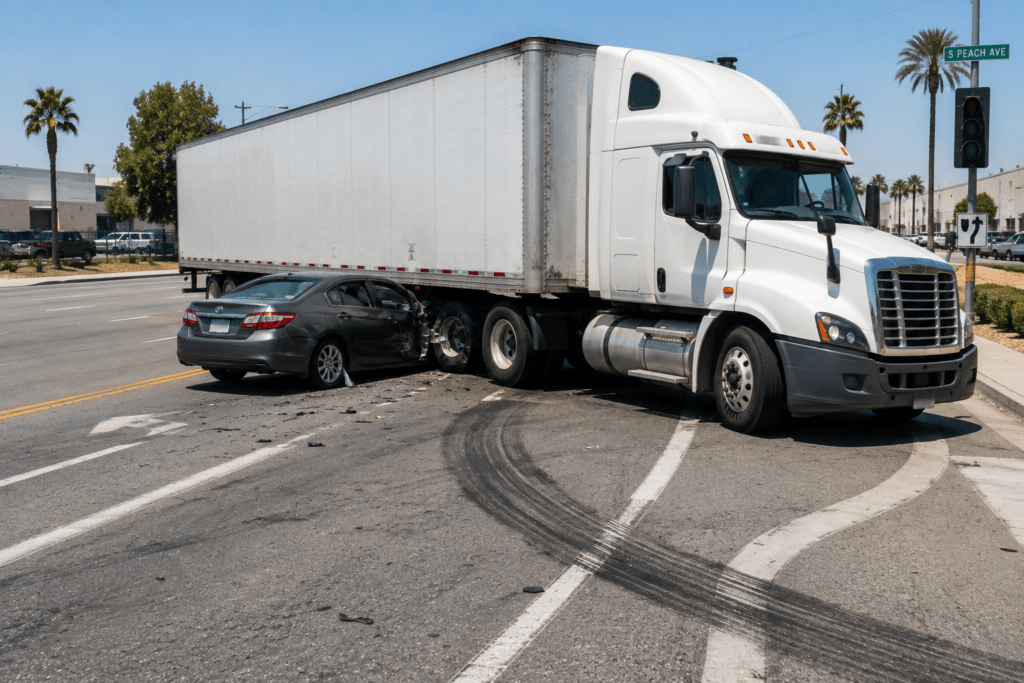
A Fresno commercial truck wide turn blind spot collision often develops differently than a typical passenger vehicle accident. Commercial trucks require considerably more space to turn, have larger blind spots, and operate under different physical limitations than smaller vehicles. Drivers of passenger cars, motorcycles, bicycles, or pedestrians may not always anticipate how a tractor-trailer or large delivery truck will maneuver through an intersection or commercial driveway. When a collision occurs during a wide turn or while another vehicle is traveling beside the truck, investigators often rely on trucking records, vehicle inspections, photographs, surveillance footage, and witness statements to better understand how the crash unfolded.
At Super Woman Super Lawyer, we understand that commercial truck accident investigations frequently involve significantly more evidence than collisions between passenger vehicles. A Fresno commercial truck wide turn blind spot investigation may include dashcam recordings, GPS information, telematics data, dispatch records, maintenance documentation, inspection reports, police reports, witness statements, roadway evidence, and vehicle damage. Looking at these sources together often provides investigators with a more complete understanding of the collision than relying on any single piece of evidence.
Commercial trucks travel throughout Fresno every day along Highway 99, Highway 41, Highway 180, Highway 168, Shaw Avenue, Blackstone Avenue, Herndon Avenue, and numerous industrial and agricultural corridors. Tractor-trailers, refrigerated trucks, construction vehicles, and local delivery trucks frequently enter distribution centers, warehouses, retail stores, food processing facilities, and commercial loading areas where wide turning movements are common. Because these vehicles require additional room to maneuver, collisions sometimes occur while nearby motorists, cyclists, or pedestrians are traveling alongside the truck.
According to the Federal Motor Carrier Safety Administration (FMCSA), commercial vehicle safety depends upon proper vehicle operation, driver awareness, inspection procedures, and compliance with federal safety regulations. Following a truck accident, investigators often review operational records together with physical evidence to better understand how the collision occurred.
This article explains why Fresno commercial truck wide turn blind spot collisions often become disputed, what trucking records may become important during the investigation, what evidence injured individuals should preserve, and why maintaining organized documentation may become valuable throughout the claims process.
Why Wide-Turn and Blind-Spot Truck Crashes Are Often Disputed
Commercial trucks operate very differently from passenger vehicles. Tractor-trailers, box trucks, and other large commercial vehicles require additional turning space, longer stopping distances, and significantly larger blind spots. As a result, collisions occurring during wide turns often involve differing accounts regarding vehicle positioning, lane usage, visibility, and the sequence of events immediately before impact.
A Fresno commercial truck wide turn blind spot investigation frequently begins by examining how the truck approached the turn, where surrounding vehicles were positioned, what roadway markings existed, and how traffic was flowing before the collision occurred. Rather than relying solely on one driver’s recollection, investigators generally compare several independent sources of evidence before reconstructing the events.
Because every truck, roadway, and intersection presents different operating conditions, investigators evaluate each collision individually.
Driver Claims About Space, Visibility, and Lane Position
One of the most common issues following a commercial truck collision involves differing opinions regarding how much space was available for the truck to complete its turn safely. Truck drivers may report that another vehicle entered a blind spot during the maneuver, while occupants of passenger vehicles may believe they remained visible throughout the approach.
A Fresno commercial truck wide turn blind spot investigation often compares these statements with photographs, surveillance footage, dashcam recordings, witness observations, roadway markings, and vehicle damage. Looking at these independent sources together frequently helps investigators better understand where each vehicle was positioned before the collision occurred.
Visibility conditions, traffic congestion, parked vehicles, roadway design, and surrounding commercial activity may all influence how the collision developed.
How Semi-Trucks and Delivery Trucks Can Create Different Evidence Questions
Not every commercial truck operates the same way. Tractor-trailers transporting freight, regional delivery trucks, box trucks, flatbed trucks, construction vehicles, and local delivery fleets often use different onboard technology, operate under different company procedures, and maintain different operational records.
A Fresno commercial truck wide turn blind spot investigation therefore begins by identifying the type of commercial vehicle involved and what electronic or operational records may be available. Some fleets utilize dashcams, GPS telematics, electronic logging devices, and dispatch software, while others maintain different forms of documentation depending on the company’s operations.
Understanding the type of commercial vehicle involved often helps investigators determine what additional evidence may be available beyond traditional accident documentation.
Why Nearby Drivers, Cyclists, or Pedestrians May Have Different Views of the Crash
Commercial truck collisions frequently involve individuals positioned in different locations around the truck immediately before impact. Passenger vehicle drivers, motorcyclists, bicyclists, pedestrians, and truck drivers often observe the same event from very different perspectives.
A Fresno commercial truck wide turn blind spot investigation may therefore include comparing multiple witness statements together with surveillance footage, roadway evidence, and truck documentation. Investigators frequently evaluate where each individual was positioned, what could reasonably be seen from that location, and how surrounding traffic affected visibility.
No single perspective typically explains every aspect of a commercial truck collision, making multiple sources of evidence especially valuable.
For additional guidance on preserving important documentation after a collision, read What to Do After a Car Accident in California: What Actually Matters. Many of the same evidence preservation principles discussed in that guide also apply following commercial truck accidents involving fleet records and electronic evidence.
If you were injured in a collision involving a commercial truck, our Fresno Truck Accident Lawyer page explains how trucking records, dashcam footage, GPS information, witness statements, and other evidence may become important during the evaluation of a truck accident claim.
Trucking and Delivery Records That May Help Explain the Collision
Commercial transportation often generates substantially more documentation than privately owned passenger vehicles. A Fresno commercial truck wide turn blind spot investigation frequently includes reviewing electronic records created before, during, and after the truck’s route in addition to traditional accident evidence.
Because different trucking companies operate different fleet management systems, investigators often begin by identifying what electronic and operational records may exist before evaluating the available documentation.
Route Details, Delivery Timing, and Dispatch Communications
Commercial trucking companies frequently maintain dispatch systems documenting scheduled routes, delivery assignments, arrival times, departure times, route changes, and communications between dispatch personnel and drivers.
A Fresno commercial truck wide turn blind spot investigation may include reviewing route documentation together with dispatch communications, delivery schedules, and other operational records to better understand the truck’s activities immediately before the collision.
Trucking and Delivery Records That May Help Explain the Collision
Commercial truck accident investigations often involve considerably more documentation than collisions between passenger vehicles. A Fresno commercial truck wide turn blind spot investigation may include reviewing electronic records created throughout the driver’s route, fleet management systems, maintenance records, and operational documentation in addition to traditional accident evidence such as photographs, witness statements, and police reports.
Because every trucking company operates differently, investigators generally begin by identifying what records may exist before determining how those records relate to the circumstances surrounding the collision.
Route Details, Delivery Timing, and Dispatch Communications
Commercial trucking companies often maintain dispatch systems documenting scheduled routes, pickup locations, delivery assignments, estimated arrival times, route changes, and communications between dispatch personnel and drivers throughout the workday.
A Fresno commercial truck wide turn blind spot investigation may include reviewing dispatch records together with route information to better understand where the truck was traveling immediately before the collision. Investigators may compare delivery schedules, GPS history, dispatch communications, and witness statements while reconstructing the truck’s movements leading up to the accident.
Because many commercial vehicles operate on carefully scheduled delivery routes, these records may provide additional context when evaluated alongside other available evidence.
Dashcam, Telematics, and GPS Records
Many commercial fleets now equip their vehicles with forward-facing dashcams, GPS tracking, telematics systems, electronic logging devices, and onboard safety technology. These systems may record vehicle location, speed, braking events, route history, and video footage while the truck remains in operation.
A Fresno commercial truck wide turn blind spot investigation often includes determining whether these electronic systems were operating before the collision. Investigators may compare GPS information with dashcam recordings, roadway evidence, surveillance footage, and witness statements to better understand how the truck approached the intersection or completed the turning maneuver.
Because every fleet uses different technology providers, the available electronic records vary considerably from one trucking company to another.
Inspection, Maintenance, and Vehicle Configuration Materials
Commercial trucks undergo routine inspections and maintenance throughout their operating lives. Depending on the type of vehicle involved, investigators may review inspection reports, maintenance records, repair documentation, tire information, brake inspections, lighting systems, mirrors, safety equipment, and vehicle configuration records.
A Fresno commercial truck wide turn blind spot investigation may compare these materials with vehicle inspections conducted after the collision to better understand the truck’s operating condition at the time of the accident. These records often complement other available evidence rather than serving as the sole basis for evaluating how the collision occurred.
Understanding how multiple forms of evidence work together can also be helpful after any serious vehicle collision. Our article How Personal Injury Settlements Really Work in California explains why preserving photographs, medical documentation, witness statements, electronic records, and repair information frequently creates a more complete understanding of a personal injury claim.
\Scene Evidence Injured People Should Preserve
While commercial trucking companies may maintain extensive operational records, evidence collected directly from the collision scene remains equally important. A Fresno commercial truck wide turn blind spot investigation frequently depends on photographs, roadway evidence, witness observations, surveillance footage, and physical evidence documented before the scene changes.
Traffic often resumes quickly after commercial truck accidents. Vehicles are moved, debris is cleared, weather conditions change, and businesses return to normal operations. Preserving available evidence early may therefore improve the opportunity to document the collision while conditions remain substantially unchanged.
Photos of Lane Markings, Turn Paths, and Vehicle Damage
Photographs often become some of the most valuable evidence following a commercial truck collision. A Fresno commercial truck wide turn blind spot investigation commonly includes photographs documenting lane markings, turning lanes, roadway striping, traffic signals, curb lines, vehicle damage, roadway geometry, and the truck’s position after the collision.
Photographs taken from several different perspectives may also help investigators evaluate visibility, roadway design, and how the truck completed the turning movement before impact.
Witness Names, Police Report Details, and Nearby Camera Locations
Witnesses frequently observe different portions of a commercial truck collision depending on where they were located before the accident. Drivers, passengers, pedestrians, nearby business employees, and other individuals may each provide different perspectives regarding the truck’s movements before impact.
A Fresno commercial truck wide turn blind spot investigation often includes preserving witness names, contact information, police report details, and the locations of nearby surveillance cameras or dashcams that may have recorded the collision. Comparing these independent sources often helps investigators reconstruct the sequence of events more accurately.
Skid Marks, Debris, Cargo Details, and Final Vehicle Positions
Physical evidence remaining on the roadway frequently helps investigators evaluate how a collision developed. Skid marks, tire marks, vehicle debris, broken lighting components, cargo that may have shifted during impact, and the final resting positions of the vehicles may all become part of the overall investigation.
A Fresno commercial truck wide turn blind spot investigation generally compares this physical evidence with photographs, witness statements, dashcam footage, GPS information, and police reports before developing conclusions regarding how the collision occurred.
If you’re continuing medical treatment after a commercial truck collision, you may also find Should You Accept a Car Accident Settlement Before Finishing Medical Treatment in Newport Beach? helpful for understanding why preserving medical documentation and completing treatment may become important before resolving a personal injury claim.
Frequently Asked Questions About Commercial Truck Wide-Turn Accidents
Why are wide-turn truck accidents often disputed?
A Fresno commercial truck wide turn blind spot collision often involves different perspectives regarding how the truck completed its turn and where nearby vehicles, cyclists, or pedestrians were positioned before impact. Truck drivers may report that another vehicle entered a blind spot during the turn, while other motorists may believe they remained visible throughout the maneuver. Investigators generally compare trucking records, photographs, witness statements, surveillance footage, and roadway evidence before reconstructing how the collision occurred.
What trucking records may become important after a collision?
A Fresno commercial truck wide turn blind spot investigation may include reviewing dispatch records, delivery schedules, GPS information, telematics data, electronic logging devices, dashcam footage, inspection reports, maintenance records, and other operational documentation maintained by the trucking company. The specific records available depend on the type of commercial vehicle and the fleet management systems used by the carrier.
Why are blind spots such an important issue in truck accidents?
Commercial trucks have significantly larger blind spots than passenger vehicles. During a Fresno commercial truck wide turn blind spot investigation, investigators often evaluate whether surrounding vehicles, cyclists, or pedestrians may have been positioned in areas that were more difficult for the truck driver to observe. They generally compare roadway evidence, witness statements, photographs, and available video recordings before developing conclusions regarding visibility.
What evidence should be preserved after a commercial truck collision?
Following a Fresno commercial truck wide turn blind spot collision, valuable documentation may include photographs of the roadway, lane markings, vehicle damage, skid marks, debris, cargo, witness names, police reports, surveillance footage, dashcam recordings, and medical records. Preserving these materials promptly may help document the collision while conditions remain substantially unchanged.
Why should medical and financial records remain organized?
Medical documentation, repair invoices, rental vehicle expenses, employment records, prescription receipts, and other financial documents often continue accumulating throughout recovery. Maintaining organized records during a Fresno commercial truck wide turn blind spot claim may help injured individuals keep track of treatment, accident-related expenses, and insurance communications as the investigation progresses.
Insurance Issues After a Fresno Commercial Truck Accident
Commercial truck collisions frequently involve additional insurance questions because several businesses or organizations may be connected to the operation of the vehicle. A Fresno commercial truck wide turn blind spot investigation often continues while insurance companies review trucking records, operational documentation, vehicle inspections, and other available evidence before evaluating the claim.
Because commercial transportation involves different ownership and operating arrangements, maintaining organized documentation throughout the process may help injured individuals keep track of insurance communications and claim activity.
Company Vehicle, Driver Employer, and Equipment Ownership Questions
Commercial truck operations sometimes involve several different businesses. The truck itself may be owned by one company, operated by another, leased through a third organization, or hauling freight belonging to a separate customer.
A Fresno commercial truck wide turn blind spot investigation may therefore include reviewing vehicle registration, employer information, equipment ownership records, dispatch documentation, and operational agreements to better understand which organizations were involved in the truck’s operation at the time of the collision.
Because every commercial trucking operation is different, investigators review these records together with the remaining evidence rather than relying on ownership information alone.
Early Contact From Commercial Insurers or Company Representatives
Following a commercial truck collision, injured individuals may receive communications from insurance adjusters, trucking company representatives, fleet managers, or other organizations involved in the claim review.
A Fresno commercial truck wide turn blind spot claim may therefore involve maintaining copies of insurance correspondence, claim numbers, emails, letters, and requests for documentation as they are received. Organizing these materials chronologically often helps individuals keep track of ongoing communications while the investigation continues.
Settlement Pressure Before Trucking Records Are Produced or Reviewed
Commercial truck investigations sometimes continue while additional operational records are still being gathered. Dashcam footage, GPS information, dispatch communications, inspection records, maintenance documentation, and other trucking materials may not all be immediately available following the collision.
A Fresno commercial truck wide turn blind spot investigation therefore often develops over time as investigators compare newly available records with photographs, witness statements, police reports, and medical documentation. Maintaining organized records throughout this period may help preserve important information while the investigation continues.
A Fresno commercial truck wide turn blind spot investigation often involves considerably more documentation than a typical passenger vehicle collision. Commercial trucking records, dispatch communications, GPS information, telematics, dashcam footage, maintenance records, photographs, roadway evidence, witness statements, and police reports may all contribute to understanding how the collision occurred.
Although no single record usually explains every aspect of a commercial truck accident, investigators generally compare operational documentation with physical evidence and witness observations before developing conclusions regarding the sequence of events. Looking at these sources together frequently provides a more complete understanding than relying on one form of evidence alone.
Because both electronic records and physical evidence may change quickly following a collision, preserving available documentation as early as reasonably possible may improve the opportunity to reconstruct the accident accurately. Whether the collision involves a tractor-trailer, delivery truck, box truck, or other commercial vehicle, maintaining organized records may become an important part of documenting what occurred.
Connect With Super Woman Super Lawyer
If you or someone you love has been injured in a collision involving a commercial truck, understanding what evidence may be available can feel overwhelming. At Super Woman Super Lawyer, we help clients understand how trucking records, GPS information, dispatch documentation, maintenance records, witness statements, police reports, and other evidence may become important during the evaluation of a truck accident claim.
You can also learn more about our services by visiting our Fresno Truck Accident Lawyer page.
Online Form: Request a case review
Call Now: 800.800.6916
Live Chat: Speak with a legal professional instantly
 Maryam Parman