Lane splitting accident evidence in Sacramento can make a significant difference when questions arise about how a motorcycle crash occurred and who may be responsible.
Because California allows lane splitting under certain circumstances, accidents involving motorcycles traveling between lanes often create disagreements between riders, drivers, witnesses, and insurance companies. What one person remembers may differ from what another person saw.
That is why preserving strong evidence becomes so important.
Photographs, video footage, witness statements, motorcycle damage, rider injuries, and roadway conditions can all help explain what happened before, during, and after the collision. Without clear documentation, important details may be lost as vehicles are moved, traffic conditions change, and memories fade.
Understanding what evidence matters most after a lane-splitting crash can help riders protect information that may become important later.
Crash Details That Can Affect a Lane-Splitting Investigation
Traffic speed, lane position, and spacing between vehicles
One of the first questions investigators often examine after a motorcycle crash involves the relationship between the motorcycle and surrounding traffic.
Lane splitting accidents do not occur in a vacuum. The position of nearby vehicles, traffic speed, and available space between lanes all influence how the situation developed.
When evaluating lane splitting accident evidence in Sacramento, investigators often want to understand how quickly traffic was moving at the time of the collision. They may review whether vehicles were stopped, moving slowly, or traveling at highway speeds.
Lane position is equally important.
The exact location of the motorcycle relative to surrounding vehicles can help explain whether the rider had a reasonable path of travel and whether the driver had an opportunity to see the motorcycle before the collision occurred.
Spacing between vehicles may also become relevant. Tight traffic conditions can affect visibility and reduce the amount of time available for both riders and drivers to react.
Because these factors can change within seconds, preserving evidence immediately after the crash often becomes critical. Photographs, witness observations, and video footage can all help clarify what traffic conditions looked like before vehicles were moved.
Strong lane splitting accident evidence in Sacramento frequently begins with a clear understanding of where every vehicle was positioned and how traffic was flowing at the time of the crash.
Whether a driver changed lanes, opened a door, or drifted suddenly
Many lane-splitting collisions involve sudden movements by another vehicle. A driver may change lanes unexpectedly, drift partially into another lane, or make a movement that leaves the rider with little time to react.
These situations often create disputes because drivers and riders experience the event differently. The driver may believe the maneuver was safe. The rider may feel the movement occurred with little warning.
This is one reason lane splitting accident evidence in Sacramento often focuses heavily on vehicle movement.
Investigators may attempt to determine whether a turn signal was used, whether the lane change was gradual or abrupt, and whether the driver checked surrounding traffic before moving.
In some situations, dooring incidents also become relevant. A vehicle occupant may open a door into the path of a motorcycle traveling between lanes. Although these incidents are less common than lane-change collisions, they can produce serious injuries and create similar questions regarding visibility and reaction time.
When evidence clearly shows how a vehicle moved immediately before impact, it becomes much easier to understand how the collision occurred.
Without that information, both sides may rely primarily on memory, which can become less reliable as time passes.
Road conditions, visibility, weather, and nearby congestion
Environmental conditions often play a larger role than people realize. Roadway surface conditions, visibility, weather, lighting, and congestion levels can all influence how a collision unfolds.
For example, lane markings may be difficult to see. Construction activity may narrow available travel space. Glare from sunlight can affect visibility for both riders and drivers.
Heavy traffic can also create challenges.
In highly congested conditions, drivers may focus primarily on the vehicles directly in front of them. As a result, motorcycles traveling between lanes may receive less attention than they otherwise would.
When gathering lane splitting accident evidence in Sacramento, photographs and video taken at the scene can help preserve these details before conditions change.
A roadway that appears normal several days later may look very different from how it appeared during the accident itself. Weather, traffic density, lighting conditions, and roadway design all help provide context for what happened. That context often becomes important when insurance companies begin evaluating fault and responsibility.
Scene Evidence to Preserve After the Motorcycle Crash
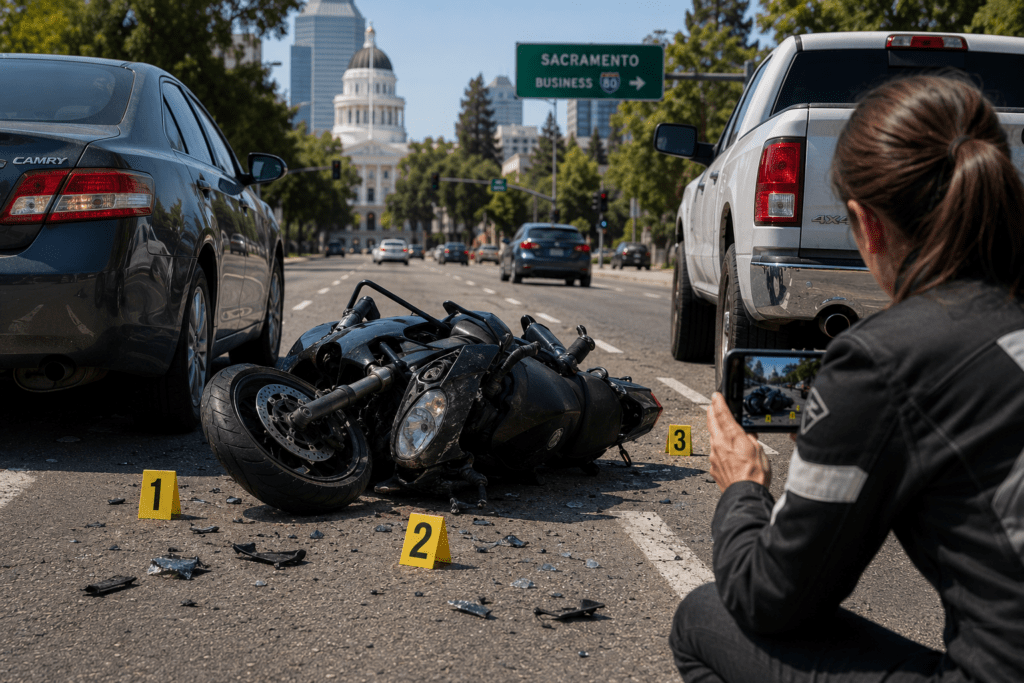
Photos of vehicle positions, lane markings, and damage patterns
One of the most valuable forms of evidence after any motorcycle collision is visual documentation. Photographs help preserve information that may disappear shortly after the crash.
Vehicle positions can help explain angles of impact. Lane markings can show where traffic was supposed to travel. Damage patterns can help identify how the collision occurred and what movements likely happened immediately before impact.
When collecting lane splitting accident evidence in Sacramento, photographs should ideally capture both close-up and wide-angle views of the scene.
Close-up images help document damage. Wider photographs help show how vehicles were positioned relative to one another and to the roadway. Even details that appear insignificant at the time can become important later.
Because accident scenes change quickly, preserving visual evidence early often becomes one of the most important steps a rider can take.
Scene Evidence to Preserve After the Motorcycle Crash
HHelmet camera, dashcam, and surveillance footage
Video footage can become some of the most persuasive lane splitting accident evidence in Sacramento because it captures events as they actually happened.
Unlike witness recollections, video provides a visual record that can be reviewed repeatedly.
Helmet cameras are increasingly common among motorcycle riders. These cameras often capture traffic conditions, lane positions, vehicle movements, and driver behavior immediately before a collision occurs. Even when the crash itself happens quickly, footage recorded in the seconds leading up to the impact can provide valuable context.
Dashcams may also become important.
Drivers involved in the collision may have dashcam systems installed in their vehicles. Nearby vehicles may have recorded the event as well. In some situations, commercial vehicles, delivery trucks, buses, and rideshare vehicles also carry onboard cameras.
Surveillance footage can provide another important source of information.
Businesses, parking structures, intersections, gas stations, and nearby properties may have security systems that captured portions of the accident. However, this type of footage is often time-sensitive. Many systems automatically overwrite recordings after a relatively short period.
Because of that, identifying potential video sources early is often critical.
Strong lane splitting accident evidence in Sacramento frequently comes from footage that might otherwise have been lost if it was not identified quickly.
The sooner video evidence is preserved, the more likely it is to remain available when questions arise later.
Witness names, contact information, and statements from nearby drivers
Witnesses often provide information that is unavailable from any other source.
A driver involved in the collision may only see part of what happened. A motorcyclist may have limited visibility because events unfolded so quickly. Witnesses, however, may have observed the entire sequence of events from a different perspective.
In many cases, nearby drivers see lane changes, traffic movement, turn signal usage, or sudden vehicle movements that become important later.
Pedestrians, passengers, cyclists, and nearby workers can also provide valuable observations.
The challenge is that witnesses frequently leave the scene once emergency responders arrive. If contact information is not gathered early, those individuals may become difficult to locate later.
This is one reason witness identification remains an important component of lane splitting accident evidence in Sacramento.
Even a brief statement recorded shortly after the collision can sometimes clarify issues that later become disputed. The closer in time a witness account is gathered to the event itself, the more reliable it often becomes.
For that reason, preserving witness information should be considered alongside photographs and video evidence whenever possible.
Motorcycle and Rider Evidence That May Become Relevant
Motorcycle damage, repair estimates, and inspection records
The motorcycle itself often becomes a critical source of information. Damage patterns can reveal details about how the collision occurred, including impact angles, contact points, and vehicle movement.
For example, damage concentrated on one side of the motorcycle may help explain where contact occurred and how the rider was positioned relative to the other vehicle. Repair estimates can also become relevant because they document the extent of damage and identify affected components. In some situations, inspection records may provide additional context regarding the motorcycle’s condition before the crash. Insurance companies sometimes review these records when evaluating a claim.
For anyone gathering lane splitting accident evidence in Sacramento, preserving photographs of the motorcycle before repairs begin is often extremely important. Once repairs are completed, some of the original evidence may no longer be visible. This does not mean repairs should be delayed unnecessarily. Rather, it means documentation should occur before the condition of the motorcycle changes.
The more completely the damage is documented, the easier it becomes to evaluate how the collision occurred.
Helmet, protective gear, lights, mirrors, and turn signals
Many riders focus on vehicle damage while overlooking equipment that may also become important evidence.
Helmets, riding jackets, gloves, protective gear, mirrors, lights, and turn signals can all provide information relevant to the accident. A damaged helmet may help demonstrate the force of impact.
Protective clothing may show how the rider contacted the roadway or another vehicle. Lighting and signal equipment may become relevant if questions arise regarding visibility.
Insurance companies sometimes examine whether lights were functioning properly or whether the motorcycle was equipped with appropriate safety equipment. This is one reason riders should avoid discarding damaged equipment immediately after a collision. Items that appear unusable may still have evidentiary value.
Strong lane splitting accident evidence in Sacramento often includes documentation of both the motorcycle and the equipment being used at the time of the crash. Preserving these items can help provide a more complete picture of what occurred.
Rider injuries, medical records, and activity restrictions
Medical evidence often becomes one of the most important parts of any injury claim. After a motorcycle collision, injuries may affect nearly every aspect of daily life.
Medical records help document:
- diagnoses,
- treatment plans,
- physician observations,
- recovery progress,
- and future recommendations.
Activity restrictions can be particularly important because they help illustrate how injuries affected daily routines. A physician may recommend limitations involving work, exercise, driving, lifting, or other activities. These restrictions provide insight into how the accident affected the rider beyond the initial emergency treatment.
For riders gathering lane splitting accident evidence in Sacramento, maintaining organized medical records can help create a clearer understanding of how injuries evolved over time.
This becomes especially important when symptoms continue beyond the initial recovery period. Many of the same documentation principles we discussed in: How Personal Injury Settlements Work in California also apply here.
Consistent records often help create a more complete picture of the injury and its impact.
California Lane-Splitting Issues Writers Should Research
How California addresses lane splitting for motorcyclists
California is unique because it is one of the few states that specifically allows lane splitting under certain circumstances. Despite that fact, misunderstandings remain common.
Many drivers still believe lane splitting is automatically illegal. Others may be unfamiliar with how motorcycles legally operate in traffic. As a result, assumptions often influence how people initially interpret a collision. This is one reason lane splitting accident evidence in Sacramento can become so important.
The fact that lane splitting is legal does not automatically determine fault in a crash. At the same time, the mere fact that a motorcycle was lane splitting does not automatically mean the rider caused the accident.
Investigators often look beyond assumptions and focus on specific facts. Questions may include:
- How fast was traffic moving?
- How much space existed between vehicles?
- Did a driver make a sudden lane change?
- Was visibility limited?
- Did roadway conditions affect the rider’s path?
The answers to these questions often matter more than generalized opinions about lane splitting itself. Because many people are unfamiliar with the details, preserving strong lane splitting accident evidence in Sacramento helps ensure the evaluation focuses on facts rather than assumptions.
Safety guidance, traffic conditions, and comparative fault questions
Even when lane splitting is legal, questions regarding safety still arise. Insurance companies and investigators often examine whether the rider’s actions were reasonable given the surrounding conditions.
Traffic speed becomes a major factor. So does congestion. A rider traveling between nearly stopped vehicles presents a different situation than a rider traveling through rapidly moving traffic.
Comparative fault may also become part of the discussion. California follows a comparative negligence system, which means responsibility can sometimes be shared among multiple parties.
For example, a driver may have changed lanes without checking mirrors while a rider may have been traveling faster than surrounding traffic. In that situation, both sides may raise arguments regarding responsibility. This is where strong lane splitting accident evidence in Sacramento becomes especially valuable.
The more clearly the evidence explains traffic conditions and vehicle movement, the easier it becomes to evaluate how the collision actually occurred. Without clear documentation, discussions about fault can become much more subjective.
How insurers may frame speed, visibility, and rider behavior disputes
Insurance companies often examine lane-splitting accidents carefully because they know these collisions frequently involve competing narratives.
Drivers may claim they never saw the motorcycle. Riders may argue the driver moved unexpectedly. Witnesses may provide different descriptions of the same event. As a result, insurers frequently focus on issues involving:
- speed,
- visibility,
- lane position,
- spacing between vehicles,
- and rider behavior.
They may ask whether the rider could have avoided the collision. They may examine whether the motorcycle was visible before impact. They may review roadway conditions to determine whether the rider’s actions were reasonable under the circumstances.
This does not mean those questions are inappropriate. However, it does mean documentation becomes extremely important.
Strong lane splitting accident evidence in Sacramento helps ensure that discussions about speed, visibility, and rider conduct are grounded in objective information rather than speculation.
Photographs, video footage, witness accounts, and physical evidence often become essential when these disputes arise. The more information available, the easier it becomes to evaluate competing explanations.
Contact Super Woman Super Lawyer for a Free Consultation — No Fee Unless We Win, Available 24/7
Motorcycle accidents involving lane splitting often generate more questions than people expect. Drivers may have one version of events. Riders may have another. Insurance companies frequently examine details involving traffic conditions, lane position, visibility, and rider behavior before reaching conclusions.
That is why preserving evidence matters.
Strong lane splitting accident evidence in Sacramento can help clarify what happened while the information is still available. Photographs, witness statements, video footage, medical records, motorcycle damage, and roadway documentation often become critical pieces of the overall picture.
The sooner that information is preserved, the easier it becomes to understand how the collision occurred. We also recommend reviewing: What to Do After a Car Accident in California
Many of the same documentation principles apply after motorcycle accidents, especially when evidence may disappear quickly.
For general information regarding motorcycle safety and rider responsibilities, the California Highway Patrol and California DMV provide educational resources: https://www.dmv.ca.gov
If you have questions about a motorcycle collision or the evidence available after a crash, speaking with a Sacramento motorcycle accident lawyer can help provide clarity about the factors that may affect your situation.
Whether the accident involved a sudden lane change, visibility concerns, traffic congestion, or questions about rider positioning, understanding the available evidence is often one of the most important steps moving forward.
Online Form: Request a case review
Call Now: 800.800.6916
Live Chat: Speak with a legal professional instantly
 Maryam Parman