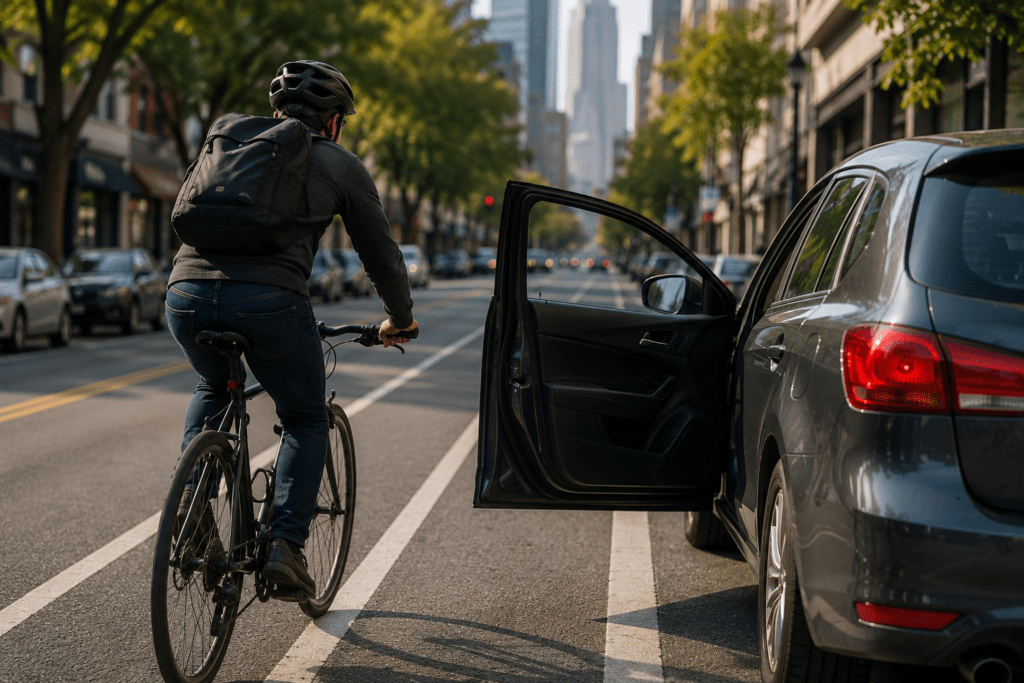
Bicycle dooring accident evidence in Oakland can make a significant difference when questions arise about how a collision occurred and what conditions existed at the time of the crash. Dooring accidents often happen with very little warning. A cyclist may be riding alongside a row of parked vehicles when a driver or passenger suddenly opens a door directly into the rider’s path. In a matter of seconds, the cyclist may collide with the door, lose control while attempting to avoid it, or be forced into another lane of traffic. Because these events happen so quickly, people involved in the collision often remember them differently. Drivers may believe the cyclist had enough time to react, while riders frequently describe having almost no opportunity to avoid the hazard. This is one reason documentation becomes so important.
Unlike many other traffic collisions, dooring accidents often occur in environments where evidence can disappear quickly. Vehicles are moved, traffic resumes, and witnesses continue on their way. What seems obvious immediately after the crash may become much harder to explain days or weeks later. Strong bicycle dooring accident evidence in Oakland helps preserve information before those details are lost. Photographs, witness statements, roadway documentation, bicycle damage, and video footage can all contribute to a more complete understanding of what happened. The sooner that information is gathered, the easier it often becomes to evaluate how the collision occurred and what factors may have contributed to it.
How Dooring Accidents Usually Need to Be Documented
Location of the parked car, bike lane, travel lane, or shoulder
One of the first things investigators typically examine after a dooring collision is the physical layout of the roadway. The position of the parked vehicle, the location of the bicycle, and the surrounding traffic environment often provide valuable clues about how the accident unfolded. In many cases, the exact placement of the vehicle relative to the bike lane becomes a central issue. A cyclist riding in a designated bicycle lane may face different conditions than someone traveling along the shoulder or within a shared traffic lane. The amount of available space between the parked vehicle and moving traffic can also influence whether the rider had any realistic opportunity to avoid the open door.
Photographs taken immediately after the crash often become some of the strongest forms of bicycle dooring accident evidence in Oakland because they preserve conditions before anything changes. A photograph can show whether the vehicle was parked legally, how close it was to the bike lane, and whether the cyclist was riding in an area intended for bicycle travel. It can also help explain whether surrounding traffic limited the rider’s options. As time passes, these details become more difficult to recreate accurately. That is why documenting the scene before vehicles move is often one of the most important steps available after a dooring accident.
In some situations, roadway design itself may become relevant. Narrow bike lanes, unusually tight parking configurations, construction zones, and temporary traffic changes can all affect how cyclists and parked vehicles interact. The more clearly those conditions are documented, the easier it becomes to understand the environment in which the collision occurred. Strong bicycle dooring accident evidence in Oakland often begins with a detailed understanding of exactly where everyone and everything was located at the moment of impact.
When the door opened and how much time the cyclist had to react
Reaction time is one of the most common points of disagreement after a dooring accident. Drivers and passengers sometimes believe a cyclist should have been able to stop or steer around the open door. Cyclists often describe a very different experience. From the rider’s perspective, the door may have opened only a fraction of a second before impact, leaving little or no opportunity to react safely. Understanding which version is more consistent with the available evidence frequently becomes an important part of the investigation.
When reviewing bicycle dooring accident evidence in Oakland, investigators often attempt to determine exactly when the door opened relative to the cyclist’s position. Was the cyclist already approaching when the door began moving? Did the rider attempt to brake or change direction? Was there enough distance to safely avoid the obstacle? These questions can sometimes be answered through video footage, witness statements, or physical evidence at the scene. Even subtle details can become important when evaluating whether a rider had a realistic chance to avoid the collision.
The issue is not simply whether the cyclist reacted. It is whether there was sufficient time to react safely. A rider may have only two options: collide with the door or move into an active traffic lane. In some situations, neither option is truly safe. That is why reaction time remains such an important component of bicycle dooring accident evidence in Oakland. The shorter the available reaction window, the more difficult it becomes to argue that the rider could have avoided the crash entirely.
Whether another vehicle, curb, or obstacle limited escape options
Many people assume cyclists can always maneuver around an open door. In reality, the surrounding environment often limits available options. Traffic may be moving in the adjacent lane. A curb may prevent movement in the opposite direction. Construction barriers, parked vehicles, pedestrians, or roadway debris can further restrict available space. As a result, a cyclist may face a situation where avoiding the door requires entering another dangerous area.
This is why investigators frequently examine the broader roadway environment when reviewing bicycle dooring accident evidence in Oakland. The question is not simply whether the cyclist could have moved left or right. The question is whether doing so would have created another significant risk. A rider who swerves into traffic to avoid a door may be exposed to a collision with a moving vehicle. A rider who turns toward the curb may lose control and crash. Understanding these alternatives often helps explain why a collision occurred despite the cyclist’s efforts to avoid it.
Photographs of nearby traffic lanes, curbs, construction zones, and surrounding obstacles can provide valuable context. Witness statements may also help explain what options were realistically available. In many cases, the roadway environment plays a larger role than people initially realize. Strong bicycle dooring accident evidence in Oakland often involves documenting not only the door itself, but also the conditions that limited the cyclist’s ability to escape the situation safely.
Photos and Scene Details to Preserve Quickly
Door position, bike damage, vehicle damage, and road markings
Photographs remain one of the most effective ways to preserve evidence after a bicycle collision. Unlike memory, photographs capture conditions exactly as they existed at a particular moment. This is especially important in dooring accidents because vehicles are frequently moved shortly after the crash. Once that happens, it becomes much harder to accurately recreate the scene.
The position of the open door often provides important information. Investigators may look at how far the door extended into the bicycle’s path and whether the cyclist would have been able to see it in time to react. Damage to the bicycle may also help identify the point of impact and the direction of travel. Vehicle damage can contribute additional context regarding how the collision occurred and what contact took place between the rider and the vehicle.
Road markings should not be overlooked. Bike lane lines, shoulder markings, parking boundaries, and traffic controls all help establish the environment in which the collision occurred. Strong bicycle dooring accident evidence in Oakland frequently includes a combination of close-up photographs and wide-angle images showing the broader roadway layout. Together, those photographs often provide a much clearer understanding of the crash than verbal descriptions alone.
Photos and Scene Details to Preserve Quickly
Distance from the parked vehicle to the bicycle path of travel
The distance between the parked vehicle and the cyclist’s path of travel often becomes an important detail in a dooring investigation. At first glance, it may seem like a minor measurement. However, even a few feet can significantly affect how much time a rider had to react and whether avoiding the door was realistically possible. Investigators frequently look at how close the cyclist was traveling to the parked vehicle, how wide the bicycle lane was, and whether the roadway provided enough room for safe maneuvering.
In many urban environments, including Oakland, cyclists often travel through corridors where parked vehicles sit directly adjacent to bike lanes. When a door suddenly opens, the available reaction space can disappear instantly. A rider may have only a fraction of a second to make a decision. If traffic is moving beside the cyclist and a curb or parked vehicle exists on the other side, the amount of usable space may be extremely limited.
This is one reason bicycle dooring accident evidence in Oakland frequently includes photographs and measurements showing roadway dimensions. The distance between the bicycle’s path of travel and the parked vehicle can help explain whether the rider had a realistic opportunity to avoid the collision. The more clearly those distances are documented, the easier it becomes to understand the physical limitations the cyclist faced at the moment the door opened.
Nearby parking signs, curb markings, lighting, and visibility conditions
The broader environment surrounding a dooring accident often provides valuable context. Parking regulations, curb markings, lighting conditions, and visibility issues may all contribute to understanding what happened. For example, investigators may examine whether the vehicle was parked legally, whether special parking restrictions existed, or whether temporary roadway conditions affected visibility.
Lighting becomes especially important in accidents that occur during the early morning, evening, or nighttime hours. Reduced visibility can affect both cyclists and vehicle occupants. A driver or passenger opening a door may not realize how quickly a bicycle is approaching, while a cyclist may have difficulty identifying a door beginning to open in low-light conditions. Shadows, glare, weather conditions, and street lighting can all influence how visible potential hazards were before the collision.
When gathering bicycle dooring accident evidence in Oakland, photographs showing lighting conditions and surrounding roadway features can help preserve details that may later be forgotten. Conditions that seem obvious immediately after the crash often become harder to describe accurately over time. The stronger the visual documentation, the easier it becomes to explain how visibility and roadway conditions may have contributed to the event.
Witness and Video Evidence That May Be Available
Statements from drivers, passengers, pedestrians, and nearby cyclists
Witness statements often provide information that no photograph can capture. Drivers, passengers, pedestrians, and nearby cyclists may have observed different parts of the incident, and their perspectives can help explain how the collision unfolded. Because dooring accidents happen so quickly, witnesses sometimes notice details that neither the cyclist nor the vehicle occupant remembers clearly.
For example, a nearby pedestrian may have seen the door open before impact. Another cyclist may have observed the rider’s path of travel. A driver traveling in an adjacent lane may have noticed traffic conditions that limited the cyclist’s ability to avoid the collision. These observations can help clarify timing, visibility, and reaction opportunities.
When reviewing bicycle dooring accident evidence in Oakland, investigators often compare witness statements with photographs and physical evidence. The goal is not simply to collect opinions. Rather, it is to understand how multiple perspectives fit together to create a more complete picture of what happened. Witness accounts are often most valuable when they are gathered early, before memories begin to fade and details become less reliable.
Cameras from businesses, residences, transit vehicles, or parked vehicles
Video footage has become increasingly important in modern accident investigations. Many businesses, apartment buildings, retail locations, and residences operate security cameras that continuously record nearby activity. In urban environments, transit vehicles, delivery trucks, and even parked cars may also have recording systems capable of capturing portions of an accident.
For a dooring collision, video footage can help answer several important questions. Investigators may review when the door opened, how quickly the cyclist was approaching, whether traffic conditions limited available escape routes, and how the collision unfolded. Unlike witness recollections, video provides a visual record that can be reviewed repeatedly.
This is why bicycle dooring accident evidence in Oakland often includes efforts to identify nearby cameras as soon as possible. Many recording systems automatically overwrite footage after a relatively short period. If potential sources are not identified quickly, valuable information may disappear. Early efforts to locate and preserve video often make a significant difference in how much information remains available later.
How to identify time-sensitive footage before it is deleted
One of the biggest challenges involving video evidence is timing. Many people assume footage will remain available indefinitely. Unfortunately, that is rarely the case. Security systems frequently overwrite recordings after days or weeks, depending on storage settings and company policies. As a result, footage that exists immediately after an accident may no longer be available later.
This is one reason investigators often prioritize identifying cameras early. Businesses near the scene, residential properties, public transit systems, parking facilities, and nearby vehicles may all have captured useful footage. Once potential sources are identified, steps can be taken to determine whether recordings exist and how long they are likely to remain available.
For anyone gathering bicycle dooring accident evidence in Oakland, understanding the time-sensitive nature of video can be extremely important. Waiting too long may mean losing access to some of the most objective evidence available. The sooner potential cameras are identified, the better the chances of preserving footage that helps explain what happened.
Medical, Bicycle, and Gear Records After a Dooring Crash
Emergency care, orthopedic care, and follow-up treatment records
Medical documentation often becomes one of the most important parts of understanding how a collision affected a cyclist. Emergency room records, urgent care visits, orthopedic evaluations, physical therapy notes, and follow-up treatment records all help create a timeline of injuries and recovery. These records often explain not only what injuries occurred, but also how those injuries evolved over time.
Dooring accidents frequently result in injuries to the shoulders, arms, wrists, head, neck, and lower extremities. Some riders are injured during the initial impact with the door. Others are injured when they fall to the pavement or collide with another object while attempting to avoid the door. The severity of those injuries is often documented through ongoing medical care rather than a single initial visit.
For anyone preserving bicycle dooring accident evidence in Oakland, maintaining organized medical records helps provide a clearer picture of the crash’s physical impact. Consistent documentation often becomes one of the strongest ways to explain how the collision affected daily activities, work responsibilities, and overall recovery.
Medical, Bicycle, and Gear Records After a Dooring Crash
Bicycle repair estimates and replacement value documentation
The bicycle itself often becomes an important source of information after a dooring collision. While many riders focus primarily on their injuries, the condition of the bicycle can also help explain how the crash occurred and what forces were involved. Damage patterns may reveal where the point of impact occurred, how the bicycle moved during the collision, and whether additional impacts happened after the initial contact with the open door.
Repair estimates frequently become relevant because they document the extent of the damage and identify components that were affected. In some situations, the cost of repairs may exceed the value of the bicycle, making replacement documentation important as well. Modern bicycles can represent a significant investment, particularly when they include specialized frames, wheels, components, or electronic systems.
For anyone preserving bicycle dooring accident evidence in Oakland, photographs of the bicycle should ideally be taken before repairs begin. Repair records, replacement estimates, and evaluations from bicycle shops can all help document the condition of the bicycle after the collision. These records often become part of the broader effort to understand how the crash occurred and what losses resulted from it.
Maintaining organized records related to bicycle repairs can also help prevent confusion later. Receipts, estimates, photographs, and communications regarding repairs provide a clearer picture of the damage and its impact on the rider.
Helmet, clothing, lights, bags, and damaged equipment
Many riders underestimate the importance of preserving damaged gear after a collision.
Helmets, jackets, gloves, lights, bags, electronics, and other equipment often contain evidence that helps explain what happened. A damaged helmet may indicate the force and location of impact. Torn clothing can help show how the rider contacted the roadway. Broken lights, mirrors, or accessories may provide additional clues regarding vehicle contact and rider movement.
When evaluating bicycle dooring accident evidence in Oakland, investigators sometimes review damaged gear alongside photographs and medical records to develop a more complete understanding of the crash. The condition of these items often helps illustrate the sequence of events and the physical forces involved.
Many people discard damaged equipment shortly after an accident because it is no longer usable. While replacing damaged safety gear is often necessary, preserving photographs and documentation before disposal can be valuable. The goal is not simply to save broken items. The goal is to preserve information that may later help explain how the collision occurred.
Strong evidence frequently comes from a combination of sources. Medical records explain injuries. Bicycle damage explains vehicle contact. Safety equipment helps illustrate how the rider interacted with the roadway and surrounding environment. Together, these records often provide a much clearer picture than any single piece of evidence alone.
Contact Super Woman Super Lawyer for a Free Consultation — No Fee Unless We Win, Available 24/7
Why early documentation often matters most
One of the most consistent themes in bicycle accident investigations is that evidence becomes harder to preserve as time passes. Vehicles are moved. Roadway conditions change. Witnesses leave. Video footage may be overwritten. Memories naturally become less precise.
That is why bicycle dooring accident evidence in Oakland is often strongest when documentation begins as early as possible. Photographs, witness information, video footage, bicycle damage, and medical records are generally easiest to preserve shortly after the collision occurs.
This does not mean every question must be answered immediately. It simply means that preserving available information early often creates a clearer record later. The stronger the documentation, the easier it becomes to understand how the collision occurred and what factors contributed to it.
Many of the same documentation principles discussed in: What to Do After a Car Accident in California also apply after bicycle accidents. The sooner evidence is identified and preserved, the more complete the overall picture tends to be.
How different forms of evidence work together
No single piece of evidence usually explains everything.
Photographs help document the scene. Witnesses provide observations. Video footage captures movement. Medical records explain injuries. Bicycle damage helps show how the impact occurred. Each source contributes different information.
For a bicycle dooring accident evidence in Oakland investigation, these pieces often work together to answer questions that would otherwise remain disputed. One photograph may show the position of the vehicle. A witness may explain when the door opened. Video footage may clarify reaction time. Medical records may help explain the physical impact of the crash.
This is one reason investigators frequently look at evidence collectively rather than individually. The strongest conclusions often come from reviewing multiple forms of documentation together.
We discuss a similar concept in: How Personal Injury Settlements Work in California where documentation and evidence frequently play an important role in understanding the overall claim.
H3: Resources that may help explain bicycle safety issues
Bicycle safety remains an important issue throughout California, particularly in urban areas where cyclists and parked vehicles frequently share the same roadway environment.
The California DMV provides educational information regarding bicycle safety, roadway responsibilities, and interactions between cyclists and drivers: https://www.dmv.ca.gov
These resources can help riders better understand common hazards, including dooring incidents, and why awareness is important for everyone using the roadway.
For individuals reviewing bicycle dooring accident evidence in Oakland, understanding the broader context of bicycle safety can help explain why certain evidence becomes important during an investigation.
H3: Free consultation — No fee unless we win
Every bicycle accident is different.
Some involve straightforward circumstances. Others involve conflicting accounts regarding visibility, reaction time, roadway conditions, or the actions of the driver or passenger who opened the door.
If you have questions regarding bicycle dooring accident evidence in Oakland, speaking with a Oakland bicycle accident lawyer can help provide additional clarity regarding the types of evidence that may become relevant and why documentation often matters so much after a crash.
Most cases are handled on a contingency fee basis, meaning there are generally no upfront attorney fees.
Connect With Super Woman Super Lawyer
Strong bicycle dooring accident evidence in Oakland often comes from a combination of photographs, witness statements, video footage, bicycle damage, roadway documentation, and medical records. The sooner that information is preserved, the easier it becomes to understand what happened and why.
Because these collisions often occur without warning, preserving available evidence quickly can make a meaningful difference in explaining how the crash unfolded. Whether the collision involved an open vehicle door, limited reaction time, roadway obstacles, or visibility concerns, clear documentation often helps create a more complete understanding of the event.
Online Form: Request a case review
Call Now: 800.800.6916
Live Chat: Speak with a legal professional instantly
 Maryam Parman