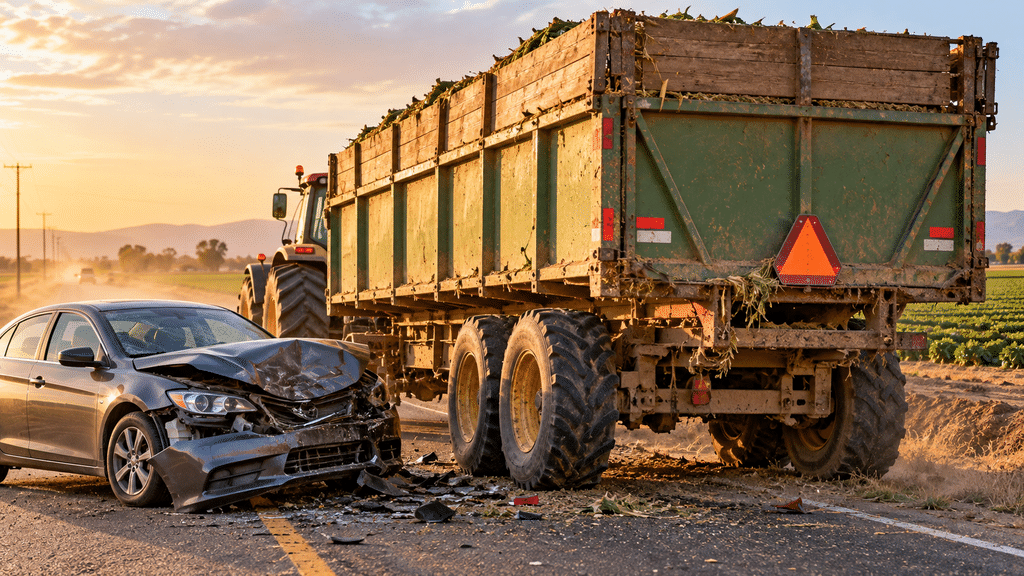
A Bakersfield agricultural trailer accident can raise complicated questions about roadway visibility, equipment condition, and the movement of large vehicles along rural roads. A driver may encounter a trailer transporting agricultural materials, machinery, or equipment between farms, processing facilities, and commercial transportation routes. If the trailer is difficult to see because of darkness, dust, missing reflectors, malfunctioning lights, or surrounding obstructions, the collision may require a detailed investigation into what each driver could reasonably see before impact.
Agricultural transportation plays an important role in Kern County, but not every vehicle associated with farming is subject to the same operating requirements. A conventional commercial trailer, a farm implement, and a vehicle transporting agricultural products may be classified differently under California law. Following a Bakersfield agricultural trailer accident, identifying the exact equipment is therefore an essential first step before evaluating whether its lighting, reflectors, warning devices, or operation complied with applicable requirements.
Visibility can become particularly important during November, when daylight hours are shorter and agricultural vehicles may be operating during late-afternoon or evening conditions. However, the time of year alone does not establish that darkness contributed to a particular collision. Investigators should determine the actual collision time, available daylight, roadway lighting, weather, dust conditions, and the positions of both vehicles before drawing conclusions about visibility.
California’s basic speed law requires drivers to operate at speeds reasonable for prevailing traffic, weather, visibility, and roadway conditions. Other California and federal provisions may govern particular agricultural vehicles, trailers, lighting equipment, and maintenance responsibilities. A Bakersfield agricultural trailer accident investigation should consider these requirements together with the physical evidence rather than assume that a particular vehicle classification or equipment defect establishes negligence.
Commercial and agricultural vehicle collisions can also involve several businesses. The towing vehicle owner, trailer owner, agricultural operator, transportation company, maintenance provider, or equipment supplier may possess different records. Identifying these relationships may help investigators locate inspection documents, repair histories, driver communications, and insurance information before those records become difficult to obtain.
Super Woman Super Lawyer helps injured people understand the evidence and insurance questions that may arise after serious motor vehicle collisions. For more information about local injury claims, read Injured in Kern County? How a Bakersfield Injury Lawyer Can Maximize Your Claim.
After a Bakersfield agricultural trailer accident, preserving photographs, equipment identification, available video, witness information, and maintenance records promptly may help prevent important evidence from disappearing while the vehicles are repaired or returned to service.
Reconstructing the Agricultural Vehicle’s Position
Reconstructing a Bakersfield agricultural trailer accident requires understanding where the trailer was positioned before the collision and how it moved into the area occupied by the other vehicle. A trailer may have been traveling along a rural road, turning into a farm entrance, entering a highway from a private access route, or crossing an intersection. Each situation presents different questions about visibility, vehicle movement, available roadway space, and reaction time.
The investigation should also determine whether the agricultural trailer was moving continuously, slowing to turn, stopped, or entering traffic from another location. Photographs, witness statements, roadway evidence, and available video may help establish those movements. The collision point alone may not explain how the vehicles approached one another.
Trailer Movement on Rural and Connecting Roads
Agricultural transportation often connects farms, storage facilities, packing operations, and distribution routes. In Kern County, rural roads may carry passenger vehicles, conventional commercial trucks, farm machinery, and specialized trailers. The differences in vehicle size, speed, and maneuverability can become important when investigating a collision.
A Bakersfield agricultural trailer accident may occur where a large vehicle transitions from a lower-speed agricultural road onto a route carrying faster traffic. Investigators may need to determine how much distance an approaching motorist had to recognize the trailer, whether it was moving or stopped, and what warning devices were visible.
Photographs should document the roadway from both directions, including lane width, shoulder conditions, curves, grades, intersections, and farm access points. A wide photograph showing the trailer’s relationship to the road may provide more useful context than an isolated close-up of damaged equipment.
Roadway geometry can also affect visibility. A trailer emerging from behind a curve, vegetation, building, or other obstruction may become visible at a different point than one traveling along an unobstructed straight road. These conditions should be documented rather than reconstructed from memory months later.
Turning, Entering, or Crossing a Traffic Lane
Large agricultural trailers may require additional space to complete a turn. Depending on their length, configuration, and load, they may occupy part of an adjacent lane or remain within an intersection longer than a passenger vehicle. The timing and location of that maneuver can become central to a Bakersfield agricultural trailer accident investigation.
Investigators may examine when the turn began, whether the operator used appropriate signals or warning devices, how much roadway the trailer occupied, and whether approaching motorists had sufficient time to respond. Tire marks, roadway measurements, vehicle damage, and final resting positions may provide additional information.
Dashcam footage can be especially valuable when the collision involves a turning maneuver. Video may show the trailer entering the roadway, its speed, and the position of surrounding traffic before impact. However, a camera’s perspective and recording quality should be considered before treating footage as a complete reconstruction.
The applicable operating rules depend on the actual equipment. A conventional tractor-trailer may be subject to requirements that differ from those governing certain implements of husbandry. Those classifications should be verified rather than assumed.
Vehicle Speed and Available Reaction Distance
Speed can become a disputed issue after a Bakersfield agricultural trailer accident involving limited visibility. The approaching driver may report that the trailer appeared suddenly, while the operator may claim it was visible from a substantial distance. These accounts should be preserved accurately and compared with objective evidence whenever available.
Roadway speed limits, actual vehicle movement, sightlines, lighting, and surrounding traffic may all influence the analysis. California’s basic speed law provides general context, but it does not establish the speed of either vehicle at the moment of the collision.
When technical analysis is needed, qualified accident reconstruction professionals may evaluate vehicle movement, stopping distance, and available reaction time. Photographs, measurements, witness observations, and video can provide the underlying evidence for that evaluation.
A Bakersfield agricultural trailer accident should not automatically be attributed to excessive speed merely because one vehicle struck another. Investigators must determine whether visibility, equipment condition, roadway design, turning movements, or other factors contributed to the collision.
Lighting and Visibility Evidence After a Bakersfield Agricultural Trailer Accident
Visibility is often one of the most important disputed issues following a Bakersfield agricultural trailer accident. An approaching motorist may report that the trailer was difficult to see until immediately before impact, while the trailer operator may maintain that all required lights and reflective devices were functioning. Rather than accepting either account as conclusive, investigators should examine the trailer’s actual equipment, the surrounding environment, and the conditions present when the collision occurred.
California has special rules for certain agricultural vehicles and implements of husbandry. The California DMV’s special-equipment guidance provides information about these vehicle classifications. The classification matters because requirements applicable to conventional commercial trailers may differ from those governing qualifying agricultural equipment.
Trailer Lights, Reflectors, and Conspicuity Markings
After a Bakersfield agricultural trailer accident, photographs should document the trailer’s lighting and reflective equipment before repairs begin. Depending on the vehicle, relevant components may include tail lamps, brake lights, turn signals, side markers, clearance lamps, reflectors, reflective tape, warning flags, and slow-moving vehicle emblems. Investigators should identify which devices were installed, whether they appeared damaged, and what the applicable regulations required.
California Vehicle Code section 24615 addresses slow-moving vehicle emblems for qualifying vehicles, while Vehicle Code section 36509 contains provisions concerning warning equipment for certain agricultural vehicles and loads. Whether these requirements apply depends on the vehicle’s classification and operating circumstances.
A broken lamp discovered after the collision does not necessarily establish that the lamp was malfunctioning beforehand. The impact itself may have damaged the assembly, wiring, or mounting hardware. Similarly, a missing reflector should be evaluated against earlier photographs, maintenance records, and the equipment’s applicable requirements before investigators determine its significance.
The strongest Bakersfield agricultural trailer accident evidence may combine photographs of the equipment with identification records, manufacturer specifications, maintenance history, and witness observations. Together, these materials can help establish what equipment was present and what additional inspection may be necessary.
Dust, Darkness, and Roadway Lighting
Dust can affect visibility along rural roads, especially where agricultural operations, unpaved access routes, or vehicle movement disturb loose soil. A temporary dust cloud may obstruct a driver’s view of a trailer, while nearby buildings, trees, or roadway curves can limit visibility independently of dust. Investigators should document which conditions were actually present rather than assuming that all rural agricultural collisions involve reduced visibility.
November creates a relevant seasonal consideration because daylight hours are shorter than during summer. A Bakersfield agricultural trailer accident occurring during the late afternoon or evening may therefore involve changing light conditions, but the exact collision time remains essential. Investigators may compare the reported time with sunset information, available weather observations, roadway lighting, and photographs.
Camera exposure can complicate the analysis. A smartphone photograph taken at dusk may appear brighter than the scene looked to a driver, particularly if the device automatically adjusts exposure. Video, witness descriptions, and photographs from several perspectives may provide additional context, but technical interpretation should account for the limitations of each source.
A Bakersfield agricultural trailer accident involving reduced visibility may also raise questions about the approaching driver’s speed. California’s basic speed law requires motorists to adjust to conditions, but determining whether a particular driver acted reasonably requires examining the actual roadway, traffic, visibility, and available response time.
Vehicle Height, Width, and Sightline Obstructions
Agricultural trailers vary considerably in size and configuration. Some carry tall equipment or wide loads, while others are smaller but may travel at relatively low speeds. These differences can affect how much roadway the equipment occupies and when another motorist can recognize its position.
A Bakersfield agricultural trailer accident involving unusually wide equipment may require review of warning devices, vehicle dimensions, and any applicable special operating requirements. Investigators should document the trailer’s width, height, load, and configuration rather than relying on a general description such as “farm trailer.”
Obstructions may also become relevant. A trailer approaching from behind roadside vegetation, a structure, another truck, or a curve may become visible later than one on an open roadway. Photographs taken from approximately the approaching driver’s perspective can help document those sightlines.
The investigation should distinguish between equipment that was insufficiently illuminated and equipment that was temporarily obscured by surrounding conditions. Those are separate questions, and the evidence supporting one explanation may differ from the evidence supporting another.
Equipment and Company Records to Preserve
A Bakersfield agricultural trailer accident may involve equipment owned, operated, or maintained by several businesses. A farm may own the trailer, a transportation company may supply the towing vehicle, and an independent repair provider may service the lighting or braking systems. Identifying those relationships helps determine where inspection, maintenance, and operational records may exist.
Federal commercial motor vehicle regulations apply to some agricultural transportation operations, while certain farm vehicles qualify for exemptions from specific requirements. The Federal Motor Carrier Safety Administration’s agricultural exemption guidance explains distinctions concerning qualifying agricultural transportation. An exemption from one requirement should not be treated as an exemption from every safety obligation.
Trailer Identification, Ownership, and Maintenance
The first step is identifying the exact equipment involved in the Bakersfield agricultural trailer accident. Useful information includes the manufacturer, model, serial number, license plate where applicable, equipment number, and ownership records. Photographs of identification plates and company markings can help connect the trailer to its maintenance history.
Maintenance documentation may include lighting repairs, wiring replacement, brake service, tire replacement, reflector installation, and other equipment work. A repair invoice can establish that work was recorded, but it does not necessarily establish the trailer’s condition at the time of the collision. Earlier inspection photographs, complaints, and service requests may provide additional context.
If the investigation involves an alleged lighting malfunction, investigators may need to determine whether employees previously reported intermittent brake lights, damaged wiring, or other concerns. The dates of those reports, the company’s response, and any subsequent repairs may become relevant.
The equipment’s location after the collision also matters. If the trailer was repaired, transferred, dismantled, or returned to service, its original condition may become difficult to examine.
Driver and Equipment Inspection Documentation
Inspection records may help establish what the operator knew about the trailer before the trip. Depending on the vehicle and business, documentation might include checklists, maintenance logs, repair requests, electronic fleet entries, or communications about equipment condition.
A Bakersfield agricultural trailer accident involving a conventional commercial vehicle may raise different regulatory questions from one involving a qualifying farm vehicle. Under 49 CFR section 390.39, certain covered farm vehicles receive exemptions from specified federal motor carrier safety requirements. The applicability of those exemptions must be established before determining which records were legally required.
Even where a particular federal recordkeeping requirement does not apply, business records may still exist. Agricultural operators may maintain internal equipment assignments, work orders, service invoices, and employee reports as part of ordinary operations.
Agricultural Operator and Transportation Company Records
Commercial agricultural transportation may involve a farm, shipper, motor carrier, equipment owner, or independent contractor. A Bakersfield agricultural trailer accident investigation should identify what each organization actually did rather than assume one business controlled the entire trip.
Dispatch records, delivery paperwork, equipment assignments, driver schedules, and communications may help establish the trailer’s movements. A farm or loading facility may also have surveillance footage, gate records, or photographs documenting the equipment before it entered the roadway.
The equipment owner may maintain repair records, while the transportation company possesses driver communications. A separate maintenance provider may hold service invoices or inspection documentation. Identifying these relationships early may help prevent relevant evidence from being overlooked.
Participation in the transportation arrangement does not automatically establish legal responsibility. That depends on the applicable duties, actual conduct, and evidence.
Insurance and Injury Issues After a Bakersfield Agricultural Trailer Accident
Insurance questions can become complicated when agricultural equipment, commercial transportation, and passenger vehicles are involved in the same collision. The towing vehicle, trailer, agricultural operator, and other motorists may have different owners or insurers. Determining which policies apply requires examining the actual arrangements, coverage language, and circumstances.
A Bakersfield agricultural trailer accident claim also requires documentation of medical treatment, property damage, lost income, and other relevant expenses. Organizing equipment evidence separately from injury and financial records, while maintaining a central timeline, can make the complete claim easier to evaluate.
Identifying Vehicle Owners and Applicable Insurance Policies
The trailer owner may not employ the driver. A farm may provide equipment to a carrier, while a contractor operates the towing vehicle. Insurance information should therefore be obtained from the relevant parties rather than inferred from the name displayed on the truck.
After a Bakersfield agricultural trailer accident, preserve claim numbers, adjuster information, coverage correspondence, and communications from each insurer. Separate folders can help prevent confusion when several representatives request statements or documents.
The California Department of Insurance provides general information about automobile coverage and claims. Commercial and agricultural insurance arrangements may involve additional provisions, making review of the actual policies important.
Medical Treatment, Vehicle Damage, and Work Loss
Medical documentation may begin with emergency care, urgent care, or another initial evaluation. Depending on the injuries, treatment may involve imaging, specialist consultations, medication, rehabilitation, or other services. Diagnoses and treatment recommendations should come from qualified healthcare professionals.
For a Bakersfield agricultural trailer accident, preserve records showing when symptoms were reported, what evaluations occurred, and what restrictions or follow-up care were recommended. Medical bills and clinical treatment records should both be retained because they document different aspects of the claim.
Vehicle photographs, repair estimates, supplemental repair findings, towing records, and inspection documentation may establish property losses and provide evidence about the collision itself. Contact points can be relevant when determining how the passenger vehicle and trailer came together.
Employment records may document missed shifts, reduced hours, modified duties, or time away for appointments. The SWSL article Injured in Kern County? How a Bakersfield Injury Lawyer Can Maximize Your Claim provides additional information about documenting injury-related losses.
Disputes About Visibility and Driver Reaction Time
An insurer may argue that the trailer was properly illuminated and visible from a reasonable distance. Another may claim that defective lighting, inadequate reflectors, dust, darkness, or a roadway obstruction prevented the approaching motorist from recognizing it in time.
A Bakersfield agricultural trailer accident investigation should compare those positions with equipment photographs, inspection findings, witness statements, roadway measurements, weather information, and video. A driver’s statement that a trailer appeared suddenly should not automatically be treated as proof of a defect.
Speed and reaction distance may also become disputed. Investigators may need to determine how quickly the passenger vehicle approached, whether the trailer was moving or stopped, and what warning information was available.
Settlement discussions can begin before those questions are resolved. The SWSL article Settlement or Lawsuit? How Your Bakersfield Personal Injury Lawyer Helps You Make the Right Choice discusses considerations surrounding evidence and settlement decisions.
Before signing a release, the injured person should understand which claims and parties it covers and whether important medical, equipment, or insurance information remains incomplete.
Legal Deadlines and Evidence Preservation
California generally provides a two-year limitations period for personal injury lawsuits under Code of Civil Procedure section 335.1, subject to exceptions and potentially shorter procedures for claims involving public entities. The applicable deadline depends on the individual circumstances.
The practical evidence-preservation period following a Bakersfield agricultural trailer accident can be much shorter. Trailer lights may be repaired, reflectors replaced, wiring altered, and equipment returned to agricultural service. Witnesses may become difficult to contact, and surveillance recordings may be overwritten.
Preserving photographs, equipment identification, available video, maintenance records, and communications promptly can help maintain a reliable record. When trailer condition is disputed, appropriate preservation and professional inspection may be important before alterations occur.
Legal deadlines and evidence-preservation deadlines should be considered separately.
Serving Injured Drivers Throughout Bakersfield and Kern County
Bakersfield’s transportation network includes agricultural roads, commercial routes, industrial facilities, and highways connecting farming operations with regional distribution centers. State Route 99, State Route 58, State Route 119, and numerous county roads carry passenger vehicles, commercial trucks, and agricultural equipment.
A Bakersfield agricultural trailer accident may occur near a farm entrance, on a rural connecting road, or where agricultural traffic enters a more heavily traveled route. Each location can create different visibility questions involving roadway lighting, lane configuration, sightline obstructions, traffic speed, and nearby surveillance.
November’s shorter daylight hours make late-afternoon and evening visibility a relevant seasonal consideration. However, the investigation should establish the actual conditions rather than assume that darkness, dust, or agricultural activity contributed to the collision.
The SWSL article Bakersfield Delivery Van Accident Claims: GPS Records and Delivery Evidence provides additional context about commercial vehicle route information and company records. Although delivery vans and agricultural trailers present different scenarios, both investigations may benefit from preserving operational evidence.
A complete Bakersfield agricultural trailer accident claim should connect equipment condition with roadway evidence, vehicle movements, medical documentation, and insurance information. The goal is to determine what happened from the available facts rather than rely on assumptions about agricultural transportation.
Frequently Asked Questions About Bakersfield Agricultural Trailer Accidents
What evidence should I preserve after an agricultural trailer collision?
After a Bakersfield agricultural trailer accident, preserve photographs of the vehicles, trailer lights, reflectors, warning devices, roadway conditions, and visible damage when safe. Witness contacts, police records, dashcam footage, towing documentation, and insurance communications may also be useful. If equipment condition is disputed, identifying the trailer owner and maintenance provider can help locate additional records.
Are agricultural trailers required to have lights and reflectors?
California has lighting and warning-equipment requirements, but their application depends on the vehicle’s classification and operation. A conventional commercial trailer may be subject to different requirements from a qualifying implement of husbandry. After a Bakersfield agricultural trailer accident, the equipment should be identified before determining which regulations apply.
What is an implement of husbandry?
An implement of husbandry is a category of equipment defined under California law for certain agricultural uses. Qualifying equipment may be subject to special registration or operating provisions. Not every vehicle carrying agricultural products qualifies, so classification depends on the vehicle’s design, use, and applicable statutory definitions.
Does a slow-moving agricultural vehicle need a warning emblem?
California Vehicle Code section 24615 addresses slow-moving vehicle emblems for qualifying equipment. Whether the requirement applies to a particular Bakersfield agricultural trailer accident depends on the type of vehicle and operating circumstances. The emblem’s presence, placement, condition, and visibility may become relevant.
Can November darkness affect an agricultural trailer accident?
Potentially. November’s shorter daylight hours may create reduced visibility during late-afternoon or evening transportation. Investigators should establish the collision time, weather, roadway lighting, and equipment condition before determining whether darkness contributed to a Bakersfield agricultural trailer accident.
What if dust made the trailer difficult to see?
Dust may affect visibility, particularly near agricultural roads or unpaved access points. Witness observations, photographs, video, and weather information may help establish whether dust was present and how it affected sightlines. The investigation should also consider the movements and speeds of the vehicles involved.
Do federal trucking regulations apply to agricultural vehicles?
Some agricultural vehicles and operations qualify for exemptions from specified federal motor carrier safety requirements. Other requirements may still apply. A Bakersfield agricultural trailer accident involving farm transportation should be evaluated according to the actual vehicle classification, operator, trip, and applicable regulations.
Can maintenance records establish whether trailer lights were working?
Maintenance records may show earlier inspections, complaints, repairs, or replacement of lighting components. They provide context but do not automatically establish the equipment’s condition at the moment of collision. Physical inspection, photographs, and witness information may also be necessary.
What if the trailer was turning across the roadway?
The investigation may need to reconstruct when the turn began, how much roadway the trailer occupied, whether signals were used, and what distance approaching drivers had to react. Video, roadway measurements, damage patterns, and witness accounts may help establish the sequence.
Can the trailer owner and driver work for different companies?
Yes. The trailer may be owned by a farm, operated by a transportation contractor, and maintained by another provider. A Bakersfield agricultural trailer accident investigation may therefore require records from several organizations. Their involvement does not automatically establish responsibility, but it may identify relevant evidence and insurance coverage.
Can an insurer argue that the approaching driver was speeding?
Yes. Speed may become disputed when visibility and reaction time are questioned. An allegation should be evaluated against roadway conditions, video, witness statements, vehicle damage, and other evidence rather than accepted as a precise measurement.
Should the trailer be inspected before repairs?
When trailer condition is disputed, inspection before repairs may help preserve information about lighting, reflectors, wiring, and other components. The appropriate process depends on the circumstances and should be handled safely by qualified professionals. A Bakersfield agricultural trailer accident may involve equipment that returns to service quickly.
What if the collision occurred on a rural road without cameras?
The absence of video does not eliminate other evidence. Photographs, roadway measurements, vehicle damage, debris, witness accounts, police records, and equipment documentation may help reconstruct a Bakersfield agricultural trailer accident. Investigators should identify the evidence that exists rather than assume a recording is available.
Should I accept a settlement before the equipment investigation is complete?
The appropriate decision depends on the claim. Before signing a release, understand what it resolves and whether important medical, equipment, insurance, or financial information remains outstanding. Settlement timing can become particularly important when the trailer’s condition remains disputed.
Call or Contact Super Woman Super Lawyer 24/7 for a Free Consultation and Pay Nothing Unless You Win
A Bakersfield agricultural trailer accident involving poor visibility may require investigation of trailer lighting, reflectors, warning devices, equipment classification, roadway conditions, vehicle movement, maintenance records, and the businesses connected to the equipment. When a collision occurs during low-light conditions, preserving the original scene and trailer condition can be especially important.
Super Woman Super Lawyer can help evaluate the available evidence, including photographs, video, witness information, company records, medical documentation, vehicle damage, employment losses, and insurance communications. The firm can also help identify which records may be relevant when equipment ownership, maintenance, or operation is disputed.
For additional information about injury claims in Kern County, visit SWSL’s Bakersfield personal injury resources.
Super Woman Super Lawyer offers free consultations. You pay no attorney fees unless you win, subject to the terms of the representation agreement. Every claim depends on its individual facts, evidence, injuries, and applicable law.
Connect with Super Woman Super Lawyer today:
Online Form: Request a case review
Call Now: 800.800.6916
Live Chat: Speak with a legal professional instantly
 Maryam Parman