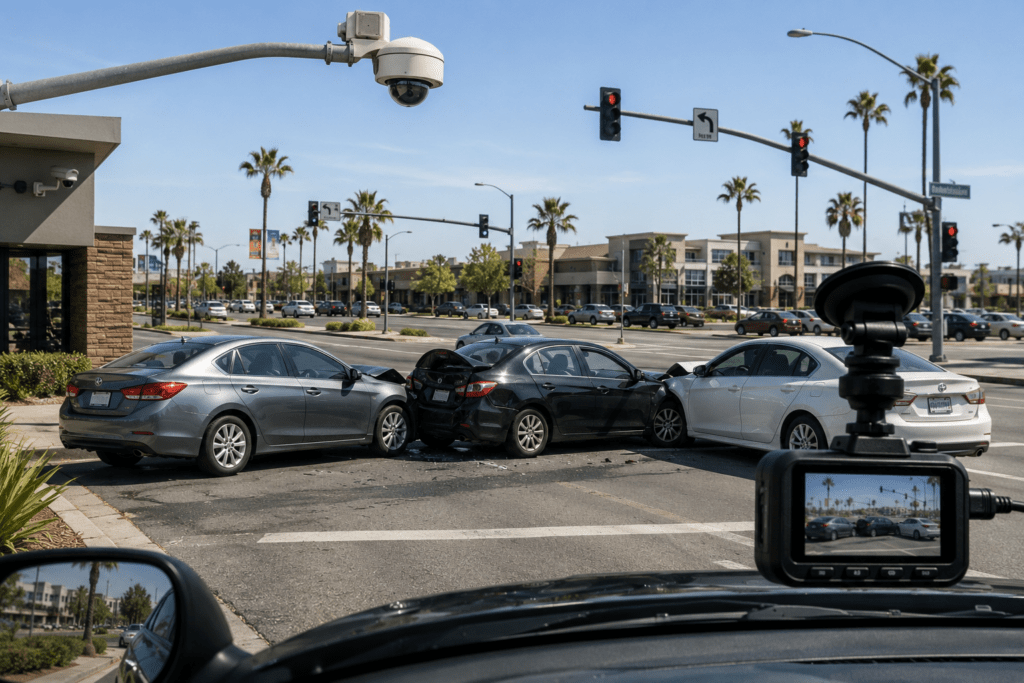
An Anaheim multi vehicle traffic camera evidence investigation may involve much more than reviewing photographs or reading a police report. Multi-vehicle collisions often unfold within only a few seconds, leaving drivers with very different recollections of what happened before impact. Modern intersections, commercial corridors, and individual vehicles frequently generate multiple sources of video evidence that may help investigators reconstruct the sequence of events. Depending on the location of the crash, available evidence may include traffic monitoring cameras, nearby business surveillance systems, residential security cameras, and dashcam recordings captured by one or more vehicles involved in the collision. While video evidence does not determine liability by itself, it may become one of the most valuable sources of information when evaluating a complex chain-reaction accident.
At Super Woman Super Lawyer, we understand that multi-vehicle collisions frequently involve conflicting witness statements and competing explanations regarding which impact occurred first. An Anaheim multi vehicle traffic camera evidence review may be compared with Event Data Recorder (EDR) information, police reports, roadway evidence, vehicle damage, witness testimony, photographs, and accident reconstruction analysis. Looking at every available source of evidence together often provides investigators with a more complete understanding of how the collision developed than relying on any single recording or witness account.
Multi-vehicle collisions occur throughout Anaheim every day, particularly along busy corridors such as Harbor Boulevard, Katella Avenue, Lincoln Avenue, Euclid Street, State College Boulevard, Ball Road, and near freeway interchanges connecting Interstate 5, State Route 57, and State Route 91. Heavy commuter traffic, tourism, commercial deliveries, sporting events, and entertainment destinations frequently create conditions where several vehicles become involved in the same collision. In these situations, multiple cameras operating from different locations may capture different portions of the accident.
According to the Federal Highway Administration (FHWA), roadway cameras, traffic monitoring systems, and transportation technology continue to play an increasingly important role in managing traffic operations and documenting roadway conditions. Although these systems are designed primarily for transportation management rather than accident reconstruction, available video footage may provide investigators with valuable context following certain collisions.
This article explains how Anaheim multi vehicle traffic camera evidence may become part of a multi-vehicle accident investigation, what types of cameras may capture relevant footage, why video evidence should be preserved promptly, and how investigators compare multiple recordings with other available sources of evidence.
Why Multi-Vehicle Collisions Often Require Multiple Video Sources
Unlike two-vehicle collisions, chain-reaction accidents often involve several separate impacts occurring within only moments of one another. Drivers positioned at different points in the traffic flow may observe completely different portions of the collision, making witness statements especially difficult to reconcile without additional evidence.
An Anaheim multi vehicle traffic camera evidence investigation frequently begins by identifying every possible video source near the accident scene. Rather than relying on one camera alone, investigators may review traffic monitoring systems, nearby businesses, parking structures, hotels, gas stations, apartment complexes, residential doorbell cameras, public transit vehicles, and individual dashcams installed inside private vehicles.
Each camera typically records the collision from a different perspective. When investigators compare multiple viewpoints together, they may better understand how traffic was moving before the first impact and how additional collisions occurred afterward.
One Camera Rarely Captures the Entire Collision
Many people assume one traffic camera will record everything that happened during a multi-vehicle accident. In reality, every camera has limitations. Traffic monitoring cameras may overlook one portion of the intersection while missing another. Business security cameras often point toward entrances or parking lots rather than travel lanes. Dashcams generally record only what occurs directly in front of—or behind—the vehicle.
An Anaheim multi vehicle traffic camera evidence investigation therefore often involves collecting footage from several different cameras. One recording may capture the initial impact, while another documents a secondary collision farther down the roadway. A third camera may show traffic conditions moments before the first vehicle braked.
Comparing these independent recordings frequently allows investigators to establish a more accurate sequence of events than relying on one camera alone.
Dashcams May Capture Driver Perspective
Dashcams have become increasingly common in passenger vehicles, commercial fleets, delivery vans, rideshare vehicles, and commercial trucks. Unlike fixed surveillance cameras, dashcams move with the vehicle and often capture the driver’s perspective immediately before the collision.
An Anaheim multi vehicle traffic camera evidence investigation may therefore include reviewing dashcam footage from several different vehicles involved in the accident. One driver may capture the first collision while another records the chain reaction developing behind them. Together, these recordings may provide valuable information regarding vehicle spacing, braking, lane changes, traffic signals, and roadway conditions.
Because dashcams continuously record while the vehicle is operating, they often preserve events leading up to the collision rather than only the moment of impact itself.
Business Surveillance Cameras May Capture Additional Angles
Commercial properties located near major intersections frequently operate surveillance systems covering sidewalks, entrances, parking lots, loading areas, and nearby roadways. While these cameras are installed primarily for security purposes, they sometimes record portions of nearby traffic collisions.
An Anaheim multi vehicle traffic camera evidence investigation may include reviewing surveillance footage from shopping centers, restaurants, office buildings, hotels, banks, apartment complexes, and gas stations surrounding the accident scene. Investigators frequently compare these recordings with traffic cameras and dashcam footage to better understand how vehicles moved before and after each impact.
Because different cameras record different angles, combining multiple recordings often produces a far more complete reconstruction than relying on one source alone.
For additional guidance on preserving important evidence immediately after a collision, read What to Do After a Car Accident in California: What Actually Matters. Many of the same documentation principles discussed in that guide also apply following chain-reaction collisions where multiple video recordings may exist.
If you were injured in a multi-vehicle collision, our Anaheim Car Accident Lawyer page explains how traffic cameras, dashcams, surveillance footage, witness statements, and other forms of evidence may become important during the investigation of a personal injury claim.
Why Video Evidence Should Be Preserved Promptly
One of the most important aspects of an Anaheim multi vehicle traffic camera evidence investigation is recognizing that digital video may not remain available indefinitely. Traffic monitoring systems, commercial surveillance cameras, and private dashcams all follow different storage and retention practices. Some recordings are automatically overwritten after only a few days, while others may remain available much longer depending on the system being used.
Because each camera operates independently, investigators often work to identify every available recording as early as reasonably possible after the collision. Acting promptly may improve the opportunity to preserve original traffic camera footage, dashcam recordings, and surveillance video before routine recording cycles overwrite the available evidence.
Every Camera System Stores Video Differently
Traffic management agencies, businesses, apartment complexes, hotels, and private vehicle owners all use different recording systems. Some cameras record continuously, while others activate only when motion is detected. Storage capacity, video quality, retention periods, and retrieval procedures also vary considerably from one system to another.
An Anaheim multi vehicle traffic camera evidence investigation often begins by identifying each available camera, determining who controls the recording system, and understanding how long footage is typically retained. Gathering this information early may improve the opportunity to preserve original recordings before normal retention schedules affect the available evidence.
How Traffic Camera and Dashcam Footage May Support a Multi-Vehicle Accident Investigation
An Anaheim multi vehicle traffic camera evidence investigation rarely depends on one video recording alone. Chain-reaction collisions often unfold in stages, with several impacts occurring only fractions of a second apart. One driver may remember being struck from behind, another may believe a vehicle entered the intersection unexpectedly, while a third may have seen only the final impact. Because every person experiences the collision from a different position, investigators often compare multiple video sources to develop a more complete timeline of the events.
Modern traffic cameras, dashcams, surveillance systems, and vehicle electronics each document different portions of the collision. When these recordings are synchronized with one another and compared alongside physical evidence, investigators may better understand how the first impact occurred and how additional collisions developed afterward.
Traffic Cameras May Capture the Initial Sequence of Events
Many signalized intersections throughout Southern California include traffic monitoring systems designed to observe traffic flow rather than record accidents. Although these cameras are not installed specifically for collision investigations, they sometimes capture valuable footage showing vehicle movements immediately before a chain-reaction crash.
An Anaheim multi vehicle traffic camera evidence investigation may include reviewing available traffic camera recordings to determine how vehicles approached the intersection, whether traffic had already begun slowing, whether signals changed immediately before the collision, or whether congestion contributed to the sequence of impacts.
Traffic cameras generally provide a wide overview of the intersection rather than detailed close-up images. For that reason, investigators often compare traffic camera footage with dashcams, surveillance systems, and physical evidence to obtain a more complete understanding of what occurred.
Dashcams May Capture Individual Driver Perspectives
Dashcams often provide details unavailable from fixed traffic cameras because they record from the driver’s perspective. During a multi-vehicle collision, several different dashcams may capture different portions of the same event.
An Anaheim multi vehicle traffic camera evidence investigation may therefore include reviewing recordings from multiple vehicles involved in the collision. One dashcam may document sudden braking several vehicles ahead, another may show a vehicle changing lanes unexpectedly, while a third captures the secondary impacts occurring behind the first collision.
Investigators frequently compare these recordings frame by frame to determine the order in which impacts occurred. Because every dashcam records from a different angle, combining several recordings often provides a much more complete reconstruction than relying on one camera alone.
Synchronizing Multiple Video Sources May Improve Accuracy
One of the greatest advantages of digital video evidence is the ability to compare multiple recordings captured at nearly the same time. A Anaheim multi vehicle traffic camera evidence investigation may involve synchronizing traffic cameras, business surveillance systems, dashcams, and even nearby residential security cameras to establish a single chronological timeline.
Investigators may compare timestamps, traffic signal changes, vehicle positions, pedestrian movements, and surrounding traffic conditions to better understand how the collision progressed from the initial impact through the final vehicle movements.
No single recording typically answers every question. Instead, the combination of several synchronized video sources often provides investigators with a far more reliable reconstruction than witness statements alone.
Understanding how multiple forms of digital evidence work together can also be helpful following any serious collision. Our article How Personal Injury Settlements Really Work in California explains why preserving electronic records, photographs, witness statements, repair documentation, and medical records frequently provides investigators with a more complete understanding of a personal injury claim.
California Laws That May Become Relevant During a Multi-Vehicle Collision Investigation
Although Anaheim multi vehicle traffic camera evidence may provide valuable visual documentation, investigators still evaluate every chain-reaction collision using the complete body of available evidence. California traffic laws, roadway conditions, witness testimony, traffic engineering, vehicle inspections, and physical evidence all contribute to understanding how the accident occurred.
Drivers Must Operate Their Vehicles at a Reasonable Speed
California’s Basic Speed Law (Vehicle Code §22350) requires motorists to drive at a speed that is reasonable and prudent based upon traffic, roadway conditions, visibility, and weather.
During an Anaheim multi vehicle traffic camera evidence investigation, investigators may compare video recordings with roadway evidence, Event Data Recorder (EDR) information, witness statements, and physical damage to better understand whether traffic conditions changed before the first impact. Video footage provides valuable context but remains only one part of the broader investigation.
Following Distance May Become an Important Issue
Chain-reaction collisions frequently raise questions regarding following distance and driver reaction time. Investigators often evaluate whether drivers maintained sufficient distance to respond safely when traffic slowed or stopped unexpectedly.
An Anaheim multi vehicle traffic camera evidence investigation may compare dashcam recordings, traffic camera footage, vehicle spacing, roadway evidence, and witness observations to better understand how much time drivers had to react before each successive impact.
Because every chain-reaction collision develops differently, investigators generally evaluate these circumstances individually rather than relying on assumptions based solely on vehicle position.
Comparative Negligence May Involve Multiple Drivers
California follows a comparative negligence system, meaning responsibility for a chain-reaction collision may involve more than one driver depending on the available evidence. Multi-vehicle accidents often require investigators to evaluate the conduct of every driver involved rather than focusing only on the first or final impact.
An Anaheim multi vehicle traffic camera evidence investigation may therefore include reviewing video recordings together with police reports, witness statements, Event Data Recorder information, vehicle inspections, photographs, and roadway evidence before determining how the sequence of impacts occurred.
If you’re recovering from injuries following a chain-reaction collision, you may also find Should You Accept a Car Accident Settlement Before Finishing Medical Treatment in Newport Beach? helpful for understanding why preserving medical documentation and completing treatment may become important before resolving a personal injury claim.
What You Can Do to Help Preserve Video Evidence
Because digital recordings may be automatically overwritten after relatively short retention periods, preserving available video promptly may improve the overall investigation. An Anaheim multi vehicle traffic camera evidence investigation often benefits from identifying every available camera before routine recording schedules replace the original footage.
Identify Every Available Camera
If it is safe to do so, look beyond the vehicles involved in the collision. Nearby intersections, businesses, shopping centers, gas stations, apartment buildings, hotels, parking garages, and even residential properties may operate cameras that captured portions of the accident.
Documenting camera locations early may help investigators locate valuable Anaheim multi vehicle traffic camera evidence before recordings are automatically overwritten or deleted.
Preserve Physical Evidence Alongside Video
Video evidence becomes significantly more valuable when reviewed together with photographs and physical evidence from the collision scene. If it is safe to do so, photograph vehicle damage, skid marks, debris fields, roadway markings, traffic signals, weather conditions, and final vehicle positions.
These photographs may later be compared with Anaheim multi vehicle traffic camera evidence, allowing investigators to evaluate how the visual recordings correspond with the physical evidence collected from the accident scene.
Frequently Asked Questions About Traffic Camera and Dashcam Evidence
What is traffic camera evidence?
Anaheim multi vehicle traffic camera evidence generally refers to video recorded by traffic monitoring cameras, intersection cameras, business surveillance systems, parking structure cameras, or other fixed recording devices located near the collision scene. Depending on the location, these recordings may capture vehicle movements, traffic signal phases, lane positioning, pedestrian activity, and the sequence of impacts during a multi-vehicle accident. While traffic camera footage does not determine fault by itself, it may provide investigators with valuable visual information when evaluated alongside other evidence.
Can multiple dashcams be used to investigate the same collision?
Yes. An Anaheim multi vehicle traffic camera evidence investigation often involves reviewing dashcam footage from more than one vehicle. Different drivers may capture different portions of the collision depending on where they were positioned in traffic. Comparing several recordings may help investigators establish a more complete timeline than relying on a single camera.
How long do traffic cameras usually keep recordings?
Every agency and business follows different retention policies. Some traffic monitoring systems retain recordings only briefly, while business surveillance systems may overwrite footage automatically after a certain period. Because retention practices vary, an Anaheim multi vehicle traffic camera evidence investigation often benefits from identifying available recordings as early as possible.
Can video footage determine who caused a chain-reaction collision?
Not by itself. Although Anaheim multi vehicle traffic camera evidence may show how the collision unfolded, investigators generally compare video recordings with Event Data Recorder (EDR) information, witness statements, police reports, vehicle damage, roadway evidence, and accident reconstruction before determining how the collision occurred.
Why should video evidence be preserved quickly?
Many recording systems automatically overwrite older footage as new video is recorded. Preserving Anaheim multi vehicle traffic camera evidence promptly may improve the opportunity to review original traffic camera recordings, dashcam footage, and surveillance video before routine recording cycles replace the available evidence.
An Anaheim multi vehicle traffic camera evidence investigation may provide valuable visual documentation that helps investigators better understand how a chain-reaction collision developed. Traffic cameras, dashcam recordings, business surveillance systems, residential security cameras, and other digital video sources may capture different portions of the same event, allowing investigators to compare multiple viewpoints when reconstructing the sequence of impacts.
While video evidence can provide important context, it represents only one component of a comprehensive accident investigation. Investigators generally compare traffic camera recordings with Event Data Recorder information, police reports, witness statements, roadway evidence, photographs, vehicle inspections, and accident reconstruction analysis before developing conclusions regarding how the collision occurred. Evaluating these sources together frequently provides a more complete understanding than relying on any single recording alone.
Because traffic cameras, surveillance systems, and dashcams may automatically overwrite older footage, preserving available recordings promptly may improve the opportunity to review original evidence. Whether the collision involves three vehicles or several more, identifying available Anaheim multi vehicle traffic camera evidence early may become an important part of documenting the events surrounding the accident.
Connect With Super Woman Super Lawyer
If you or someone you love has been injured in a multi-vehicle collision, understanding what video evidence may be available can feel overwhelming. At Super Woman Super Lawyer, we help clients understand how traffic camera footage, dashcam recordings, surveillance video, Event Data Recorder information, witness statements, and other forms of evidence may become important during the investigation of a personal injury claim.
You can also learn more about our services by visiting our Anaheim Car Accident Lawyer page.
Connect with Super Woman Super Lawyer today.
Online Form: Request a case review
Call Now: 800.800.6916
Live Chat: Speak with a legal professional instantly
 Maryam Parman