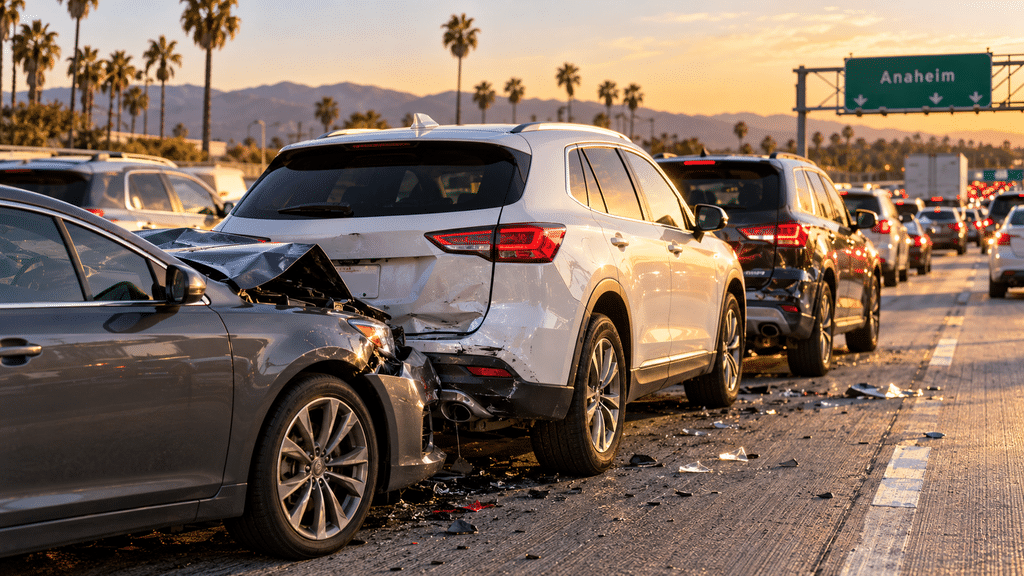
An Anaheim freeway accident during Thanksgiving travel can develop within seconds when vehicles moving through heavy traffic encounter an unexpected slowdown. Brake lights may appear across several lanes as motorists approach a congested interchange, an existing traffic queue, or a sudden change in roadway conditions. One driver may stop in time, another may strike the vehicle ahead, and a third may collide with the resulting queue. When several vehicles become involved, determining how the collision started and which impact caused particular damage or injuries can require more than identifying the last vehicle in line.
Thanksgiving travel can introduce additional complications because drivers may be traveling long distances, navigating unfamiliar freeway exits, or moving between Orange County and other Southern California destinations. However, an Anaheim freeway accident should not automatically be attributed to holiday congestion. Investigators still need to determine what traffic was doing immediately before the collision, how much distance separated the vehicles, whether brake lights were visible, and how each driver responded. The holiday provides relevant context, but the evidence must establish what actually happened.
California law requires motorists to consider traffic conditions when selecting their speed and following distance. California Vehicle Code section 21703 addresses following another vehicle more closely than is reasonable and prudent, while California Vehicle Code section 22350 establishes the state’s basic speed law. These requirements may become relevant when insurers disagree about whether a driver maintained adequate distance or adjusted appropriately to slowing traffic.
A multi-vehicle Anaheim freeway accident can also generate disputes about which collision happened first. One vehicle may strike a stopped car and push it forward, while another collision may involve two separate impacts occurring moments apart. Vehicle damage, dashcam recordings, witness statements, roadway evidence, and available electronic information may help distinguish those scenarios. The fact that a vehicle was struck from behind may be important, but it should not automatically be treated as resolving every question about responsibility.
For families seeking local assistance, Super Woman Super Lawyer provides information about accident claims through its Anaheim personal injury lawyer service page. The firm can help evaluate collision evidence, medical documentation, insurance communications, and financial losses when a holiday trip is interrupted by a serious crash.
Connect with Super Woman Super Lawyer today through our Online Form, call 800.800.6916, or start a Live Chat. After an Anaheim freeway accident, preserving vehicle photographs, available video, witness information, and towing records promptly can help prevent important evidence from disappearing.
Reconstructing Traffic Before an Anaheim Freeway Accident
Understanding traffic movement before the first impact is often central to an Anaheim freeway accident involving sudden braking. Investigators may need to determine whether vehicles were traveling at steady freeway speeds, slowing gradually, stopping in a developing queue, or moving through repeated stop-and-go congestion. Those differences can affect how much time each driver had to recognize changing conditions and respond.
The investigation should also distinguish the initial traffic slowdown from the collision sequence that followed. A queue can form without a crash, and a sudden braking event does not necessarily establish that the first driver acted improperly. Dashcams, available roadway information, witness accounts, vehicle damage, and debris locations may help reconstruct the sequence.
Traffic Queue Formation During Thanksgiving Travel
A traffic queue may develop when vehicles approach a congested interchange, a lane restriction, an existing collision, or another interruption to normal traffic flow. During Thanksgiving travel, motorists may encounter changing traffic volumes along routes serving Anaheim, but the actual cause of a particular slowdown must be established rather than presumed.
In an Anaheim freeway accident investigation, the location of the queue can help provide context. Was traffic slowing before an interchange? Were vehicles approaching an exit? Did a nearby lane become unavailable? Was there an existing incident farther ahead? These questions may guide requests for available traffic information, witness accounts, and video evidence.
The timing of the slowdown also matters. A driver approaching congestion from a distance may have a different opportunity to respond than someone encountering a sudden obstruction after a curve or other visibility limitation. Investigators may consider roadway geometry, lighting, traffic conditions, and the position of surrounding vehicles when evaluating what happened.
Holiday travel may also involve motorists unfamiliar with local freeway configurations. That possibility should not be treated as proof of negligence, but it may provide context when examining lane changes, exits, and the movement of traffic immediately before a collision.
Brake Lights and Following Distance
Brake lights may become central to a disputed Anaheim freeway accident. One driver may report that the vehicle ahead stopped without warning, while another may say traffic had been slowing for several seconds and brake lights were clearly visible. Witnesses may offer different descriptions depending on their positions and what they could see.
California’s following-distance rule considers factors such as vehicle speed, traffic, and roadway conditions. That makes the actual distance between vehicles relevant, but determining it after a collision can be difficult. Video, roadway reference points, available vehicle information, and witness observations may help qualified investigators evaluate spacing before impact.
A driver’s estimate that another vehicle was only a few feet away should be treated as an observation rather than an exact measurement. Similarly, the fact that a vehicle struck another from behind does not necessarily establish how the entire multi-vehicle collision unfolded. The evidence should be evaluated in context.
When reviewing an Anaheim freeway accident involving sudden braking, investigators may also consider whether the driver was approaching an already visible queue, whether traffic conditions changed unexpectedly, and whether another vehicle moved into the available following space. These questions can help distinguish the circumstances rather than relying on a general assumption about rear-end collisions.
First Impact and Subsequent Vehicle Movements
Several vehicles colliding in a line may involve one initial impact pushing a vehicle forward, or multiple independent rear-end collisions occurring moments apart. An Anaheim freeway accident investigation may therefore need to establish which vehicle made the first contact and whether later impacts changed the positions of other vehicles.
Photographs of front and rear damage, broken components, debris, and final resting positions may help reconstruct the sequence. If a vehicle has both front and rear damage, investigators may need to determine whether the front contact occurred before or after the rear impact. Physical evidence should be compared with witness accounts and available video.
Passenger statements can also become important when occupants describe feeling more than one impact. Medical records may document a person’s account of the collision, including whether the vehicle was struck once or several times. Those descriptions should remain accurate rather than being shaped to support a preferred insurance position.
In an Anaheim freeway accident involving several impacts, the order of collisions may influence how insurers evaluate responsibility and damages. That makes preserving the original vehicle condition and collision evidence especially important before repairs or disposal.
Evidence to Preserve After an Anaheim Freeway Accident
An Anaheim freeway accident during Thanksgiving travel may involve evidence from several sources that are not immediately available to the injured driver. The California Highway Patrol may investigate the collision, towing companies may move the vehicles, and traffic-management systems may provide information about roadway conditions. Other motorists may have dashcams, while passengers or nearby drivers may have witnessed the sequence of braking and impacts.
The purpose of gathering this evidence is to create a reliable account of what happened rather than relying entirely on the drivers’ recollections. This becomes particularly important when an Anaheim freeway accident involves several vehicles and each insurer receives a different description of the collision.
Dashcams and Traffic Cameras
Dashcam footage can help establish when brake lights first appeared, whether traffic was already slowing, how vehicles moved between lanes, and whether a collision occurred before the injured person’s vehicle was struck. A forward-facing camera may capture traffic ahead, while a rear-facing camera may document an approaching vehicle or later impact.
The Caltrans QuickMap system provides information about traffic conditions, incidents, closures, and available camera views. However, the agency’s traffic-video FAQ explains that its freeway camera video is not recorded or saved by that system. Families should not assume that viewing a Caltrans camera online means historical footage can later be obtained.
For an Anaheim freeway accident, identifying private or vehicle-based video sources may therefore be particularly important. Investigators can look for recordings from commercial vehicles, passenger vehicles, and other available systems without assuming a government recording exists.
The SWSL article What to Do After a Car Accident in California: What Actually Matters explains why photographs, witness information, and early documentation can be valuable before conditions change. These principles are especially relevant when several vehicles must be cleared from a freeway within a short period.
Vehicle Damage, Debris, and Electronic Data
Vehicle damage may help distinguish separate impacts in a multi-car Anaheim freeway accident. A vehicle struck from behind and pushed into the car ahead may have both front and rear damage, while another vehicle may have sustained damage from only one contact. The pattern and severity of damage should be evaluated alongside photographs, vehicle positions, and witness descriptions rather than treated as definitive proof of a particular sequence.
Photographs should show the entire vehicle from multiple angles before repairs begin, followed by closer images of damaged areas. Broken bumper components, lighting assemblies, glass, tire marks, and other debris may provide additional context. If vehicles were moved to the shoulder before photographs were taken, that fact should be documented so their later positions are not mistaken for the original crash positions.
Some vehicles may store limited event data depending on their equipment and the circumstances of the impact. The SWSL guide to rear-end collision event data recorders discusses why electronic evidence must be compared with photographs, video, and witnesses rather than treated as the entire reconstruction.
If a repair estimate changes after disassembly, the related Anaheim hidden vehicle damage article explains how supplemental repair documentation can provide context. The discovery of additional damage may affect repair costs, but whether it resulted from the collision must still be evaluated from the evidence.
Witnesses and California Highway Patrol Records
Witnesses may provide information about traffic conditions before an Anaheim freeway accident, including whether the queue formed gradually or abruptly. A passenger in one vehicle may remember several impacts, while another driver may have seen the first collision from an adjacent lane. Witnesses should describe what they personally observed rather than being asked to confirm a particular theory.
The California Highway Patrol’s crash-report request page explains how eligible parties may request available CHP collision records. A report may contain involved-party information, statements, diagrams, and other investigative findings, depending on the circumstances.
For an Anaheim freeway accident, preserve the investigating agency, report number, date, location, and officer information when available. The report can provide an important foundation, but it should be reviewed alongside video, photographs, medical records, and other evidence rather than treated as the only account of the collision.
Witnesses traveling during Thanksgiving may return to other cities or states soon after the crash. Obtaining accurate contact information while it is available can therefore be particularly important.
Insurance Questions After Sudden Braking and Multiple Impacts
Insurance disputes following an Anaheim freeway accident can become complicated when several vehicles collide in congested traffic. Each insurer may examine the actions of its insured driver, the distance between vehicles, the timing of the braking, and whether one collision caused another. Different drivers may also remember the same sequence differently, particularly when impacts occurred within seconds.
California’s basic speed law requires drivers to travel at a speed reasonable for prevailing conditions, including traffic and visibility. A driver traveling below the posted speed limit may still need to slow further when approaching congestion. These principles can become relevant when insurers evaluate an Anaheim freeway accident involving unexpected braking.
Competing Accounts About Following Distance
An insurer may argue that the driver behind another vehicle failed to maintain adequate following distance. Another insurer may argue that a sudden maneuver, abrupt stop, or earlier collision contributed to the event. A reliable Anaheim freeway accident investigation should examine these competing accounts rather than assume the rear driver was automatically responsible for every impact.
The available evidence may include video, vehicle spacing, traffic speed, road conditions, brake-light visibility, and whether a vehicle had already been struck before moving forward. A driver’s recollection of distance can be useful, but it may not provide an exact measurement.
The distinction between a voluntary braking maneuver and a vehicle being pushed by an impact can also matter. In a multi-vehicle collision, investigators may need to determine whether a particular driver had an opportunity to avoid the contact that followed.
An Anaheim freeway accident may also involve a driver who changed lanes shortly before traffic slowed. The timing and location of that movement may become relevant if another motorist claims that the lane change reduced the available following distance.
Multiple Vehicles and Separate Insurance Policies
A chain-reaction Anaheim freeway accident may involve several liability insurers and potentially other coverages. Each driver may have a separate claim number, adjuster, and account of the collision. The injured person may therefore receive multiple requests for statements, photographs, medical information, or settlement discussions.
Maintaining a separate folder for each insurer can reduce confusion. The folder can contain claim numbers, adjuster names, contact information, correspondence, recorded-statement requests, coverage letters, and settlement documents. A central timeline can connect those files without combining them into one indistinguishable record.
California follows comparative-fault principles, so responsibility may be allocated based on the conduct of the parties and the evidence. An insurer’s initial position is not necessarily the final determination. A complete Anaheim freeway accident claim may require reviewing the full sequence before evaluating how responsibility should be assigned.
The California Department of Insurance provides general information about automobile insurance coverage and claims. The actual policies, circumstances, and available evidence determine which coverage may apply.
Settlement Before the Impact Sequence Is Clear
Settlement discussions may begin while an Anaheim freeway accident investigation is still incomplete. One insurer may offer to resolve a claim before another driver’s footage has been obtained, before all vehicle damage has been documented, or while medical treatment continues.
A release may affect legal rights, and its scope depends on its wording and the circumstances. Families should not assume that settling with one insurer necessarily has no effect on other potential claims.
The SWSL article How Personal Injury Settlements Really Work in California discusses the role of evidence, medical documentation, and settlement timing. These considerations may become especially important when an Anaheim freeway accident involves multiple impacts or unresolved insurance questions.
Preserving every offer, release, demand, and substantive communication helps establish what information was available when negotiations occurred. Medical treatment and repair records should also be organized so unresolved issues can be identified before important decisions are made.
Documenting Injuries and Thanksgiving Travel Disruptions
Thanksgiving travel can add practical complications to an Anaheim freeway accident. A collision may interrupt a trip to visit relatives, leave a vehicle undrivable far from home, or require an injured person to seek treatment outside their usual healthcare network. Those circumstances can generate records from hospitals, tow companies, rental providers, employers, and insurers in several locations.
The fact that a collision occurred during holiday travel does not automatically make every resulting expense recoverable. Nevertheless, preserving documentation allows medical, transportation, property, and financial questions to be evaluated accurately.
Emergency Treatment and Follow-Up Medical Care
Medical documentation may begin with ambulance care, an emergency department evaluation, or another initial appointment. Depending on the injuries, later treatment may involve imaging, specialist care, therapy, medication, or rehabilitation. Diagnoses and treatment recommendations should come from qualified healthcare professionals.
For an Anaheim freeway accident, preserve the date of each visit, the provider, the symptoms reported, the evaluation performed, and any activity or work restrictions. If treatment began in Orange County but continued after the person returned home, records from both locations may be needed to understand the full medical chronology.
The timing of medical treatment can also matter when insurers review the claim. A complete record should accurately reflect when symptoms began, whether they changed, and what treatment occurred without attempting to create a more convenient timeline.
If the person experienced several impacts, the description provided to healthcare professionals should reflect what they actually remember. Medical documentation can help establish the reported symptoms and treatment, while the physical crash investigation separately addresses the sequence of vehicle contacts.
Towing, Vehicle Storage, and Alternative Transportation
A freeway collision may leave a vehicle unsafe or impossible to drive. Tow companies may transport it to a storage facility, body shop, insurer-designated location, or another destination. For travelers, the vehicle may remain in Anaheim while the owner returns to another city.
A complete Anaheim freeway accident file should preserve towing invoices, storage notices, repair estimates, rental agreements, rideshare receipts, and other transportation documentation. The location and condition of the vehicle should also be recorded before it is repaired or released.
Transportation costs may continue if repairs take longer than expected or the vehicle is declared a total loss. Maintaining receipts and communications as they arrive is generally easier than reconstructing the expenses months later.
The SWSL article Injured During a Road Trip? Who to Call and What Steps to Take provides additional guidance about organizing accident-related information when a collision happens away from home.
Missed Work and Additional Travel Expenses
An injured person may miss work because of medical appointments, recovery restrictions, transportation problems, or other documented effects of the collision. Relevant employment records may include schedules, timecards, wage statements, provider restrictions, and employer communications.
Thanksgiving travel can create additional expenses such as replacement transportation, lodging, or rearranged travel plans. In an Anaheim freeway accident claim, these records should be kept separate from medical expenses and vehicle repair costs so each category can be evaluated appropriately.
The important distinction is between documenting an expense and establishing its legal recoverability. Preserving accurate records does not guarantee compensation for every cost, but it creates a more reliable financial history.
A simple expense log can help connect receipts with the reason each cost was incurred. Dates, amounts, payment confirmations, and relevant communications may be useful when an insurer later requests supporting documentation.
Legal Deadlines and Evidence Preservation After an Anaheim Freeway Accident
California generally provides a two-year statute of limitations for personal injury actions under Code of Civil Procedure section 335.1, subject to exceptions and circumstances that can affect the applicable deadline. Claims involving public entities can require different procedures and potentially shorter claim-presentation deadlines. A general article cannot determine the deadline for an individual case.
The practical evidence timeline after an Anaheim freeway accident can be far shorter. Dashcam footage may be overwritten, damaged vehicles repaired, and witnesses dispersed after holiday travel. Identifying these sources promptly can help preserve information needed to reconstruct the collision.
Vehicle data may also become unavailable if a damaged vehicle is repaired, disposed of, or otherwise altered before appropriate inspection. Towing and storage facilities may have their own procedures concerning vehicle release, and surveillance systems may operate under different retention policies.
The fact that a person may have time before a potential lawsuit deadline does not mean every form of evidence will remain available. Medical, vehicle, digital, and insurance records should be organized as early as reasonably possible.
Serving Injured Drivers Throughout Anaheim and Orange County
Anaheim connects with major Southern California transportation routes, including Interstate 5, State Route 91, State Route 57, and nearby State Route 22. These corridors connect Orange County with Los Angeles, Riverside County, and other destinations throughout the region. During Thanksgiving travel, motorists may encounter changing traffic conditions as they move between freeways, interchanges, and local exits.
An Anaheim freeway accident on one of these routes should be evaluated according to the actual roadway and traffic conditions at the time. The presence of holiday travelers does not establish that congestion caused the collision. Investigators may need to review available traffic information, collision records, video, weather conditions, lane configuration, and vehicle movements before reaching conclusions.
Caltrans QuickMap provides current traffic information that can help motorists understand incidents, closures, and roadway conditions. However, it should not be assumed to preserve historical camera recordings. The California Highway Patrol may also possess collision records when it investigated the incident.
For families dealing with an Anaheim freeway accident, Super Woman Super Lawyer can help evaluate the available accident evidence, insurance issues, medical documentation, and financial losses. The objective is to develop an accurate account of the collision rather than assume responsibility based only on where a vehicle came to rest or which driver struck another from behind.
For location-specific assistance, visit the Anaheim personal injury lawyer service page, which provides information about representation and consultation options.
Frequently Asked Questions About Anaheim Freeway Accidents During Thanksgiving Traffic
Can sudden braking cause a multi-vehicle freeway accident?
Yes. When traffic slows abruptly, vehicles traveling close together may become involved in successive collisions. An Anaheim freeway accident may involve one initial rear-end impact, several separate impacts, or a combination of the two. Dashcam footage, vehicle damage, witness statements, and roadway evidence may help establish the sequence. Responsibility depends on what each driver did and the circumstances immediately before the collision.
Is the rear driver always responsible for a freeway collision?
No. California law requires drivers to maintain reasonable following distances, but the position of a vehicle alone does not necessarily resolve responsibility for every collision. In an Anaheim freeway accident involving multiple vehicles, investigators may need to determine whether a car was struck and pushed forward, whether a separate impact occurred, and whether other driving conduct contributed.
Does California require drivers to slow down in heavy traffic?
California’s basic speed law requires drivers to use a speed reasonable for conditions, including traffic and visibility. The posted speed limit is not necessarily a safe speed during heavy congestion. A driver involved in an Anaheim freeway accident may therefore face questions about whether their speed and following distance were appropriate for the traffic conditions.
Can dashcam footage help determine which collision happened first?
Potentially. Dashcam footage may show brake lights, traffic movement, lane positions, and the timing of impacts. A rear-facing camera may provide additional information about approaching vehicles. In a multi-vehicle Anaheim freeway accident, recordings from several vehicles may help qualified investigators reconstruct the sequence more accurately than one recording alone.
Can I obtain footage from Caltrans freeway cameras?
Do not assume historical recordings exist. Caltrans states that its freeway camera video is not recorded or saved by that system. Other sources, including vehicle dashcams or private surveillance, may still be available. After an Anaheim freeway accident, identifying those sources promptly may be important.
How do I request a California Highway Patrol collision report?
The CHP provides information about requesting collision reports through its official crash-report request page. Eligible parties may request records through the available procedures. Preserve the collision date, location, report number, and investigating agency to make the request easier.
What if I felt two separate impacts during the collision?
Report the sequence accurately to the investigating agency and healthcare providers. An Anaheim freeway accident involving more than one impact may require examination of front and rear vehicle damage, video, witness statements, and the timing of each collision. A person’s recollection can provide useful context, but technical conclusions should be supported by the broader evidence.
What if the other driver says I stopped too suddenly?
The statement should be evaluated alongside the actual traffic conditions and available evidence. Drivers may need to brake when congestion develops. In an Anaheim freeway accident, investigators may examine whether traffic was already slowing, how much following distance existed, and whether the braking maneuver was related to conditions ahead.
Should I photograph every vehicle involved?
When it is safe and reasonably possible, photographs of each involved vehicle can help preserve the damage pattern and final positions. Wide photographs provide context, while close-ups document particular damage. In a multi-vehicle Anaheim freeway accident, photographs of both front and rear damage may become especially useful.
What if my vehicle was towed before I could photograph it?
Record the towing company and storage location. Photographs may still be taken later, and the tow company, insurer, repair facility, or investigating agency may possess additional documentation. An Anaheim freeway accident file should preserve the vehicle’s location and condition before repairs or disposal when reasonably possible.
Can I document extra transportation expenses caused by the collision?
Yes. Preserve towing bills, rental agreements, rideshare receipts, and other transportation records. Whether each expense is recoverable depends on the circumstances, but keeping an organized record allows those costs to be evaluated as part of an Anaheim freeway accident claim.
What if I was visiting Anaheim from another city or state?
Preserve the collision records, vehicle location, medical documentation, and insurance communications even after returning home. An Anaheim freeway accident may generate records in several locations if the person receives initial treatment in Orange County and follow-up care elsewhere. A centralized digital file can help keep those records organized.
Should I accept an insurance settlement before all vehicle damage is known?
The appropriate decision depends on the individual circumstances. Before signing a release, it is important to understand what the document resolves and whether relevant repair, medical, or liability information remains incomplete. An Anaheim freeway accident involving multiple impacts may require additional review before the full loss and collision sequence are understood.
How soon should I preserve evidence after a Thanksgiving freeway collision?
As early as reasonably possible. Dashcam recordings can be overwritten, vehicles may be repaired, debris can be cleared, and witnesses may become difficult to contact. The practical evidence-preservation period after an Anaheim freeway accident may be considerably shorter than the applicable legal filing deadline.
Call or Contact Super Woman Super Lawyer 24/7 for a Free Consultation and Pay Nothing Unless You Win
Thanksgiving freeway congestion can turn an unexpected slowdown into a complicated collision involving several vehicles, competing insurance positions, and injuries requiring medical care. An Anaheim freeway accident involving sudden braking may require careful investigation of the traffic queue, brake-light visibility, following distance, initial impact, subsequent collisions, vehicle damage, dashcams, witness statements, and available CHP records.
Super Woman Super Lawyer can help evaluate the complete Anaheim freeway accident record, including collision evidence, medical treatment, vehicle repairs, towing, transportation expenses, missed work, and insurance communications. When several vehicles are involved, understanding the full sequence can be particularly important before evaluating responsibility or settlement documents.
For more information about representation after a collision in Orange County, visit our Anaheim personal injury lawyer page.
Super Woman Super Lawyer offers free consultations, and you pay no attorney fees unless you win, subject to the terms of the representation agreement. Every claim depends on its individual facts, evidence, injuries, and applicable law.
Connect with Super Woman Super Lawyer today:
Online Form: Request a case review
Call Now: 800.800.6916
Live Chat: Speak with a legal professional instantly
 Maryam Parman