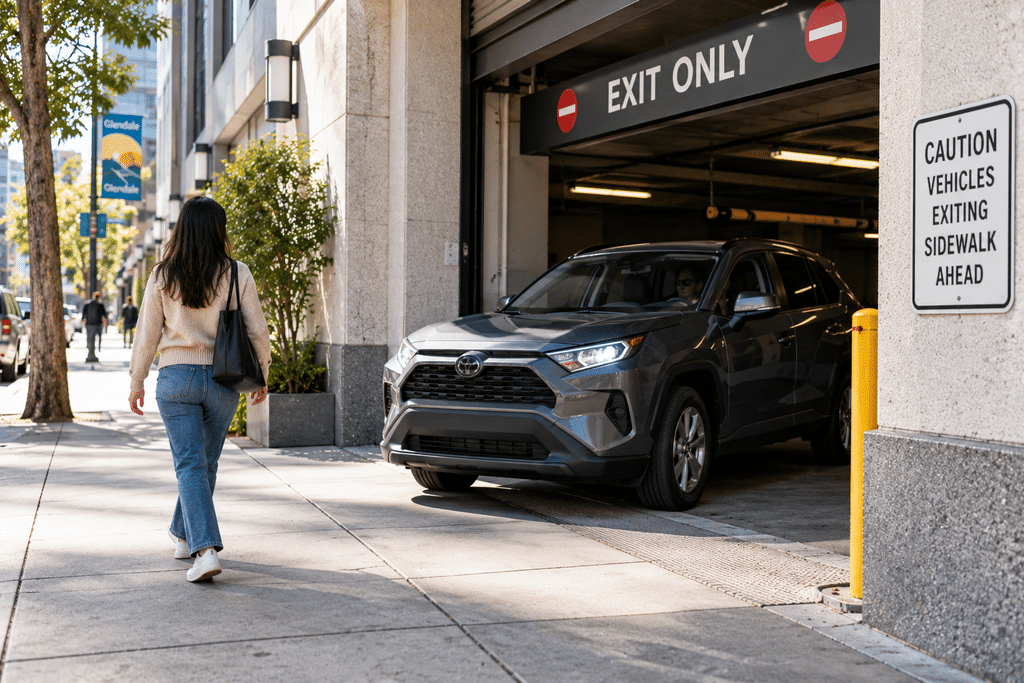
A Glendale pedestrian accident can happen when a driver leaves a parking garage and crosses a sidewalk before entering the street. Unlike a typical roadway collision, this type of accident can develop at the boundary between private property and the public pedestrian path. The driver may be traveling up a ramp, waiting for a gate, turning through a narrow exit, or looking toward street traffic while a pedestrian approaches from either side of the driveway. Walls, columns, landscaping, signs, parked vehicles, mirrors, lighting, warning signals, and the garage’s physical design may all affect what each person could see before the collision.
California law specifically addresses vehicles crossing sidewalks. California Vehicle Code section 21952 requires a driver about to cross a sidewalk while entering or leaving an alley, building, or other property to yield to pedestrians approaching closely enough to present an immediate hazard. The California DMV Driver’s Handbook also instructs motorists to use caution and yield as necessary for pedestrians. The application of these rules to a particular Glendale pedestrian accident depends on the evidence showing where the pedestrian and vehicle were positioned and how the collision developed.
The physical design of a garage exit can be especially important. Glendale’s own Downtown Specific Plan recognizes that garage entries can create conflicts with pedestrians and calls for design measures intended to reduce those conflicts, including narrow garage openings, setback gates or doors, and distinctive paving where vehicles cross the pedestrian environment. Those planning standards do not automatically establish responsibility for an individual collision, but they illustrate why garage geometry and pedestrian visibility deserve careful documentation.
If you or someone you love was injured in a Glendale pedestrian accident, our Glendale Pedestrian Accident Lawyer page provides additional information about how Super Woman Super Lawyer can evaluate accident evidence, medical documentation, property records, and insurance issues.
Connect with Super Woman Super Lawyer today through our Online Form, call 800.800.6916, or start a Live Chat. After a Glendale pedestrian accident at a garage exit, preserving camera footage, photographs, witness information, and property records quickly can matter because some of that evidence may disappear long before the legal deadline for bringing a claim.
Reconstructing the Vehicle and Pedestrian Paths
Reconstructing a Glendale pedestrian accident at a parking garage exit requires understanding two separate paths: how the vehicle moved from inside the garage toward the street and how the pedestrian traveled along the sidewalk. The collision point alone may not answer when each person first became visible or how much time either had to respond.
Photographs, measurements, surveillance footage, vehicle damage, pedestrian location, roadway geometry, and witness observations can help reconstruct those movements. Investigators may also consider whether the garage ramp required the driver to travel uphill or downhill, whether a gate caused the vehicle to stop before proceeding, and whether the driver needed to turn while simultaneously watching street traffic.
Garage Exit, Sidewalk, Driveway, and Street Layout
The physical layout should be documented from several perspectives after a Glendale pedestrian accident. Useful photographs may show the interior garage approach, ramp, gate, driveway opening, sidewalk, curb, street, adjacent buildings, landscaping, signs, and parked vehicles. Wider photographs can often provide more context than images focused only on the collision point.
The relationship between the garage and sidewalk is particularly important. Some garages have a relatively flat exit that gives drivers an extended view of approaching pedestrians. Others may have ramps, walls, columns, gates, or narrow openings that limit visibility until the vehicle is close to the sidewalk.
Glendale’s Downtown Specific Plan expressly acknowledges the potential conflict between garage entries and the pedestrian realm. Among other design provisions, it calls for garage doors or gates to be set back from the building face, enhanced paving at driveway crossings, and garage openings that are as narrow as practical. In a Glendale pedestrian accident investigation, documenting whether similar features existed at the actual location may help explain the environment without assuming that their presence or absence automatically determines liability.
Measurements can sometimes add useful context. The width of the garage opening, distance between a wall and sidewalk, location of the gate, slope of the ramp, and distance from the driver’s stopping point to the pedestrian path may all help investigators evaluate sightlines.
Vehicle Direction and Pedestrian Direction of Travel
The direction each person was traveling can substantially affect visibility. A driver exiting a garage may look primarily toward approaching street traffic while a pedestrian approaches from the opposite direction. A pedestrian walking close to the building may also become visible at a different moment from someone walking nearer the curb.
A Glendale pedestrian accident investigation should therefore document whether the pedestrian approached from the driver’s left or right and whether the vehicle traveled straight across the sidewalk or turned as it exited. Surveillance footage can be especially valuable because it may capture the movement of both parties before contact.
Physical evidence may provide additional information. The location of vehicle damage, final vehicle position, items dropped by the pedestrian, debris, or other scene evidence can be considered alongside video and witness statements.
The California DMV emphasizes checking for pedestrians and other traffic while maneuvering through parking environments and yielding when necessary for safety. That general safety principle provides context, while the specific Glendale pedestrian accident must still be evaluated from its own evidence.
Gate, Ramp, or Exit Position Before the Collision
A gate can divide a garage exit into several stages. A driver may stop to use a ticket, keycard, payment system, or automatic gate and then move forward toward the sidewalk. The gate’s position may therefore help establish where the vehicle stopped before entering the pedestrian path.
A ramp can create different questions. If the vehicle was traveling uphill, the driver’s view may change as the front of the vehicle approaches street level. If the vehicle was descending, speed and braking may become relevant. Walls or columns alongside the ramp may further restrict lateral visibility.
For a Glendale pedestrian accident, photographs should capture these features from approximately the driver’s eye level when safely possible. Investigators may also look for mirrors, warning lights, audible signals, pavement markings, or signs intended to alert drivers or pedestrians.
Entry or exit records may help establish timing. A keycard system, ticket record, license-plate reader, or gate log could potentially identify when the vehicle left the garage. Those records may become especially useful when compared with surveillance timestamps.
For general guidance on preserving accident evidence while the scene and memories are still fresh, read What to Do After a Car Accident in California: What Actually Matters.
Visibility Evidence at the Garage Exit
Visibility is often one of the central issues in a Glendale pedestrian accident involving a parking garage. A driver may say that the pedestrian appeared suddenly, while the pedestrian may report that the vehicle entered the sidewalk without warning. Rather than treating either statement as conclusive, investigators can examine what each person could reasonably see from the positions they occupied.
That review may include physical obstructions, lighting, mirrors, warning systems, ramp geometry, parked vehicles, vegetation, signs, and surveillance video. Photographs taken soon after the collision can be particularly useful because landscaping, parked vehicles, construction barriers, or other temporary conditions may later change.
Walls, Columns, Landscaping, Signs, and Parked Vehicles
Parking structures often contain structural columns and walls close to exit lanes. Depending on their placement, these features may limit a driver’s ability to see pedestrians approaching from the side until the front of the vehicle reaches the sidewalk.
Landscaping and signs can create similar questions. Glendale regulates parkway landscaping in part to protect visibility and safe pedestrian passage, and the City’s guidance prohibits objects or plant materials that create traffic hazards or block safe pedestrian travel in the public right-of-way. Whether that guidance is relevant to a particular private garage exit depends on the actual location, but it reinforces why visibility obstructions should be photographed rather than described only from memory.
Parked vehicles can also affect a Glendale pedestrian accident investigation. A large SUV, van, delivery vehicle, or other parked automobile near the exit may temporarily restrict the driver’s or pedestrian’s view. If such a vehicle was present, photographs or surveillance footage may preserve an obstruction that is gone by the time investigators return.
The strongest evidence generally shows the entire sightline. Photographing only a column may prove that the column exists, but a wider image from the driver’s approximate position can better demonstrate how that column relates to the sidewalk and approaching pedestrian path.
Mirrors, Warning Lights, Gates, and Other Safety Features
Some parking garages use convex mirrors, flashing warning lights, audible alarms, signs, pavement markings, gates, or other features to address the interaction between vehicles and pedestrians. A Glendale pedestrian accident investigation should document which features were actually present and whether available evidence shows how they were functioning.
A convex mirror may be positioned to give a driver a view around a wall or column. A warning light may activate when a vehicle approaches the sidewalk. A gate may require the driver to stop before proceeding. These features can become relevant to understanding the environment, but their mere presence does not establish whether anyone acted appropriately.
Maintenance records may matter if a safety feature is alleged to have been malfunctioning. Property management records, service invoices, inspection documentation, repair requests, or prior incident reports may help establish whether a problem had previously been reported.
The investigation should remain evidence-driven. A Glendale pedestrian accident involving a garage with a warning system is not automatically a property claim, just as the absence of a particular warning device does not automatically establish negligence. Responsibility depends on the circumstances and applicable law.
Lighting and Sightlines From the Driver’s Position
Lighting can change dramatically between the interior of a garage and the sidewalk outside. During daylight, a driver may travel from a relatively dark structure toward bright sunlight. At night, the opposite can occur: the garage may be illuminated while the sidewalk or street has different lighting conditions.
A Glendale pedestrian accident investigation may therefore consider the time of day, direction of sunlight, artificial lighting, shadows, weather, and other conditions affecting visibility. Photographs taken at approximately the same time of day may sometimes provide additional context, although they cannot perfectly recreate the original conditions.
The driver’s actual position also matters. A photograph taken from standing height outside the garage may show a clear view that was not available from the driver’s seated position inside a vehicle. When sightlines are disputed, documentation from approximately the driver’s perspective can be more informative.
The pedestrian’s view should also be considered. Did the pedestrian have a clear view into the garage? Was the approaching vehicle visible before it reached the sidewalk? Were there warning lights or audible signals? A complete Glendale pedestrian accident investigation should evaluate both perspectives rather than only one.
Camera and Property Records to Preserve
A parking garage may generate considerably more evidence than a typical residential driveway. Cameras, entry systems, access cards, ticket machines, license-plate readers, security staff, property managers, maintenance contractors, and incident-reporting systems may all create records.
For a Glendale pedestrian accident, identifying these records early can be important. Some surveillance systems overwrite footage automatically, while access or security records may be retained according to internal business policies. The practical evidence-preservation period may therefore be much shorter than the legal filing deadline.
Garage Cameras, Building Surveillance, and Entry or Exit Records
Start by identifying every visible camera near the garage exit. Cameras may face the driveway, sidewalk, payment area, vehicle lanes, building lobby, elevator, street, or nearby businesses. One camera may capture the collision itself while another establishes when the vehicle entered or exited.
A Glendale pedestrian accident may also be recorded by neighboring properties. Retail businesses, apartment buildings, offices, residences, dashcams, and municipal cameras can provide additional angles.
The City of Glendale itself operates multiple downtown parking structures, illustrating how significant parking-garage activity is within the city’s pedestrian environment. Its public parking system includes the Exchange, Marketplace, and Orange Street structures, among others. A particular accident may occur at a city-owned or privately operated facility, so ownership and operation should be verified rather than assumed.
Entry and exit records can complement video. Keycard logs, ticket timestamps, payment records, license-plate recognition systems, or electronic gate records may help establish when a vehicle moved through the facility.
Witness Information From Employees, Residents, or Customers
Parking garage accidents may be observed by people who are not obvious witnesses at first. A security employee may have been watching a monitor. A parking attendant may have heard the impact. A resident or customer may have been entering the building. Another pedestrian may have been walking behind the injured person.
After a Glendale pedestrian accident, preserve names and contact information when reasonably possible. Witnesses may be able to describe the vehicle’s movement, pedestrian direction, warning signals, lighting, or conditions around the garage exit.
Employees may also know whether cameras exist, where footage is stored, or who manages the property. Those details can help identify evidence even when the employee did not witness the collision itself.
Witness recollections should be documented accurately rather than coached. Specific observations are generally more useful than conclusions about who was at fault.
Incident Reports and Property Management Communications
Property owners or managers may prepare an incident report after learning about a Glendale pedestrian accident. Security personnel, parking operators, building managers, or homeowners associations may also create internal communications regarding the event.
Preserve copies of reports provided to the injured person and note who was notified, when notification occurred, and what information was exchanged. If the property manager takes photographs or obtains statements, those records may later become relevant.
Prior maintenance or repair communications may matter when the condition of a mirror, warning light, gate, lighting system, or other feature is disputed. Again, their relevance depends on the specific issue raised by the evidence.
Glendale’s Downtown Specific Plan expressly recognizes that garage entries can create pedestrian conflicts and incorporates design standards intended to address the interaction between vehicles and the pedestrian realm. For an individual Glendale pedestrian accident, the actual property’s design, records, maintenance, and conditions must still be investigated rather than inferred from citywide planning guidance.
Injury and Insurance Documentation
A Glendale pedestrian accident investigation should not focus exclusively on the garage. Personal injury claims also require documentation of medical treatment, functional limitations, work effects, transportation changes, and insurance communications.
Pedestrians do not have the structural protection of a vehicle around them, but the type and severity of injury still depend on the individual collision. Medical diagnoses should come from qualified healthcare professionals rather than assumptions based on the fact that a pedestrian was struck.
Emergency Care, Imaging, and Follow-Up Treatment
Medical documentation may begin with ambulance care or an emergency department evaluation. Depending on the injuries, treatment may later involve imaging, specialist consultations, surgery, physical therapy, occupational therapy, or other follow-up care.
For a Glendale pedestrian accident, preserve medical records showing when symptoms were reported, what providers evaluated, what diagnoses were made, and what treatment was recommended. Follow-up documentation can be particularly important when recovery continues beyond the first emergency visit.
Medical bills should also be preserved, but they serve a different purpose from clinical records. Bills document charges, while treatment records document medical evaluation and care.
If symptoms or functional limitations change during recovery, those changes should be accurately reported to treating providers. The medical record should reflect the person’s actual course rather than an attempt to make the injury history fit assumptions about the collision.
Mobility Limits, Missed Work, and Transportation Changes
Pedestrian injuries can affect walking, standing, driving, commuting, household responsibilities, childcare, and employment. A Glendale pedestrian accident claim may therefore involve evidence extending beyond medical charts.
Provider restrictions, mobility-aid documentation, work schedules, time records, employer communications, wage information, transportation receipts, and calendars may help document these effects. A before-and-after comparison can be useful when the person’s normal routine changed significantly after the collision.
Transportation costs may become relevant if the injured person cannot drive, walk normal distances, or use the same commuting method during recovery. Preserve rideshare, taxi, transit, parking, or other transportation records when they relate to treatment or functional limitations.
Whether a particular loss is recoverable depends on the circumstances. The purpose of documentation is to create an accurate record so those questions can later be evaluated.
Driver, Vehicle Owner, and Property Insurance Communications
A Glendale pedestrian accident at a parking garage exit may generate communications from more than one insurer. The driver may have automobile insurance. The vehicle may be owned by another person or business. Depending on the evidence and issues raised, a property insurer or other coverage may also become relevant.
The existence of multiple insurance policies does not mean every policy applies. Coverage should be identified and evaluated based on the actual facts.
Maintain a communication log identifying the insurer, claim number, adjuster, date, and subject of each contact. Preserve letters, emails, claim portal messages, recorded-statement requests, medical authorization forms, and settlement offers.
Early settlement discussions may begin before camera footage, property records, medical treatment, or other evidence has been fully reviewed. Our article How Personal Injury Settlements Really Work in California provides additional information about why the available evidence and timing of resolution can matter.
Legal Deadline Versus Evidence Preservation After a Glendale Pedestrian Accident
California legal filing deadlines and practical evidence-preservation deadlines are different. The California Courts Self-Help Guide provides general information about civil statutes of limitations and explains that different claims can have different deadlines. Claims involving government entities can also involve separate and potentially shorter procedures.
The practical preservation period after a Glendale pedestrian accident may be far shorter. Garage surveillance may be overwritten. Access logs may be deleted under routine retention policies. Warning equipment may be repaired. Landscaping can be trimmed. Parked vehicles move. Employees leave, and witness memories fade.
Photographing the garage exit, identifying cameras, preserving witness information, and requesting relevant records promptly may therefore be important even when no lawsuit is being filed immediately.
If the garage is publicly owned or operated by a government entity, additional claim procedures may apply. The property’s ownership and operation should therefore be identified rather than assumed.
Serving Injured Pedestrians Throughout Glendale
Glendale has a substantial downtown environment where pedestrians regularly move between parking structures, offices, apartments, restaurants, stores, entertainment destinations, and public sidewalks. The City operates several downtown public parking structures, including the Exchange, Marketplace, and Orange Street facilities, which together provide thousands of parking spaces. Private residential and commercial garages add many more vehicle-and-pedestrian crossing points throughout the city.
The City of Glendale has also expressly acknowledged pedestrian safety as an infrastructure priority and reports using measures such as high-visibility crosswalks, curb extensions, advanced yield markings, pedestrian-activated flashing beacons, and intersection improvements. Garage exits create a different type of pedestrian conflict, but the same basic need to understand vehicle and pedestrian interaction remains.
A Glendale pedestrian accident should therefore be evaluated from the actual property and evidence rather than assumptions about a particular garage. The ramp, gate, sidewalk, columns, mirrors, warning lights, lighting, cameras, access records, witnesses, and maintenance documentation may each answer a different question.
Super Woman Super Lawyer can evaluate those records alongside police information, vehicle evidence, medical documentation, employment records, and insurance communications. For additional information about local representation, visit our Glendale Pedestrian Accident Lawyer page.
Frequently Asked Questions About a Glendale Pedestrian Accident at a Parking Garage Exit
Do drivers have to yield to pedestrians when exiting a parking garage?
California law addresses drivers crossing sidewalks when entering or leaving property. California Vehicle Code section 21952 requires drivers in specified circumstances to yield to pedestrians approaching closely enough to present an immediate hazard. A Glendale pedestrian accident still requires evaluation of the actual vehicle and pedestrian movements rather than assuming the statute alone resolves every factual question.
Why does the garage layout matter?
Walls, columns, ramps, gates, signs, landscaping, and other features can affect when a driver and pedestrian become visible to each other. A Glendale pedestrian accident investigation may use photographs, measurements, surveillance footage, and sightline evidence to reconstruct those conditions.
What should I photograph after a garage-exit pedestrian accident?
When safely possible, photograph the garage opening, ramp, gate, sidewalk, curb, street, columns, mirrors, warning devices, lighting, signs, landscaping, parked vehicles, vehicle damage, and the broader scene. A Glendale pedestrian accident is easier to reconstruct when photographs show relationships between these features rather than isolated close-ups.
Can surveillance footage help?
Yes. Garage and building cameras may show the vehicle approaching the exit, the pedestrian walking along the sidewalk, and the collision itself. Nearby businesses or residences may have additional footage. Because recordings can be overwritten, camera evidence after a Glendale pedestrian accident should be identified promptly.
Can garage entry or exit records matter?
Potentially. Ticket systems, access cards, payment records, license-plate readers, or electronic gates may create timestamps. These records may help establish when a vehicle left the garage and can sometimes be compared with video or other evidence.
What if a column blocked the driver’s view?
The actual sightline should be documented. A column may affect visibility, but its presence alone does not determine responsibility. In a Glendale pedestrian accident, investigators may consider its location, the driver’s position, vehicle speed, mirrors, stopping points, and the pedestrian’s approach.
What if there was a convex mirror near the exit?
Document the mirror’s position and condition. A mirror may be intended to improve visibility around an obstruction, but the investigation should determine what it actually showed from the driver’s position and whether available evidence indicates that it was functioning normally.
Can a malfunctioning warning light become relevant?
Potentially. If a warning light, audible alarm, gate, or other safety feature is alleged to have malfunctioned, maintenance and repair records may become relevant. A Glendale pedestrian accident involving a property feature should still be evaluated from actual records rather than assumptions about why the equipment was installed.
Should I report the collision to property management?
Creating a contemporaneous record can be useful. If the property manager or security staff prepares an incident report, preserve any copy or reference number provided and document who received the report. Do not assume that an internal report will automatically be preserved indefinitely.
What if the driver says the pedestrian appeared suddenly?
That statement can be compared with surveillance, photographs, sightline evidence, vehicle movement, witness observations, and the garage layout. A Glendale pedestrian accident should be reconstructed using the available evidence rather than resolved solely from either party’s recollection.
What medical records should I preserve?
Preserve records relating to emergency care, imaging, specialist evaluations, surgery when applicable, therapy, medications, follow-up appointments, and provider restrictions. A Glendale pedestrian accident injury claim should rely on qualified medical documentation rather than assumptions about injury severity.
Can missed work and transportation expenses be documented?
Yes. Time records, employer communications, wage documentation, provider restrictions, rideshare receipts, transit expenses, and other appropriate records may help document how the injuries affected work and transportation. Whether a particular loss is recoverable depends on the circumstances.
Could more than one insurer contact me?
Yes. Depending on the facts, communications may come from the driver’s insurer, vehicle owner’s insurer, or other insurers. A Glendale pedestrian accident file should keep each claim number, adjuster, and communication organized separately so the roles of different insurers are clear.
How quickly should evidence be preserved?
As early as reasonably possible. Surveillance footage, electronic access records, temporary obstructions, and witness memories may change or disappear quickly. A Glendale pedestrian accident can therefore have an evidence-preservation timeline much shorter than the applicable legal filing deadline.
Call or Contact Super Woman Super Lawyer 24/7 for a Free Consultation and Pay Nothing Unless You Win
A vehicle emerging from a parking garage can create a difficult pedestrian conflict because the driver must transition from a private structure, cross a sidewalk, and enter street traffic while pedestrians may be approaching from either direction. A Glendale pedestrian accident at a garage exit may therefore require careful review of the ramp, gate, walls, columns, mirrors, warning systems, lighting, cameras, access records, and pedestrian and vehicle paths.
Super Woman Super Lawyer can help evaluate the full Glendale pedestrian accident record, including surveillance footage, property documentation, witness statements, vehicle evidence, medical records, employment documentation, transportation costs, and insurance communications. Preserving garage evidence promptly may be particularly important because video and electronic access records can disappear under routine retention practices.
Super Woman Super Lawyer has recovered more than over $2 billion for clients. Past results do not guarantee a particular outcome, and every pedestrian accident claim depends on its individual facts, evidence, injuries, insurance coverage, and applicable law.
For additional information about local representation, visit our Glendale Pedestrian Accident Lawyer page.Connect with Super Woman Super Lawyer today:
Online Form: Request a case review
Call Now: 800.800.6916
Live Chat: Speak with a legal professional instantly
 Maryam Parman