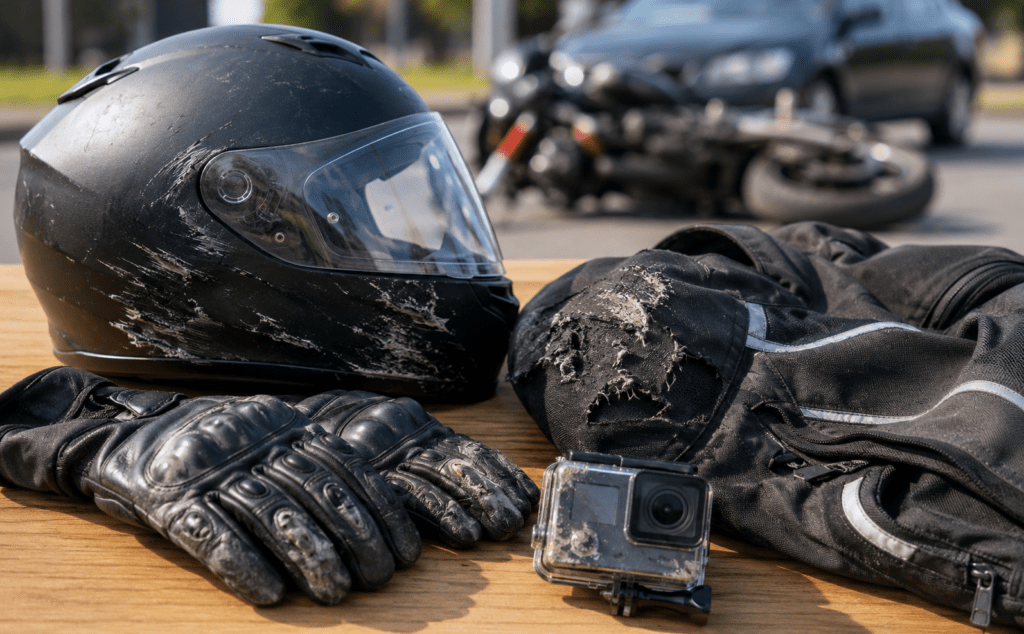
Seattle motorcycle accident helmet gear evidence often becomes one of the most valuable sources of information after a serious motorcycle collision. While police reports, witness statements, and photographs frequently play important roles in an investigation, the rider’s own equipment may also provide valuable clues regarding how the crash occurred and the forces involved during the collision. Helmets, riding jackets, gloves, boots, protective armor, and helmet-mounted cameras often preserve physical evidence that cannot be recreated once damaged items are repaired, discarded, or replaced. Understanding the importance of preserving this equipment early can help create a more complete record of the accident.
Unlike many passenger vehicle collisions, motorcycle accidents frequently leave riders with direct physical contact between their bodies and the roadway. Protective gear is designed to reduce injury, but it also records the effects of the crash itself. Damage patterns on a helmet, abrasions on protective clothing, torn gloves, broken boots, or impact marks on riding equipment sometimes help investigators better understand the sequence of events leading up to and during the collision. Combined with photographs, medical documentation, and witness observations, this evidence frequently provides important context regarding the crash.
Understanding Seattle motorcycle accident helmet gear evidence can help riders and their families recognize why damaged equipment should often be preserved rather than immediately discarded. The condition of riding gear, together with photographs, digital recordings, and medical records, frequently contributes to a more complete understanding of how the collision occurred and how it affected the rider.
Why Physical Gear Evidence Can Matter After a Motorcycle Crash
Helmets, jackets, gloves, and boots as impact indicators
Protective riding equipment is designed to absorb and distribute impact forces during a motorcycle collision. Although its primary purpose is reducing injury, that same equipment often preserves valuable physical evidence after the accident. Damage to a helmet, abrasion marks on a riding jacket, torn gloves, scuffed boots, and scraped protective armor may all provide information regarding how the rider contacted the motorcycle, another vehicle, or the roadway. Because each piece of equipment experiences different forces during a collision, investigators frequently evaluate the entire collection rather than focusing on a single damaged item.
For a Seattle motorcycle accident helmet gear evidence investigation, helmets often receive particular attention because they are designed to absorb significant impact energy. Visible cracks, scrapes, compression marks, or damage to the outer shell may help illustrate where contact occurred. Riding jackets and protective pants frequently show abrasion patterns that help explain how the rider slid across the pavement, while gloves and boots sometimes identify the rider’s instinctive attempts to protect themselves during the crash.
Preserving this equipment in its post-accident condition often provides valuable documentation before repairs, cleaning, or disposal occur. Photographs taken from multiple angles, together with careful storage of damaged items, frequently help preserve information that may later contribute to understanding the overall sequence of the collision.
How torn gear may help explain slide distance or contact points
Motorcycle collisions frequently involve more than one point of impact. A rider may initially strike another vehicle before sliding across the roadway, contacting curbs, guardrails, or additional obstacles during the accident sequence. Protective clothing often reflects these different stages of the collision through distinct abrasion patterns, tears, or impact damage.
For a Seattle motorcycle accident helmet gear evidence review, investigators sometimes compare damaged riding gear with photographs of the roadway and vehicle damage to better understand how the rider moved after impact. A heavily worn area on one sleeve, damage to one shoulder, or abrasion concentrated along one side of the jacket may correspond with the rider’s movement across the pavement. Similarly, damage to gloves, boots, or protective knee armor may help identify additional contact points that occurred during the slide.
Although damaged equipment alone rarely explains every aspect of a collision, it frequently provides valuable physical evidence when reviewed alongside other documentation. Combined with roadway photographs, witness statements, surveillance footage, and medical records, damaged riding gear often helps investigators reconstruct the crash more accurately.
Why damaged items should not be discarded too early
After a motorcycle accident, many riders understandably want to replace damaged equipment as quickly as possible. Helmets that have sustained an impact should generally not continue being used because their protective ability may be compromised. Likewise, torn jackets, damaged boots, broken gloves, and cracked protective armor are often replaced during recovery. While replacing damaged safety equipment is important, preserving the original items before disposal can also be valuable.
For a Seattle motorcycle accident helmet gear evidence investigation, keeping damaged equipment available until it has been photographed and documented often helps preserve important physical evidence. Riders may consider taking detailed photographs of every damaged item before replacing it, including close-up images showing impact marks, tears, abrasions, and broken components. Maintaining these records frequently helps preserve information even after the equipment is no longer usable.
The goal is not to encourage riders to keep unsafe equipment in service. Rather, it is to recognize that damaged gear often tells an important part of the story regarding how the collision occurred. Once items are discarded, that physical evidence may no longer be available for future review.
Digital Evidence Riders May Be Able to Preserve
Helmet camera files, phone photos, and GPS route history
Modern motorcyclists often carry far more digital evidence than they realize. Helmet-mounted action cameras, smartphones, GPS navigation systems, motorcycle communication devices, and ride-tracking applications frequently record information throughout a trip. After a collision, these digital records may become valuable because they preserve details regarding the rider’s route, travel times, roadway conditions, and, in some situations, the collision itself.
For a Seattle motorcycle accident helmet gear evidence review, helmet camera footage can be particularly valuable if it captured the moments leading up to the crash. Even when the actual impact is not visible, recordings may document traffic conditions, weather, vehicle movements, roadway hazards, or driver behavior immediately beforehand. Smartphone photographs taken at the scene often preserve vehicle positions, roadway conditions, traffic signs, and visible injuries, while GPS route history may help establish where the rider traveled before the collision occurred.
Preserving digital evidence as early as possible is often important because files may be overwritten, deleted, or lost if devices continue being used after the accident. Creating backup copies of photographs, videos, and GPS information frequently helps ensure that valuable documentation remains available while the investigation continues.
Digital Evidence Riders May Be Able to Preserve
Timestamps, metadata, and backup copies of original footage
Digital evidence often contains much more information than what appears on the screen. In addition to photographs and video recordings, electronic files frequently include timestamps, GPS coordinates, device information, and other metadata that help establish when and where recordings were created. Although many riders focus on the visual content itself, this supporting information often provides valuable context when investigators review the circumstances surrounding a collision.
For a Seattle motorcycle accident helmet gear evidence investigation, preserving original digital files is often just as important as preserving the visible images. Editing videos, compressing files, or repeatedly transferring media between devices may remove or alter certain metadata. Creating backup copies of the original recordings while leaving the originals unchanged helps preserve important technical information that may later assist investigators in understanding the sequence of events.
Many riders also upload videos to cloud storage or social media shortly after an accident. While backups are helpful, preserving the original files before any editing occurs often provides the clearest record of what was captured. Maintaining organized copies of helmet camera recordings, phone photographs, GPS route history, and related digital files frequently creates a more complete evidence file alongside the rider’s physical equipment and medical documentation.
Nearby business cameras and dashcams from other vehicles
Helmet cameras are not the only potential source of video evidence after a motorcycle collision. Businesses located near the crash scene, apartment buildings, parking facilities, delivery vehicles, transit buses, and private automobiles may all have recorded portions of the accident. In busy areas throughout Seattle, surveillance cameras frequently overlook roadways, intersections, parking lots, and commercial entrances where motorcycle crashes occur.
For a Seattle motorcycle accident helmet gear evidence review, identifying nearby cameras early often becomes important because many recording systems automatically overwrite stored footage after several days or weeks. Businesses may not realize their cameras captured the collision unless someone asks about the recordings promptly. Dashcams installed in nearby vehicles may also preserve valuable information regarding traffic conditions, rider position, vehicle movement, and the sequence of events before impact.
When combined with helmet camera footage and scene photographs, surveillance recordings often help investigators compare multiple viewpoints of the same collision. These different perspectives frequently provide a more complete understanding of what occurred than any single camera could provide independently. Preserving available recordings before they are lost often becomes one of the most valuable steps following a serious motorcycle accident.
How Gear and Medical Records Can Be Compared
Road rash, fracture locations, and helmet impact concerns
Protective riding equipment often tells only part of the story. Medical documentation helps explain how the physical injuries correspond with the damage observed on the helmet and riding gear. Physicians routinely document fractures, abrasions, road rash, head injuries, orthopedic trauma, and other conditions resulting from the collision. When these medical findings are reviewed together with damaged equipment, investigators often gain a clearer understanding of how the crash unfolded.
For a Seattle motorcycle accident helmet gear evidence investigation, helmet damage may correspond with documented head injuries, while abrasion patterns on riding gear sometimes align with road rash or orthopedic injuries recorded in the medical file. Boots, gloves, jackets, and protective armor may all show impact locations that help explain why particular injuries occurred. Although no single piece of evidence tells the entire story, the combination of physical gear and medical records frequently provides valuable context.
This comparison is especially helpful because motorcycles provide relatively little physical protection compared to passenger vehicles. Riders often experience direct contact with the roadway, making protective equipment an important source of information regarding the forces involved during the collision. Together, medical records and damaged riding gear frequently provide a much more complete picture than either source alone.
Emergency room notes, imaging, and follow-up treatment
Emergency medical care often provides the first formal documentation of injuries sustained during a motorcycle collision. Ambulance reports, emergency room evaluations, diagnostic imaging, physician observations, and trauma assessments frequently establish the initial medical timeline following the accident. These records often describe visible injuries, neurological findings, fractures, soft tissue trauma, and other conditions requiring immediate treatment.
For someone involved in a Seattle motorcycle accident helmet gear evidence review, follow-up treatment records frequently become just as important as the initial emergency evaluation. Orthopedic appointments, neurological consultations, physical therapy, rehabilitation, and specialist referrals often document how injuries continue developing throughout recovery. Additional imaging, surgical reports, and rehabilitation records frequently provide information that simply was not available during the first hospital visit.
Maintaining organized medical records alongside photographs of damaged riding gear often creates a much stronger overall record of the collision. While protective equipment documents how impact occurred, medical records explain how those impacts affected the rider physically. Together, these records frequently provide valuable insight into both the mechanics of the collision and the recovery process that follows.
Provider instructions about activity limits and recovery
Recovery from a serious motorcycle accident often extends well beyond the initial hospital stay. Physicians frequently recommend temporary or long-term restrictions involving driving, lifting, exercise, work activities, and other aspects of daily life. These recommendations are usually documented throughout follow-up appointments as healthcare providers monitor healing and evaluate the rider’s progress.
For individuals managing a Seattle motorcycle accident helmet gear evidence investigation, provider instructions frequently help explain how injuries affected everyday activities after the collision. Some riders require extended physical therapy before returning to work. Others may need restrictions related to fractures, spinal injuries, traumatic brain injuries, or orthopedic recovery. As treatment progresses, physicians often revise these recommendations based on healing and rehabilitation milestones.
Keeping copies of activity restrictions, rehabilitation plans, follow-up appointment summaries, and therapy recommendations often creates a more complete record of recovery. These medical documents frequently complement the physical evidence preserved through damaged helmets, riding gear, photographs, and digital recordings, providing a comprehensive understanding of both the accident and its ongoing effects.
Claim Disputes Riders May Face in Seattle Motorcycle Cases
Driver claims that the rider was hard to see or speeding
One of the most common issues that arises after a motorcycle collision involves differing opinions regarding how the accident occurred. Drivers sometimes report that they did not see the motorcycle until the last possible moment or believe the rider was traveling faster than expected. Riders, on the other hand, may explain that they were operating lawfully, were clearly visible, and had little opportunity to avoid the collision. Because motorcycles are smaller than passenger vehicles, visibility frequently becomes a central topic during the investigation.
For a Seattle motorcycle accident helmet gear evidence review, investigators typically avoid relying solely on statements from either party. Instead, they compare those statements with photographs, helmet camera footage, surveillance recordings, roadway evidence, skid marks, and the condition of the rider’s protective equipment. The damage sustained by the helmet, jacket, gloves, boots, and motorcycle often helps provide valuable context regarding how the collision unfolded. When reviewed together, these different sources of evidence frequently provide a much clearer understanding of the sequence of events than witness recollections alone.
Roadway conditions may also influence visibility. Weather, lighting, traffic congestion, parked vehicles, curves, hills, and intersections can all affect how quickly a driver recognizes an approaching motorcycle. Evaluating these conditions alongside the available physical evidence often helps investigators better understand the circumstances surrounding the collision rather than relying on assumptions made after the fact.
Insurer attempts to minimize injuries despite visible gear damage
Motorcycle riders frequently wear protective equipment specifically designed to reduce the severity of injuries during a crash. Helmets, armored jackets, reinforced gloves, riding pants, and protective boots often absorb significant impact forces. Ironically, because this equipment sometimes helps reduce visible injuries, the seriousness of the collision may occasionally be underestimated if the role of the protective gear is not fully appreciated.
For a Seattle motorcycle accident helmet gear evidence investigation, damaged riding equipment frequently helps explain how much force the rider experienced even when catastrophic injuries were avoided. Deep abrasions, cracked helmets, torn jackets, damaged gloves, and broken riding boots often demonstrate that the equipment performed exactly as intended by absorbing impact energy that otherwise could have resulted in much more severe injuries.
Medical documentation frequently complements these observations. Physicians may document fractures, soft tissue injuries, concussions, orthopedic trauma, or road rash while the damaged equipment illustrates how those injuries occurred. Reviewing both sources together often creates a much more complete understanding of the collision than focusing on visible injuries alone.
Preserving damaged riding gear before disposal therefore becomes an important part of maintaining the overall evidence file. Once helmets or protective clothing are discarded, valuable physical evidence explaining the forces involved in the collision may no longer be available.
Recorded statements before all evidence has been reviewed
Following a motorcycle accident, insurance companies frequently begin gathering information while the investigation is still developing. Riders may receive requests to discuss the collision, describe what happened, or answer questions regarding their injuries and the circumstances surrounding the crash. At the same time, investigators may still be collecting surveillance footage, reviewing helmet camera recordings, examining damaged equipment, and gathering witness statements.
For someone involved in a Seattle motorcycle accident helmet gear evidence investigation, it is important to recognize that the evidence file often continues developing long after the collision itself. Medical treatment may still be ongoing, additional photographs may become available, surveillance footage may be located, and specialist evaluations may provide new information regarding the rider’s injuries. As a result, the overall picture of the collision often becomes clearer over time as additional documentation is collected.
Maintaining organized records throughout this process frequently helps riders better understand how the investigation develops. Photographs, helmet camera footage, damaged equipment, medical records, police reports, repair estimates, and communication logs often work together to provide a much more complete understanding of the collision than any single source of evidence could provide independently.
Call or Contact Super Woman Super Lawyer 24/7 for a Free Consultation and Pay Nothing Unless You Win
Why preserving physical and digital evidence often strengthens the investigation
Motorcycle accidents frequently generate two distinct categories of evidence. Physical evidence includes helmets, jackets, gloves, boots, damaged motorcycles, and roadway debris. Digital evidence includes helmet camera recordings, photographs, GPS information, and other electronic records created before or after the collision. Together, these materials often provide investigators with valuable information regarding both how the accident occurred and how it affected the rider.
For a Seattle motorcycle accident helmet gear evidence review, preserving both forms of evidence as early as possible often helps create the clearest overall record. Damaged riding gear explains how impact forces were distributed. Helmet camera footage may document traffic conditions before the crash. Medical records describe injuries sustained during the collision. Photographs preserve the condition of the scene before vehicles are moved or evidence disappears. When reviewed collectively, these materials frequently provide a far more complete understanding of the accident than relying on any single source alone.
Riders may also benefit from reviewing motorcycle safety information provided by the National Highway Traffic Safety Administration (NHTSA), which offers educational resources on protective gear, rider safety, and crash prevention:
Organizing these records also helps families navigate the recovery process more effectively. Keeping photographs, digital files, medical records, repair estimates, insurance correspondence, and damaged equipment together often creates a comprehensive record that remains available as the investigation progresses.
Free consultation — No fee unless we win
Every motorcycle accident presents unique circumstances involving roadway conditions, rider actions, vehicle movements, protective equipment, and available evidence. Understanding how these factors fit together often requires reviewing both the physical evidence preserved after the collision and the medical documentation generated throughout recovery.
If you have questions regarding Seattle motorcycle accident helmet gear evidence, speaking with a Seattle Motorcycle Accident Lawyer can help provide additional clarity regarding the records, documentation, and evidence that may become important during the claim review process.
Most cases are handled on a contingency fee basis, meaning there are generally no upfront attorney fees.
Connect With Super Woman Super Lawyer
Seattle motorcycle accident helmet gear evidence often provides some of the strongest documentation available following a serious motorcycle collision. Helmets, riding jackets, gloves, boots, helmet camera recordings, photographs, medical records, and other physical evidence frequently work together to explain how the crash occurred and how it affected the rider.
The sooner these materials are preserved, the easier it often becomes to understand the sequence of events and document the recovery process. While every motorcycle accident is different, maintaining organized physical and digital evidence frequently creates the clearest overall picture of what happened and how the collision affected every aspect of the rider’s recovery.
Online Form: Request a case review
Call Now: 800.800.6916
Live Chat: Speak with a legal professional instantly
 Maryam Parman