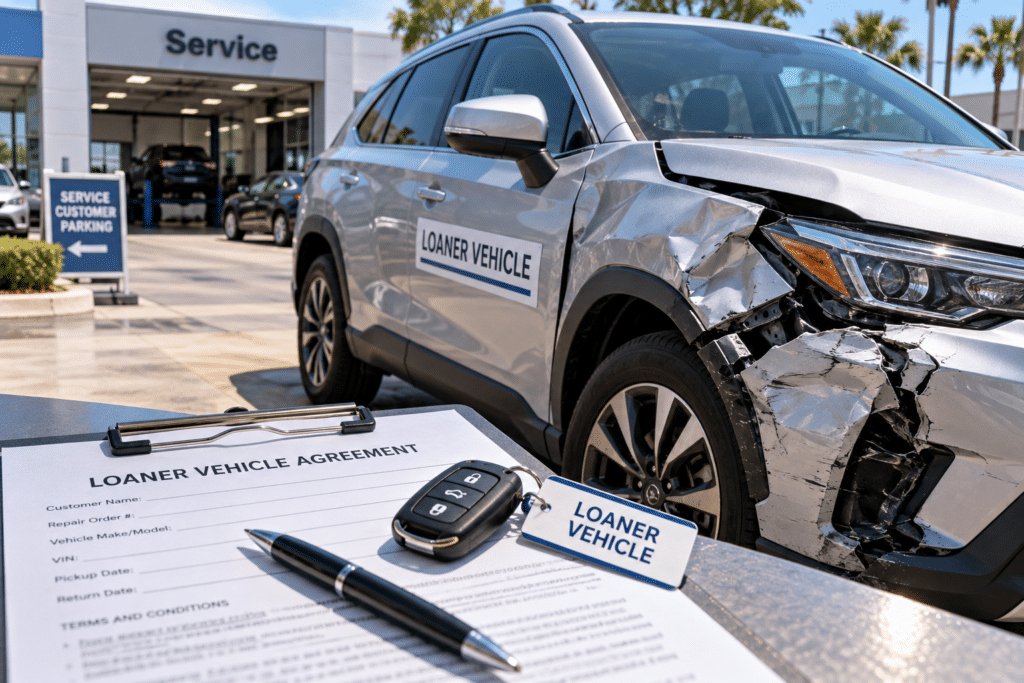
A Rancho Cucamonga loaner car accident can create insurance and evidence questions that are different from a collision involving the injured person’s regular vehicle. The driver may have received the temporary vehicle from a dealership while another car was being serviced, borrowed a vehicle from an independent repair facility, or been provided transportation under another type of temporary replacement arrangement. After a collision, questions may arise about who owns the vehicle, who was authorized to drive it, which insurance policies may apply, and what must happen before the loaner is returned.
The paperwork created before the collision can become particularly important. A loan agreement, repair order, pickup record, insurance acknowledgment, vehicle-condition form, and key receipt may establish when the driver received the vehicle and what conditions applied to its use. After a Rancho Cucamonga loaner car accident, those documents should be preserved rather than returned with the vehicle without keeping copies.
Insurance should also be evaluated rather than assumed. The fact that a dealer or repair shop owns a vehicle does not automatically determine which policy will respond to every loss. The vehicle owner’s coverage, the driver’s own automobile policy, temporary replacement vehicle provisions, and other potentially applicable insurance may need to be reviewed. California’s Department of Insurance provides general consumer information about automobile insurance, but the actual policy language and facts control an individual claim.
Vehicle evidence can create another time-sensitive issue. A driver ordinarily controls when their own damaged car is repaired or inspected. With a loaner vehicle, the dealership, repair facility, insurer, or another owner may regain possession quickly. A Rancho Cucamonga loaner car accident investigation may therefore require photographs, dashcam footage, vehicle information, inspection requests, and other evidence before the temporary vehicle is returned, repaired, transferred, or otherwise changed.
If you were injured while driving or riding in a temporary replacement vehicle, our Rancho Cucamonga Car Accident Lawyer page provides additional information about how Super Woman Super Lawyer can evaluate accident evidence, insurance issues, medical documentation, and financial losses.
Connect with Super Woman Super Lawyer today through our Online Form, call 800.800.6916, or start a Live Chat. After a Rancho Cucamonga loaner car accident, preserving the agreement and vehicle evidence early may help clarify who supplied the vehicle, who was authorized to drive it, what insurance information was exchanged, and what condition the vehicle was in before it was returned.
Identifying the Loaner Vehicle and Authorized Driver
One of the first tasks after a Rancho Cucamonga loaner car accident is identifying the temporary vehicle arrangement accurately. People sometimes use terms such as “loaner,” “courtesy car,” “replacement vehicle,” and “rental” interchangeably even though the paperwork and business arrangement may differ.
The documents signed when the vehicle was picked up can help answer those questions. Rather than relying on memory about what a service advisor said, preserve the actual agreement and associated repair paperwork.
Loan Agreements, Repair Orders, and Vehicle Pickup Records
The loan agreement may identify the vehicle owner, authorized driver, vehicle identification information, mileage, fuel level, dates of use, insurance representations, and restrictions. Preserve every page, including terms printed on the back or incorporated electronically.
For a Rancho Cucamonga loaner car accident, the repair order for the driver’s regular vehicle can provide additional context. It may establish why a temporary vehicle was supplied and when the customer’s own car entered the shop.
Vehicle pickup records may include a condition report noting preexisting scratches, dents, windshield damage, mileage, or other conditions. Preserve that record because it can help distinguish damage existing before the loan from damage associated with the later collision.
Electronic paperwork deserves the same treatment. Save emailed agreements, text-message links, digital signatures, app records, and photographs taken during pickup. Do not assume those materials will remain accessible indefinitely through a dealer or repair-shop portal.
Whether the Vehicle Came From a Dealer or Independent Repair Shop
Identifying who supplied the vehicle can help determine which organizations possess relevant records. A dealership may own and administer its own loaner fleet, use vehicles through another business arrangement, or provide transportation through a separate rental company. An independent repair shop may have a different system.
A Rancho Cucamonga loaner car accident file should therefore identify the business that physically provided the vehicle, the entity listed as owner, and any separate company named in the agreement.
The California Bureau of Automotive Repair provides consumer information about California automotive repair transactions, including estimates, authorizations, invoices, and repair documentation. Those rules concern the underlying repair transaction; they do not by themselves establish insurance responsibility for a separate accident involving a temporary vehicle.
Keep the repair transaction and loaner transaction organized separately even if the same business is involved. One file explains why the customer’s vehicle was in the shop. The other documents the temporary vehicle being used when the collision occurred.
Restrictions or Conditions Listed in the Loaner Agreement
Loaner agreements may contain conditions governing who can drive the vehicle, how long it can be used, where it may be driven, mileage, fuel, return requirements, accident reporting, and insurance. The precise terms vary, which is why the actual document matters.
After a Rancho Cucamonga loaner car accident, review the agreement rather than relying on a general assumption about loaner-car rules. If another household member was driving, for example, whether that person was listed or otherwise authorized may become an issue.
Preserve accident-reporting instructions as well. The agreement may require prompt notification to the dealer, repair shop, vehicle owner, or another company. Document when notice was provided, who received it, and what instructions followed.
The existence of a contractual restriction does not automatically resolve liability for the collision or insurance coverage. Those are separate questions requiring review of the agreement, policies, facts, and applicable law.
For broader information about preserving evidence immediately after a crash, read What to Do After a Car Accident in California: What Actually Matters.
Insurance Policies That May Need Review
Insurance can become one of the most complicated parts of a Rancho Cucamonga loaner car accident because the driver may be operating a vehicle owned by an unrelated business. The driver’s personal auto insurer, the vehicle owner’s insurer, another driver’s liability insurer, and potentially other coverage may all need to be identified.
Which policy applies cannot be determined solely by looking at the name on the loaner agreement. Policy terms, ownership, authorization, accident circumstances, and other facts may matter.
Vehicle Owner Coverage and Driver Coverage
Start by identifying insurance information associated with the loaner vehicle and the driver. The vehicle may be insured under coverage maintained by its owner, while the driver may separately maintain personal automobile insurance.
A Rancho Cucamonga loaner car accident may therefore produce communications from several insurers. Keep each claim number and adjuster separate so that correspondence from one carrier is not confused with another.
The California Department of Insurance provides general information about automobile insurance and common types of coverage. That guidance can help consumers understand terminology, but it does not determine how a particular loaner vehicle claim will be handled.
If another driver caused the collision, that driver’s liability insurance may create an additional claim file. Multi-vehicle collisions can further increase the number of carriers and adjusters involved.
Temporary Replacement Vehicle Provisions
A driver’s own automobile policy may contain provisions addressing temporary substitute or replacement vehicles, non-owned automobiles, or similar circumstances. The terminology and scope vary among policies.
For a Rancho Cucamonga loaner car accident, obtain the relevant policy documents rather than relying only on an insurance card or declarations page. A declarations page can identify limits and vehicles but may not contain the contractual language governing a temporary replacement vehicle.
The reason the loaner was being used may also provide context. If the driver’s own car was temporarily unavailable because it was undergoing repair or service, preserve the repair order and dates. Those facts may become relevant when policy language concerning replacement transportation is reviewed.
Do not assume that a dealer’s statement that “your insurance covers it” or a driver’s belief that “the dealer is responsible” resolves the coverage issue. The actual policies and agreements should be examined.
Communications From the Repair Facility and Other Insurers
A dealership or repair facility may contact the driver quickly after learning about a Rancho Cucamonga loaner car accident. The business may request that the vehicle be returned, ask for a police report, request insurance information, or provide instructions about towing or inspection.
Preserve those communications. Save emails, text messages, voicemails, claim instructions, forms, and information about telephone conversations. Note the name and role of each person involved.
Insurers may separately request recorded statements, photographs, medical authorizations, or other documentation. Before confusing one request with another, identify which insurer is asking and what claim it represents.
A simple communication log can be useful. Record the date, organization, representative, claim number when applicable, subject, documents requested, and next step. This can prevent the Rancho Cucamonga loaner car accident file from becoming fragmented among several businesses and insurers.
Vehicle Evidence to Preserve Before the Loaner Is Returned
Evidence preservation can be particularly urgent after a Rancho Cucamonga loaner car accident because the injured driver may not own the vehicle. Once the loaner is returned, control may pass completely to the dealership, repair shop, fleet owner, insurer, or another company.
The vehicle could then be repaired, inspected, moved, sold, or otherwise altered. Preserving appropriate evidence before that occurs may help document its post-collision condition.
Damage Photos, Dashcam Files, and Vehicle Data
Take clear photographs of the entire loaner vehicle when it is safe and appropriate to do so. Photograph all sides, not only the obvious impact area. Then take closer photographs of dents, scratches, broken lights, glass, wheel damage, interior damage, deployed airbags, or other relevant conditions.
A Rancho Cucamonga loaner car accident may also involve onboard electronic evidence. Some vehicles have factory cameras, aftermarket dashcams, driver-assistance systems, or other technology. The existence and availability of data vary by vehicle.
If a dashcam is present, preserve the original recording before it is overwritten. Do not repeatedly operate or reset electronic equipment simply to search for evidence without understanding how the system works.
Vehicle data should be handled carefully. The fact that a modern vehicle contains electronic systems does not mean every car stores recoverable collision information or that a consumer can access it directly. Qualified professionals may be needed when particular electronic evidence is relevant.
Inspection Requests and Repair Documentation
If vehicle condition is disputed, an inspection may become important before repairs begin. A Rancho Cucamonga loaner car accident can create a shorter practical inspection window because the vehicle owner may want the loaner returned to service.
Document where the vehicle is located and who has custody. If it is towed, preserve the tow record and destination. If it returns directly to the dealer or repair facility, note the date and time.
Any repair estimate or damage assessment prepared for the loaner should also be preserved when available. Photographs taken by the insurer, dealership, or repair facility may supplement the driver’s own images.
California’s Bureau of Automotive Repair provides information concerning repair estimates, authorization, invoices, and consumer records. If the damaged loaner is repaired in California, repair documentation may later help establish what work was performed.
Mileage, Condition, and Return Records
Loaner agreements often record mileage and condition when the vehicle is issued. The return process may create another record showing mileage, fuel, damage, date, and time.
For a Rancho Cucamonga loaner car accident, preserve both ends of that record when possible. The pickup documentation establishes the vehicle’s starting condition, while the return documentation records what was noted afterward.
Do not sign a vehicle-condition statement without reviewing it. If the document describes damage inaccurately, ask how the disagreement can be noted rather than assuming it can be corrected later.
Photograph the vehicle at return when reasonably possible. Also preserve any receipt showing the date and time the business regained possession.
These details can become particularly useful if a later dispute arises about whether particular damage existed before the collision or occurred afterward.
Documenting the Injured Driver’s Losses
The unusual ownership of a loaner vehicle should not distract from the personal injury portion of a Rancho Cucamonga loaner car accident claim. An injured driver or passenger may still require medical treatment, miss work, incur transportation costs, and receive settlement communications while the insurance questions are being sorted out.
Medical, employment, and financial documentation should therefore be maintained separately from the vehicle and loan-agreement file while remaining connected through one overall timeline.
Medical Treatment and Recovery Records
Medical records may begin with ambulance care, emergency treatment, urgent care, or another initial evaluation depending on the collision. Follow-up care may include physician visits, imaging, specialist evaluations, therapy, medications, or other treatment based on the injuries.
For a Rancho Cucamonga loaner car accident, preserve records showing when symptoms were reported, what providers evaluated, what diagnoses were made, and what treatment was recommended. Medical conclusions should come from qualified healthcare professionals.
The fact that the injured person was driving a temporary vehicle generally does not change the need for careful medical documentation. Insurance questions about which carrier handles a claim are separate from the clinical question of what injuries were diagnosed and treated.
Medical bills should also be preserved, although billing records and clinical treatment records serve different purposes.
Missed Work and Transportation Costs
Injuries may cause missed work, reduced hours, modified duties, or time away for medical appointments. Preserve provider restrictions, schedules, time records, pay information, employer communications, and other appropriate employment documentation.
Transportation can create a particularly unusual issue after a Rancho Cucamonga loaner car accident. The driver’s regular vehicle may already be unavailable because it is being repaired, and the temporary replacement may now also be damaged. That can create a second transportation disruption.
Preserve rideshare receipts, rental documentation, public transportation expenses, or other reasonable transportation records. Whether a particular cost is recoverable depends on the facts and available coverage, but undocumented expenses are harder to evaluate.
The repair timeline for the person’s regular vehicle may also matter because it can show why alternative transportation remained necessary even after the damaged loaner was returned.
Recorded Statements and Settlement Communications
Several insurers may request statements after a Rancho Cucamonga loaner car accident. The driver could hear from their own carrier, the loaner vehicle’s insurer, another driver’s insurer, or a claim administrator.
Keep a record of every request. Identify the company, representative, claim number, and subject before providing information. Preserve copies of written statements and note when recorded statements occur.
Settlement offers should also be retained in their original form. Before signing a release, understand which claim, insurer, parties, and losses the document addresses.
Our article How Personal Injury Settlements Really Work in California provides additional information about settlement timing and documentation. A Rancho Cucamonga loaner car accident may involve additional coverage questions, making it especially important to understand which claim an offer is intended to resolve.
Legal Deadline Versus Loaner Vehicle Evidence Preservation
California legal deadlines and evidence-preservation timelines are different. The California Courts Self-Help Guide provides general information about statutes of limitations and cautions that different claims can have different deadlines.
A Rancho Cucamonga loaner car accident can create a much shorter practical evidence window. The vehicle may be returned to its owner immediately. Dashcam footage may be overwritten. Electronic information can change. Damage may be repaired. The vehicle could return to the loaner fleet.
That is why vehicle preservation should be considered before simply dropping off the keys and assuming all evidence will remain available. Photographs, video, agreements, return records, and available electronic evidence may need to be preserved while the driver still has access.
Legal deadlines should be evaluated separately, particularly when a public entity, government vehicle, or other special circumstance is involved.
Serving Injured Drivers Throughout Rancho Cucamonga
Rancho Cucamonga includes dealerships, automotive service businesses, repair facilities, shopping areas, offices, residential neighborhoods, and major traffic corridors such as Foothill Boulevard, Base Line Road, Haven Avenue, Archibald Avenue, Day Creek Boulevard, Interstate 10, and Interstate 15. Drivers may receive temporary vehicles while their regular cars are undergoing routine service, warranty work, collision repair, or other maintenance.
A Rancho Cucamonga loaner car accident can therefore happen while the driver is using a vehicle for only a few hours or several days. The temporary nature of possession makes paperwork and vehicle documentation particularly important.
The loan agreement can establish the arrangement. Repair records can explain why the driver’s regular vehicle was unavailable. Insurance policies can address potential coverage. Vehicle photographs and electronic records can document the crash. Medical and employment records can document the injuries and resulting losses.
Super Woman Super Lawyer can evaluate these categories together rather than assuming the loaner vehicle’s owner or the driver’s insurer automatically controls every issue. For more information about local representation, visit our Rancho Cucamonga Car Accident Lawyer page.
Frequently Asked Questions About a Rancho Cucamonga Loaner Car Accident
What should I save after an accident in a dealership loaner car?
Preserve the loan agreement, repair order, pickup paperwork, vehicle-condition documentation, insurance information, photographs, police information, communications with the dealer or repair shop, medical records, and insurer correspondence. A Rancho Cucamonga loaner car accident may involve several overlapping records.
Is a loaner vehicle the same as a rental car?
Not necessarily. The business arrangement and agreement determine what type of vehicle transaction exists. A dealer may provide a courtesy or loaner vehicle, while another business may arrange a separate rental. Preserve the actual documents rather than relying only on the label used in conversation.
Whose insurance covers a loaner car accident?
It depends on the policies, ownership, authorization, accident circumstances, and other facts. A Rancho Cucamonga loaner car accident may require review of the vehicle owner’s coverage, driver’s personal auto policy, another driver’s coverage, or additional insurance.
Does my personal auto insurance follow me into a loaner vehicle?
Some policies contain provisions addressing temporary replacement or non-owned vehicles, but policy language varies. The actual policy should be reviewed rather than assuming the same answer applies to every Rancho Cucamonga loaner car accident.
Why should I keep the repair order for my regular car?
The repair order may establish why your regular vehicle was unavailable and why you were using the loaner. That information may provide context when temporary replacement vehicle provisions are evaluated.
What if someone else in my household was driving the loaner?
Review the agreement to determine who was listed or authorized to drive. Driver authorization can become an important issue after a Rancho Cucamonga loaner car accident.
Should I photograph the loaner before returning it?
Yes, when reasonably possible. Photograph the entire vehicle and specific damage before the business regains possession. Once the loaner is returned, you may no longer control access to the vehicle.
Can dashcam footage be important?
Yes. If the loaner has a dashcam or other accessible camera system, footage may help document the collision. Preserve available original recordings promptly because some systems overwrite older files automatically.
Should I ask the dealer not to repair the vehicle yet?
Whether a formal preservation or inspection request is appropriate depends on the circumstances. If vehicle condition is important to a disputed Rancho Cucamonga loaner car accident, addressing inspection before repairs can help preserve options.
Why does the return mileage matter?
Pickup and return mileage can help document when and how long the vehicle was used. Along with condition records and timestamps, it contributes to the overall loaner-vehicle chronology.
What if the dealer says I am responsible for all vehicle damage?
The agreement, collision facts, insurance policies, and applicable law should be reviewed before assuming a verbal statement determines responsibility. Preserve any written demand or communication from the business.
Can several insurance adjusters contact me?
Yes. The driver’s carrier, vehicle owner’s carrier, another driver’s insurer, or other administrators may communicate about a Rancho Cucamonga loaner car accident. Keep each claim number and adjuster organized separately.
Should I settle before the insurance questions are completely sorted out?
The appropriate decision depends on the circumstances. Before signing a release, understand which parties, policies, and claims it addresses and what medical or financial information remains incomplete.
What should I bring to a consultation?
Bring the loan agreement, repair order, pickup and return paperwork, insurance information, crash photographs, police information, vehicle communications, medical records, employment documentation, transportation receipts, and settlement correspondence. A Rancho Cucamonga loaner car accident consultation can then identify what evidence exists and what may still need to be preserved.
Call or Contact Super Woman Super Lawyer 24/7 for a Free Consultation and Pay Nothing Unless You Win
An accident in a temporary replacement vehicle can create additional questions at a time when an injured person may already be dealing with medical treatment, transportation problems, and repairs to their regular vehicle. A Rancho Cucamonga loaner car accident may involve the loan agreement, dealership or repair facility, vehicle owner, driver’s personal insurance, another driver’s insurance, and physical evidence that could disappear once the loaner is returned.
Super Woman Super Lawyer can help evaluate the complete Rancho Cucamonga loaner car accident record, including loan agreements, repair orders, pickup and return records, insurance policies, vehicle photographs, available dashcam or electronic evidence, inspection records, medical documentation, missed work, transportation expenses, recorded statements, and settlement communications.
Super Woman Super Lawyer has recovered more than over $2 billion for clients. Past results do not guarantee a particular outcome, and every accident claim depends on its individual facts, evidence, injuries, insurance coverage, and applicable law.
For additional information about local representation, visit our Rancho Cucamonga Car Accident Lawyer page.
Connect with Super Woman Super Lawyer today:
Online Form: Request a case review
Call Now: 800.800.6916
Live Chat: Speak with a legal professional instantly
 Maryam Parman